


 Noticias en español

The scholarship is sponsored by the Fundación Encuentros del Futuro (FEF) and the “We Share” Fund of the company Tianqi.
The engineers of the Center for Mathematical Modeling (CMM) of the University of Chile, Catherine Lemun and Karina De Requeséns, were selected by the academic exchange program New Energy Talents to carry out an internship in the Chinese city of Chengdu, Sichuan province, which seeks that graduate students can learn and contribute to the development of the lithium industry in Chile.
The instance, which deepens the understanding of national professionals and experts with universities and companies in China, is promoted by the Foundation Encounters of the Future (FEF) and the “We Share” Fund of Tianqi, a company that controls more than 46% of the world production of this soft metal.
According to the bases, the academic program “is part of the social responsibility of Tianqi Lithium Corporation”, has an extension of one month -between October and November of this year-, and puts “its focus on research and prospecting of the Lithium industry and other emerging energy sources in China, addressing the latest trends and electric energy storage; Hydrogen energy; ecological environment, sustainable development and corporate governance”.
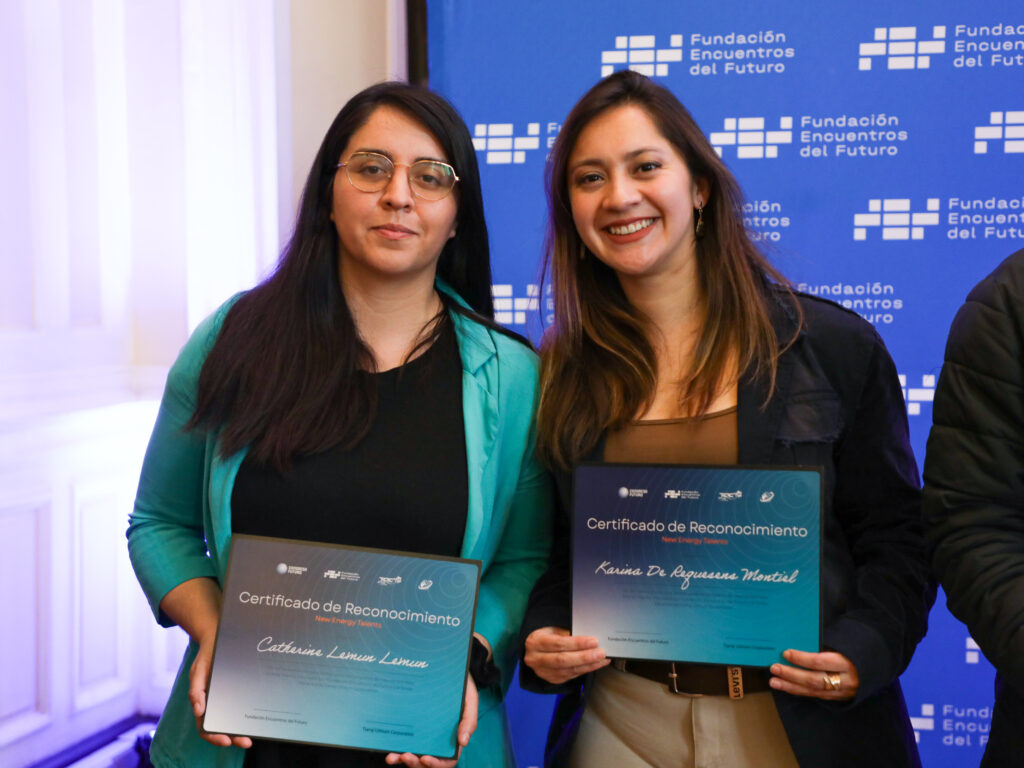
Catherine Lemun and Karina De Requeséns, CMM engineers.
“I thought it was a joke”.
Catherine Lemun, student of the Master in Applied Mathematics at the University of Chile and member of the Digital Mining line of CMM and the Copernicus Regional Center for Latin America and the Caribbean, details that “on Sunday, September 24, I had a missed call and when I dialed a guy named Pablo spoke to me telling me that I had been in the internship to which I had applied. At first I thought it might even be a joke, but then he told me all about the program and that he was the coordinator. I felt excited because I had considered in my short term plans to go to China and now it has become a reality”.
“The internship, on the one hand, helps me to learn a new aspect in an area that is relevant for the development of the country, such as lithium. This is related to what I have been working on, which is the management of natural resources with artificial intelligence and mathematical modeling. On the other hand, the trip itself helps me to improve as a researcher and to work with peers from other disciplines, since I am going with people from very diverse areas. In addition to strengthening and acquiring new knowledge in the communicational and personal areas, since I will be living for a month in a place that is not only geographically distant but also culturally distant”, adds Lemun.
Along these lines, he expresses that “I would like to forge good relations with my travel companions, so that we can work on projects that help to improve the policies and uses of lithium in our country. I am also interested in learning about the articulation that China achieves between scientific research coming from universities and industry, since in Chile they are generally seen as separate worlds”.
“I feel a responsibility to Chile”
Meanwhile, the student of the Master of Resources and Water Environment of the University of Chile and member of the Copernicus Regional Center for Latin America and the Caribbean, Karina De Requeséns, says that “I found out one Sunday while I was having lunch, Pablo, the program coordinator, called me, first I had a great impression, I did not expect to be selected. Although it is within my plans to expand my knowledge constantly, I never expected to go so far to do so. I feel very excited and happy to have the opportunity to go to a country with the fame of having a millenary culture, I feel that I will learn much more than just academic subjects and that this experience will make me grow in professional and personal aspects of my life”.
“Although I have oriented my knowledge of geology to water resources, these are still very broad, thanks to my master’s thesis I have been able to direct my knowledge to remote sensing and glaciers, and this new milestone marks the exploration of a new world in this area such as lithium. In this same line, I find myself in a moment of doubt in which I do not know if once I finish my master’s degree I should start working or follow a more academic path with a doctorate. So, I find that this trip gives me the opportunity to extract more information to solve this dilemma”, says De Requeséns.
The CMM engineer adds that “I am going with a great willingness to learn and I feel the responsibility to bring everything I have learned back to Chile”.
Ver esta publicación en Instagram
The coordinator of the Digital Mining area of the Center for Mathematical Modeling (CMM) of the Faculty of Physical and Mathematical Sciences (FCFM) of the University of Chile and scientific director of the Copernicus Regional Center for Latin America and the Caribbean, Jaime Ortega, emphasized that “both have developed a very good work within the framework of the project and have also been a great contribution to the laboratory. I am very happy that they are participating in this select group, because it is a tremendous opportunity for them, both to learn about a culture and to learn about the lithium industry, an issue of great importance considering that Chile is part of the lithium triangle”.
“The center has a mission of training advanced human capital to respond to the needs of the public and private world, which fits very well with this trip where they are going to be trained in a very relevant topic. Although the center itself does not have training programs, we are immersed in the community of the Department of Mathematical Engineering and even many of the theses developed by PhD students are within the CMM”, he adds.
After a 40-hour trip, Lemun and De Requeséns arrived in Chengdu on October 12. There they will remain at Sichuan University until November 11 of this year. The program includes classes, workshops and visits to research centers, as well as cultural activities, such as visits to museums and a giant panda reserve.
Center for Mathematical Modeling
The CMM is today the most active scientific research institution in mathematical modeling in Latin America. It is a center of excellence of the National Agency for Research and Development (ANID) of Chile, integrated by eight partner universities and located at the Faculty of Physical and Mathematical Sciences of the University of Chile. It is also the International Research Laboratory (IRL) #2807 of the French National Center for Scientific Research (CNRS).
Its mission is to create mathematics in response to problems in other sciences, industry and public policy. It seeks to develop science with the highest standards, excellence and rigor in areas such as data science, climate and biodiversity, education, resource management, mining and digital health.
Alonso Farías Ponce, journalist of the Center for Mathematical Modeling.
Posted on Oct 12, 2023 in News
