


 Noticias en español

WCCM 2024 was attended by two CMM members, in the context of a stay in Vancouver.
The 16th World Congress on Computational Mechanics – WCCM 2024 ‘, co-organised by the International Association for Computational Mechanics (IACM) and the Canadian Association for Computational Science and Engineering (CACSE), was held in Vancouver, Canada, between 21 and 26 July, with the participation of two members of the Centre for Mathematical Modelling (CMM) of the University of Chile. Both are also part of the Centre for Research in Mathematical Engineering (CI²MA) of the U. de Concepción and the Computational Mathematics for Desalination Problems Ring Project, DSALT (210087).

One of them is project director Dr. Ricardo Oyarzúa Vargas, an academic from the Department of Mathematics of the Faculty of Sciences of the U. del Bío-Bío (UBB), who presented the talk ‘A mass conservative finite element method for a nonisothermal Navier-Stokes/Darcy coupled system’ in the session ‘Recent advances in numerical methods for interface problems’ organised by Aycil Cesmelioglu from Oakland University, Jeonghun J. Lee from Baylor University, and Sander Rhebergen from the University of Waterloo, Canada. ‘They extended the invitation to me last year to participate, to which I immediately agreed because the theme of the session was very close to the themes of the Ring,’ he explained.
‘In the talk, he explained, ‘I presented an article obtained in the thesis work of Miguel Serón, a doctoral student directed by me, in collaboration with Jessika Camaño and Manuel Solano. This work deals with the fluid-membrane interaction present in a desalination process called membrane distillation’.
Meanwhile, Dr. Jessika Camaño Valenzuela, an academic from the Department of Applied Mathematics and Physics of the Faculty of Engineering of the U. Católica de la Santísima Concepción (UCSC), explained that ‘in mid-October, I received an invitation from Martina Bukač (University of Notre Dame, USA), Sunčica Čanić (University of California at Berkeley, USA), Ricardo Ruiz Baier (Monash University, Australia) and Paolo Zunino (Politecnico di Milano, Italy) who were organising the minisymposium entitled “Next-generation numerical methods for coupled multiphysics problems”’.
‘My talk ‘Analysis of a mixed FEM with exactly divergence-free magnetic field for the stationary Magnetohydrodynamic problem’ responds to a work done in collaboration with Ana Alonso Rodríguez (U. of Trento, Italy) and Ricardo Oyarzúa (UBB‘),’ he added.
‘Magnetohydrodynamics,’ he contextualised, ’in simple words, studies the movement of a fluid affected by a magnetic field. Nowadays, there are proposals to develop new desalination procedures using magnetic fields, although they are still an unknown subject of possible study for us. This is why a good starting point is to be able to analyse these equations and propose numerical schemes that are efficient in solving them’.
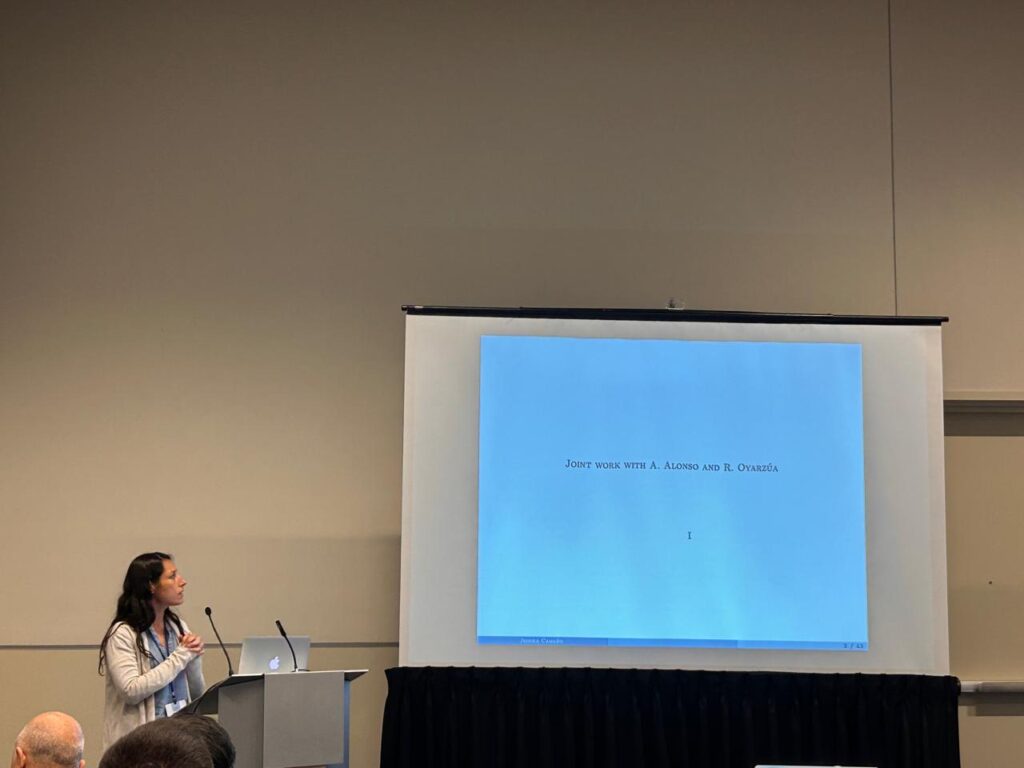
Camaño explained that this trip was partially financed by his Regular Fondecyt (1231336) and funds committed to the development of the Basal FB210005 project by the UCSC and emphasised that ‘participating in congresses is always positive, it allows you to interact with researchers from different parts of the world, exchange ideas and be able to make known the things that are being developed here in Concepción. Many of the people who participated in the congress were strangers to me, and this event gave me the chance to interact with them, which is the first step towards expanding my network’.
In addition, the week before the congress, both Camaño and Oyarzúa paid a collaborative visit to their colleague Nilima Nigam from the Department of Mathematics at Simon Fraser University (SFU), also located in Vancouver.
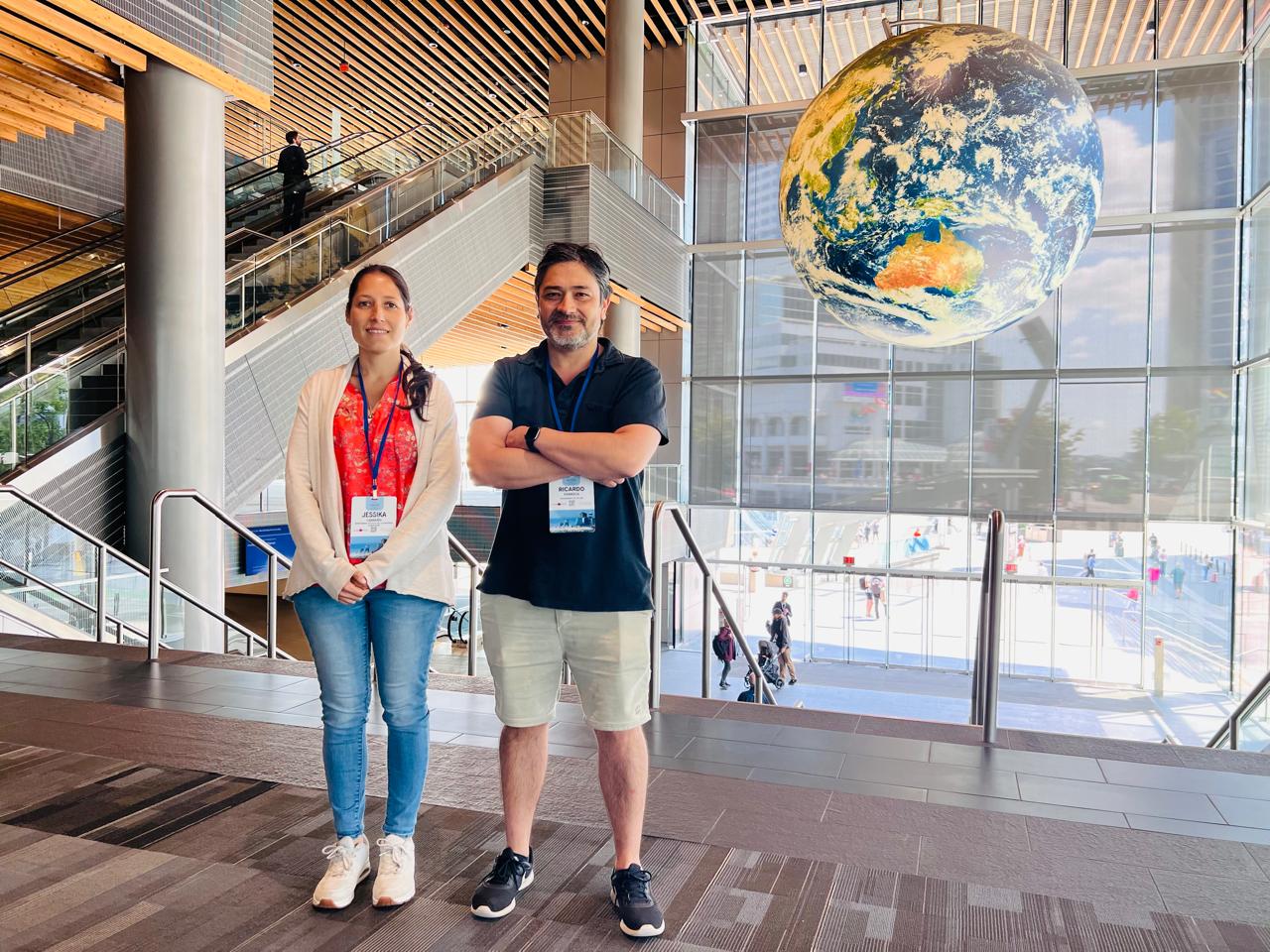
Oyarzúa explained that ‘during WONAPDE 2024, I told Nilima that I was going to Vancouver for this conference and, without hesitation, she immediately invited us and Jessika to visit her at SFU, taking advantage of the fact that we would be there. We had talked with her many years ago about the idea of working on something together, but for one reason or another it hadn’t materialised. So, during our stay, we talked about the research that each of us was currently doing and we agreed to start working on some of the ideas that came out of those meetings.
By Iván R. Tobar Bocaz, CMM journalist in Concepción.
Posted on Aug 5, 2024 in News
