


 Noticias en español
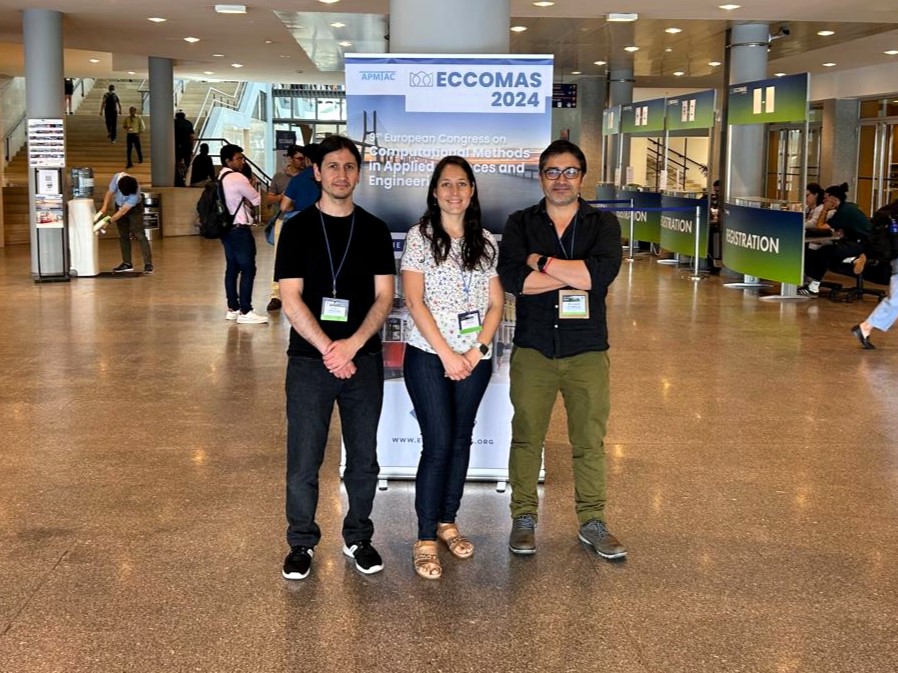
Ricardo Oyarzúa, Jessika Camaño and Pablo Venegas presented advances in their studies related to desalination models.
In early June, the ‘9th European Congress on Computational Methods in Applied Sciences and Engineering – ECCOMAS’ was held in Lisbon, Portugal.
The scientific meeting took place at the Lisbon Congress Centre and sought to promote joint efforts of European universities, industries and research centres that collaborate in research at the frontier of knowledge in the fields of numerical methods and computational simulation in engineering and applied sciences.
Three researchers from the Center for Mathematical Modelling (CMM) of the University of Chile participated in the event: Ricardo Oyarzúa Vargas and Pablo Venegas Tapia, both academics from the Universidad del Bío-Bío, as well as Jessika Camaño Valenzuela from the U. Católica de la Santísima Concepción, all three of whom are also members of the DSALT Group Project (Computational Mathematics for Desalination Problems – ACT210087).
“The academic from the University of Pittsburgh, Ivan Yotov, renowned for his work on numerical methods for coupled problems, extended an invitation to me and Jessika to present our work in the session on multiphysics problems that he was organising. We accepted immediately. Ivan has been collaborating for several years with researchers from the Concepción Numerical Analysis group on topics of mutual interest, which has created an important link with his team. This collaboration has been especially significant thanks to the mediation of UCSC researcher Sergio Caucao”, Oyarzúa explained.
Pablo Venegas presented the talk ‘Mathematical and numerical analysis of an axisymmetric thermoelectrical problem’ in the session ‘Electromagnetic Problems Arising in Industry: Modelling and Numerical Techniques’, while both Camaño and Oyarzúa participated in the session ‘Domain Decomposition and Time-Splitting Methods for Multiscale Multiphysics Problems’, presenting results of the studies they have carried out in collaboration with each other and, in addition, with Manuel Solano (U. de Concepción and Miguel Serón (PhD student in Mathematics at UBB), under the titles ‘A conforming finite element method for a nonisothermal fluid-membrane interaction’ and ‘A mass conservative finite element method for a nonisothermal Navier-Stokes/Darcy coupled system’.
“At the conference, I presented a new mass-conserving H(div)-conformal finite element method for modelling the coupling of non-isothermal fluid flow with flow in non-isothermal porous media. These equations model complex interactions between fluids and porous media, which has diverse applications, including desalination processes. This work is part of the PhD thesis of Miguel Serón, who is being supervised by me, Jessika Camaño and Manuel Solano”, Oyarzúa said.
“An important part of our DSALT project is to make our results visible to the international scientific community, and participation in this event aims to achieve this goal”, the DSALT director concluded .
By Iván R. Tobar Bocaz, CMM journalist in Concepción
Posted on Jul 17, 2024 in News
