


 Noticias en español
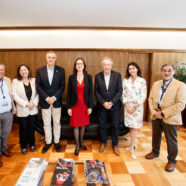
The Regional Center, hosted by the CMM, now has two of the three satellite tools of the European Earth Observation Program in operation.
Félix Fernandez Shaw, Director for Latin America and the Caribbean at the European Union’s Directorate-General for International Partnerships (DG INTPA); Claudia Gintersdorfer, European Union Ambassador to Chile; and Gloria Navarrete, Chile’s Ambassador to the European Union in Belgium and Luxembourg, led the delegation that visited the Center for Mathematical Modeling (CMM) at the University of Chile on Wednesday, November 6, to learn in detail about the operations of the Regional Copernicus Center for Latin America and the Caribbean (CopernicusLAC Chile).
In March 2023, the EU and the University of Chile officially launched this joint project as part of the new Digital Alliance. A year and a half later, this Earth observation initiative already provides free services to the public in Latin America and the Caribbean, including Land Cover and Use and Urban Atlas services, while Coastal Ocean Monitoring will be available in early 2025.
Florencio Utreras, Director of CopernicusLAC Chile, outlined the processes for infrastructure acquisition, energy expenditures, the water cooling system at the University of Chile, and efforts to reach collaboration agreements with countries in Latin America and the Caribbean. He also announced that an online image repository would be operational by April and an image processing service for Latin American and Caribbean users would be available by May.
Jaime Ortega, the project’s Scientific Director and a lead researcher at the CMM, explained the functioning of the currently available tools and announced a specific project to address the Caribbean’s sargassum issue. This seaweed has proliferated massively along Central American and Caribbean coasts in recent years, posing an environmental problem for countries in the region.
Satellite Images for the World
Following Utreras and Ortega’s presentations, the officials visited the Data Center at the University of Chile, which will soon host CopernicusLAC Chile’s servers, alongside the National Laboratory for High Performance Computing (NLHPC), another flagship project of the CMM.
“I believe it’s crucial for Chile to collaborate with the European Union, particularly with the Copernicus program, which is a public, open-access service funded by the EU. Adding the supercomputer, the Bella cable project, and our partnership with Chile, we have all the elements for Latin America and the Caribbean to use advanced technology for their development,” noted Félix Fernandez Shaw, the EU’s Director for Latin America and the Caribbean.
European Union Ambassador to Chile, Claudia Gintersdorfer, remarked: “Copernicus is one of the four components of the Digital Alliance, which also includes physical infrastructure like the Bella submarine cable that connects Portugal with Brazil and extends via land through Chile and other countries. First, we have regulatory dialogues and other topics. Second, political dialogues on connectivity and artificial intelligence initiated with ECLAC. Third, private sector involvement, and the fourth pillar is the Copernicus program, with two regional centers in Latin America and the Caribbean, one in Panama and the other in Chile.”
“I’m very excited as this is my first visit to this center, which is still in development and will soon have a regional scope, covering topics such as forest fires and the sargassum issue, which is a major concern for the Caribbean. The repository in Chile will be essential for the next phase of the project, which involves raising awareness of this free tool among individuals and businesses,” added Gintersdorfer.
Gloria Navarrete, Chile’s Ambassador to the European Union in Belgium and Luxembourg, stated: “Chile and the European Union have always had a close relationship. It’s a source of pride that an academic institution like the University of Chile is hosting this repository. It highlights the recognition of Chile’s capacity to host and distribute images to all of Latin America and the Caribbean from the CMM. I had not visited the Data Center before, and I found it impressive.”
Afterward, the delegation met with Francisco Martínez and Marcela Munizaga, Dean and Vice Dean of the Faculty of Physical and Mathematical Sciences at the University of Chile, respectively.
“There is much enthusiasm from the European Union to continue collaborating on projects for the development of Latin America and the Caribbean. We discussed in detail how to address issues in other countries with international relations support they can provide. A strong relationship is forming that I hope will be long-lasting and impactful, both in Chile and internationally,” stated Professor Martínez.
Ver esta publicación en Instagram
Center for Mathematical Modeling
The CMM is today the most active scientific research institution in mathematical modeling in Latin America. It is a center of excellence of the National Agency for Research and Development (ANID) of Chile, integrated by eight partner universities and located at the Faculty of Physical and Mathematical Sciences of the University of Chile. It is also the International Research Laboratory (IRL) #2807 of the French National Center for Scientific Research (CNRS).
Its mission is to create mathematics in response to problems in other sciences, industry and public policy. It seeks to develop science with the highest standards, excellence and rigor in areas such as data science, climate and biodiversity, education, resource management, mining and digital health.
Alonso Farías Ponce, journalist of the Center for Mathematical Modeling.
Posted on Nov 18, 2024 in News
