


 Noticias en español
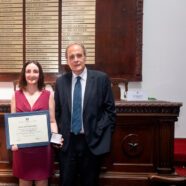
Recognized as the first female doctor and engineer in Chile by the College of Engineers, Henríquez is a pioneer in digital health and artificial intelligence.
Gloria Henríquez Díaz, researcher in the Digital Health area at the Center for Mathematical Modeling (CMM) of the University of Chile, has received the 2024 “Justicia Acuña Mena” award, presented by the Institute of Engineers of Chile. This award recognizes her distinguished professional career and exemplary qualities, which reflect the legacy of the first female engineer in Chile and the second in South America.
During the award ceremony held on October 29 in the corporation’s Hall of Honor, its president, Juan Carlos Barros, emphasized that “Justicia Acuña and a very small group of other female professionals graduating in the early 20th century were at the forefront of breaking down barriers and prejudices, thus paving the way for the full integration of women into society (…) The 2024 award has been granted to our colleague Gloria Henríquez, who embodies the personal and professional attributes that make her worthy of this special distinction for women engineers.”
Henríquez, recognized for over a decade as the first female doctor and engineer in Chile after graduating from the University of Santiago (USACH), holds a Master’s in Engineering Sciences with a mention in Electrical Engineering and a Master’s in Clinical Epidemiology. Additionally, she holds a Ph.D. in Engineering Sciences with a mention in Automation and has extensive experience in both public and private healthcare institutions. She is a lecturer at USACH and actively participates in international medical and engineering organizations, where she has contributed to books and research documents.
A Source of Inspiration
“Her professional career has been impactful. She is an inspiring example of dedication, passion, and perseverance. A symbol for us due to her courage and bravery in opening paths for many women. She has managed to cross over into various fields, and I believe that is the future—that we should be able to transfer knowledge across fields and combine expertise,” stated Nélida Heresi Milad, recipient of the 2022 “Justicia Acuña Mena” award and a prominent Chemical Civil Engineer from the University of Chile, who was entrusted with presenting the attributes of her successor.
Heresi also reflected, “I wondered, who is this superwoman? With this capacity for study, patience, a goal-oriented personality, a constant seeker of her path to find her niche, curiosity, and Cartesian mindset (based on René Descartes’ philosophy of ‘I think, therefore I am’), and so on (…) This award is not only a recognition of her outstanding career but also of her role as a pioneer. She is a role model and a source of inspiration for all women in engineering and medicine. Her work, creativity, and dedication light the way for many.”
In her acceptance speech, Gloria Henríquez remarked, “It is an honor to be awarded this prize in memory of Justicia Acuña, a truly inspirational figure in our country’s history. For me, she was an inspiring woman, as was Eloísa Díaz in the field of medicine, especially for the difficulties they must have faced to achieve their goals, probably going against societal norms at that time.”
“I also have my own inspiring women among my ancestors, and I always like to mention Eduvigis, someone I never met. She was born at the end of the 19th century, and, in an era when women had to stay home, she had a paid job at El Salvador Hospital. Her story of hard work was always a source of motivation for me, as were the women in my family—my grandmothers and my mother, who were also working women. So, working outside the home was not taboo, nor prohibited, but something that naturally came from previous generations,” noted the CMM researcher.
After recounting her educational and professional journey, Henríquez expressed her gratitude “to the Institute of Engineers for granting me this award, especially to Mr. Alejandro Steiner, for believing I deserved it and making this nomination a reality. I also want to thank my family, especially my parents, for my upbringing, and my husband, my partner in life for the past 18 years.”
Ver esta publicación en Instagram
Beginnings and Career
Born in Santiago and raised in Peñalolén, Gloria Henríquez is the eldest of three siblings, a public education graduate, and the first professional generation in her family. She started her education at Camilo Ortúzar Montt School in Macul and later at Luisa Saavedra de Providencia Girls’ High School. In 1995, she entered the University of Santiago at the age of 17 to study medicine, but it would not be her only program at this institution.
After graduation, she began her career as a general practitioner in 2003 at the Carol Urzúa Primary Care Center in Peñalolén and with the HELP medical rescue service. Two years later, she reached a significant milestone by being hired by the Mutual de Seguridad to join the Doña Inés de Collahuasi Mining Company, becoming the second female doctor at that site.
“In that search for happiness, I remembered that when I was studying medicine, I had a friend who was studying electrical engineering and doing his thesis with hospital scanner equipment. So, I thought, ‘that’s where I want to go’ because the human body functions on electricity,” Henríquez explains today, regarding her decision in 2006, at the age of 28, to return to USACH to study Electrical Engineering and a Master’s in Engineering Sciences with a mention in Electrical Engineering.
“In medicine, we conduct exams using sensors that transmit electrical signals from the body—such as electrocardiograms, electroencephalograms, and electromyograms. We also perform therapies or treatments such as defibrillation and cardiac synchronization with electronic devices. Furthermore, there’s the entire field of medical equipment in health, where many of the devices are imported, usually from abroad. That’s where I saw a very interesting niche to develop advancements from engineering applied to health for Chile’s specific needs, and that’s what motivated me,” she adds.
Due to her academic excellence, her journey at USACH continued in 2014 with a Ph.D. in Engineering Sciences with a specialization in automation, which was funded by a Conicyt Scholarship. “That year, with my thesis, I began to get involved in artificial intelligence applied to health, which relates to the Fondef project on predicting peaks in pediatric hospitalizations for respiratory diseases, on which we are currently working together with the Ministry of Health and the Clinical Hospital of the University of Chile,” she notes.
Throughout her academic advancement, Henríquez worked at Integramédica, the Directorate General of Civil Aviation—marking another milestone as the first woman to work emergency shifts at Arturo Merino Benítez Airport—and at ITMS (now Atrys Health), where she served as Innovation Manager between 2019 and 2022.
Digital Health
In 2020, the global COVID-19 health crisis presented new goals for Gloria. She completed her Master’s in Clinical Epidemiology at the University of La Frontera, joined the Public-Private Robotics Roundtable of the Chilean-Japanese Interparliamentary Group—which produced the document “Robotics in the Service of the Pandemic”—and became a founding member of the Research Committee of the Latin American Open Chair “Matilda and Women in Engineering.”
“We promote women’s participation not only in engineering but also in STEM careers and for this to extend to Latin American girls. I know the path is difficult because often the problem arises within families that don’t envision their daughters in STEM careers, especially in certain types of engineering. Therefore, the call is to fight for and study what they truly want. Additionally, it’s a message to their future colleagues to avoid discrimination based on being a woman, as this still exists,” she reflected.
Following this outstanding career, which has set a new paradigm in interdisciplinary training, in October 2022, Gloria Henríquez joined the Digital Health line at the Center for Mathematical Modeling of the University of Chile. There, she integrates the Chile-Mexico project on Mathematical Modeling of Epidemic Processes incorporating population, regional, and risk group structures in a pandemic context and leads the aforementioned project on hospitalization prediction, where she works with mathematical, epidemiological, and artificial intelligence tools. This project has been applied since 2023 at Dr. Luis Calvo Mackenna Hospital in Santiago.
“Gloria’s arrival strengthened the work of the Digital Health line, giving it structure and depth, and above all, greater coherence between the objectives and the line’s capabilities to achieve those goals,” highlighted the CMM’s director and coordinator of the Digital Health area, Héctor Ramírez.
“Her integration into the CMM has been rapid and remarkably successful. With less than two years on the team, Gloria has already left a profound mark on the Digital Health line,” added the University of Chile professor.
In addition to her work at the CMM, in 2023, Gloria Henríquez authored the chapter “Artificial Intelligence” in the book “Lights and Shadows: Sixty Years of Changes in Medicine and Health,” published by the Chilean Academy of Medicine. She is currently a lecturer in the Clinical Engineering and Hospital Maintenance Diploma program at USACH and a member of the Health Committee of the College of Engineers, where she previously held the position of Vice President of the Electrical Specialty Council.
Center for Mathematical Modeling
The CMM is today the most active scientific research institution in mathematical modeling in Latin America. It is a center of excellence of the National Agency for Research and Development (ANID) of Chile, integrated by eight partner universities and located at the Faculty of Physical and Mathematical Sciences of the University of Chile. It is also the International Research Laboratory (IRL) #2807 of the French National Center for Scientific Research (CNRS).
Its mission is to create mathematics in response to problems in other sciences, industry and public policy. It seeks to develop science with the highest standards, excellence and rigor in areas such as data science, climate and biodiversity, education, resource management, mining and digital health.
Alonso Farías Ponce, journalist of the Center for Mathematical Modeling.
Posted on Nov 21, 2024 in News
