


 Noticias en español
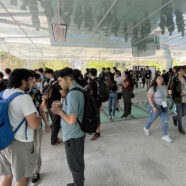
In the VIII National Meeting of Mathematical Engineering, ENIM 2024, which gathered more than 300 attendees at the U. de Chile.
More than 15 presentations, six short courses and 16 posters, among other academic activities, distributed over three days, gave shape to the National Meeting of Mathematical Engineering, ENIM 2024, which took place a few weeks ago at the Faculty of Physical and Mathematical Sciences of the Universidad de Chile.
In addition to the academic and student community in the field of applied mathematics, ENIM 2024 aimed to be a meeting place for all those interested in the nascent and fruitful development of these tools in Chilean industry.
The more than 300 participants came from nine universities: U. de Chile, Pontificia U. Católica de Chile (organizer of the first version of the meeting), U. de Concepción, U. Católica del Maule, U. de la Frontera, U. de O’Higgins, U. de Santiago de Chile, U. de Valparaíso and U. Técnica Federico Santa María-
Sharing a passion for mathematics
This eighth version of ENIM was organized by students of the Department of Mathematical Engineering (DIM), with the support of the Center for Mathematical Modeling (CMM) of the Universidad de Chile. This is the case of Cristóbal Ramos Suzuki, who, on behalf of the 14 students who participated in the organization, commented that this event “has a very special value for the students, because it functions as a meeting point for the whole mathematical engineering student community in the country, allowing us to share our passion for mathematics and our eagerness to learn and teach”.
“We wanted to offer a comprehensive experience, with talks that addressed various topics, always keeping mathematical engineering as the common thread”, the student detailed and added that “we sought to create spaces for the exchange of knowledge among peers, giving prominence to the students, which we achieved through 9 thesis exhibitions of students from different universities, as well as an exhibition of mathematical posters on various topics”.

ENIM 2025 brought together more than 300 participants from nine Chilean universities, as well as representatives of the industry.
Since collaboration between academia and industry is fundamental for the advancement of mathematical engineering, they were joined by representatives of the companies SimpliRoute, Unholster, Notus, SARCAN, NoiseGrasp, as well as the Center for Mathematical Modeling (CMM) of the University of Chile, whose participation allowed the attendees the opportunity to learn about practical applications of mathematics in various sectors, promoting the exchange of knowledge and experiences that enrich both academic training and professional development.
In this sense, Cristóbal explained that “we were interested in bringing the student community closer to the working world and showing the great impact of mathematical engineering in today’s world” and exemplified that “we were able to explore the impact of mathematical engineering in industry, in the fight against climate change, in the reduction of gender gaps and in the solution of everyday problems of citizenship”.
Vision of the speakers
During the inaugural day, the panel discussion ‘Origins and Projections of Mathematical Engineering in Chile’ was held, with the participation of CMM researchers Jaime San Martín (academic at the U. de Chile and National Science Award 2023) and Raimund Bürger (U. de Concepción), who discussed the role of Mathematical Engineering in our country, under the moderation of Cristián Reyes, also a CMM researcher.
.

Panel Origins and Projections of Mathematical Engineering in Chile, with Raimund Bürger and Jaime San Martín.
“The event surprised me by the number of participants, the breadth of the topics and the organization in general,” said Jaime San Martín.
“About the conversation with Professor Bürger, I emphasize the importance of mathematical engineering in Chilean engineering,” said the U. de Chile academic. “A career that provides international level training and allows its graduates to work in interdisciplinary teams and contribute with analytical tools, with a critical and evidence-based vision,” he said.

Jaime San Martín signs books during ENIM 2025.
“The wide variety of job possibilities was also highlighted, from modeling groups in large national or international companies, such as banks, insurance companies, large mining companies -among others-, to academia, through own ventures or startups”, commented Dr. San Martín and added that “the importance of training in data/modeling/computing/IA was discussed and that the basic training that our students have allows them to cover these topics with some ease”.
Raimund Bürger emphasized that “first of all, I consider it an honor to have been invited both as a plenary speaker and to participate in the plenary conversation”.
“One of the aspects that was briefly discussed”, he explained, “was whether mathematical engineering is suitable for Chile or whether it exists elsewhere as well. Certainly the concept of mathematical engineering comes from other countries, notably from France, but in few places is the community as active as in Chile”.
“It is curious,” he reflected, “that there are master’s programs in mathematical engineering in universities in several Latin American countries such as Honduras, Panama, Colombia or Ecuador. Some of them have asked us for curricular advice, and we are interested in maintaining contact with a view to our graduate programs.”
- During the three days of the event, there were six workshops, organized in two daily blocks, and the following specialized talks:
- How is gender made in engineering and mathematics, by Andrea Vera and María Isabel Cortez, U. de Valparaíso
- Who knows enough mathematics to teach in elementary education? by Salomé Martínez, U. de Chile
- Analyzing early cognitive development with mathematics, by Marcela Peña, Mircea Petrache, Felipe Gutiérrez and Martín Alcántara, Pontificia U. Católica de Chile
- Optimization and Democracy, by José Correa, U. de Chile
- Mathematical Models for Sewage Treatment Plants, by Raimund Bürger, U. de Concepción
Dr. Salomé Martínez explained that her talk “focused on school mathematics and how mathematical engineering can contribute to mathematics education. This topic connects with the school experience. All of us who work in mathematics are sensitive to the fact that others can learn and enjoy it, so reflecting on how difficult it is to teach, the depth of school mathematics, is interesting”. “This is a very relevant meeting,” commented the also director of the MWC Education Laboratory (CMMEdu).

“ENIM allows students to generate friendships and links with future mathematical engineers from all over Chile, to talk about their experiences and concerns, what they have learned,” he added. “It connects them through thinking about current problems that require mathematics and modeling to be addressed. I got to interact with students from different universities and it was very nice to see them so eager to learn and face future challenges”.

Prof. Raúl Gormaz teaching the course Some Adventures in the History of Mathematics.
Adriana Piazza gave the course ‘Affirmative Actions in School and University Admission Systems’, which focused, as she explained, on “analyzing some of the affirmative action measures currently used in educational admission systems, particularly in Chile. For this purpose, the Deferred Acceptance mechanism was studied, we showed how it should be adapted to implement affirmative actions and the efficiency and manipulability properties of the adapted mechanism were explained”.
“ENIM allows students and future professionals not only to explore practical applications of mathematics in various sectors”, commented the academic from the Faculty of Economics and Business of the U. de Chile, “but also offers them a valuable opportunity to build networks of contacts that will be fundamental for their professional development”.
“This version stands out as an integral event that combined academic activities, contact with the industry and spaces for socializing,” Dr. Piazza valued. “The multiplicity of programmed activities ensured an enriching experience”, she said.
All the information on ENIM 2024 is available at the event’s website.
By Iván R. Tobar Bocaz, journalist of the Center for Mathematical Modeling, Concepción.
Posted on Dec 30, 2024 in News
