


 Noticias en español
The event addressed the technological and scientific challenges of space mining — an emerging field that combines robotics, artificial intelligence, and applied engineering in extreme environments.
The Center for Mathematical Modeling (CMM) of the University of Chile and SK Godelius held the fifth session of the CMM–SK Godelius Conference Series on October 9 in the John von Neumann Room at CMM. This initiative aims to strengthen the link between academia and industry by promoting dialogue on frontier technologies and their impact on the country’s scientific and productive development.

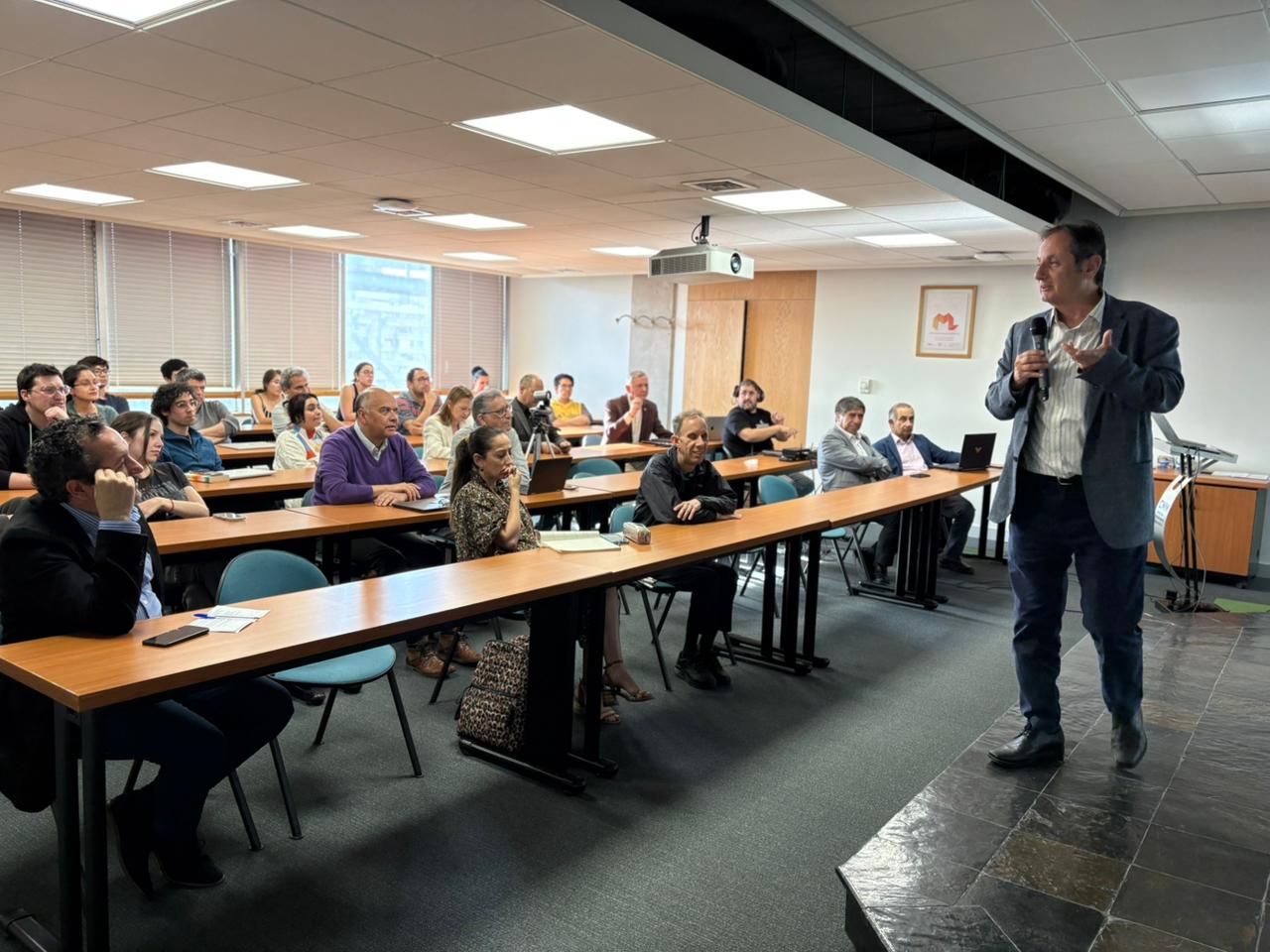
This session focused on space mining, a rapidly evolving discipline that integrates advanced robotics, artificial intelligence, and applied engineering to explore, identify, and eventually extract mineral resources from celestial bodies. Once confined to the realm of science fiction, this field is now emerging as a new technological frontier with strategic implications for the supply of critical minerals and the future of the global mining and energy industries.
In this context, SK Godelius, a Chilean company specialized in the development, manufacturing, and integration of engineering solutions for teleoperation, robotization, and connectivity, has been a pioneer in advancing technologies that enable remote and autonomous operations in extreme environments—enhancing safety, efficiency, and sustainability across industrial processes.
The session featured a presentation by Fernando Bracco, founder and CEO of SK Godelius, who discussed how robotics, artificial intelligence, and automation are creating new opportunities for remote operations and human–machine collaboration, both in terrestrial mining and future space exploration scenarios.
“What we seek is for academia and industry, science and technology, physics and applied engineering to work together. That is the spirit behind this initiative. At Godelius, we believe that collaboration with the CMM strengthens that connection,” emphasized Bracco during his presentation.
For his part, Marco Muñoz, CEO of Red Minera and President of the Institute of Mining Engineers of Chile (IIMCh), highlighted the event as a key meeting point for collaborative innovation.“These kinds of activities foster interaction among people and organizations, building bridges that make it possible to develop joint and collaborative initiatives,” he commented.
The event also featured Prof. Néstor Becerra, academic from the Department of Electrical Engineering at the University of Chile, who addressed the scientific and technological challenges involved in designing intelligent and resilient systems capable of operating under extreme conditions, where autonomy and adaptability are critical.
Among the attendees were engineering students, representatives from the mining sector, and leading figures from the scientific community, including National Science Award laureates Servet Martínez (1993) and Alejandro Maass (2025). “Collaboration between academia and industry is essential for building applied knowledge with real-world impact. This conference series led by CMM plays a fundamental role in fostering that dialogue,” noted Servet Martínez, CMM researcher and 1993 National Science Award recipient.
Through the CMM–SK Godelius Conference Series, the Center for Mathematical Modeling seeks to create interdisciplinary spaces for conversation that promote the exchange of knowledge among scientists, engineers, and industry professionals—addressing strategic issues for technological development, sustainability, and innovation in Chile.
Written by Cintia Beltrán, CMM Communications
Posted on Oct 16, 2025 in News
