
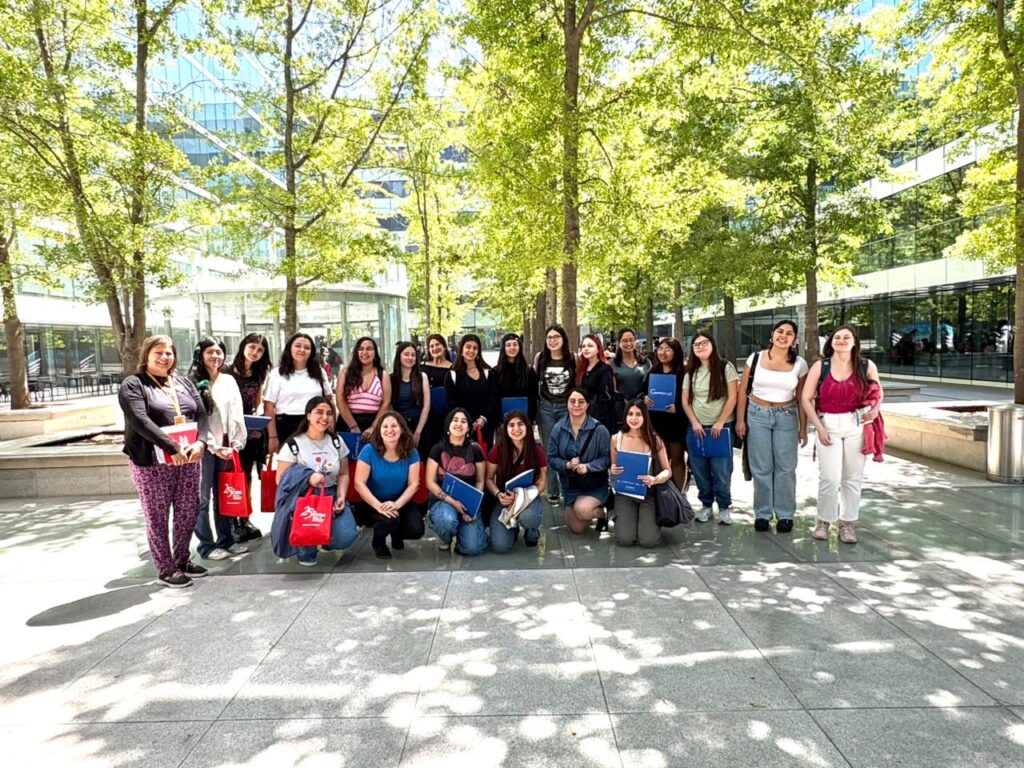
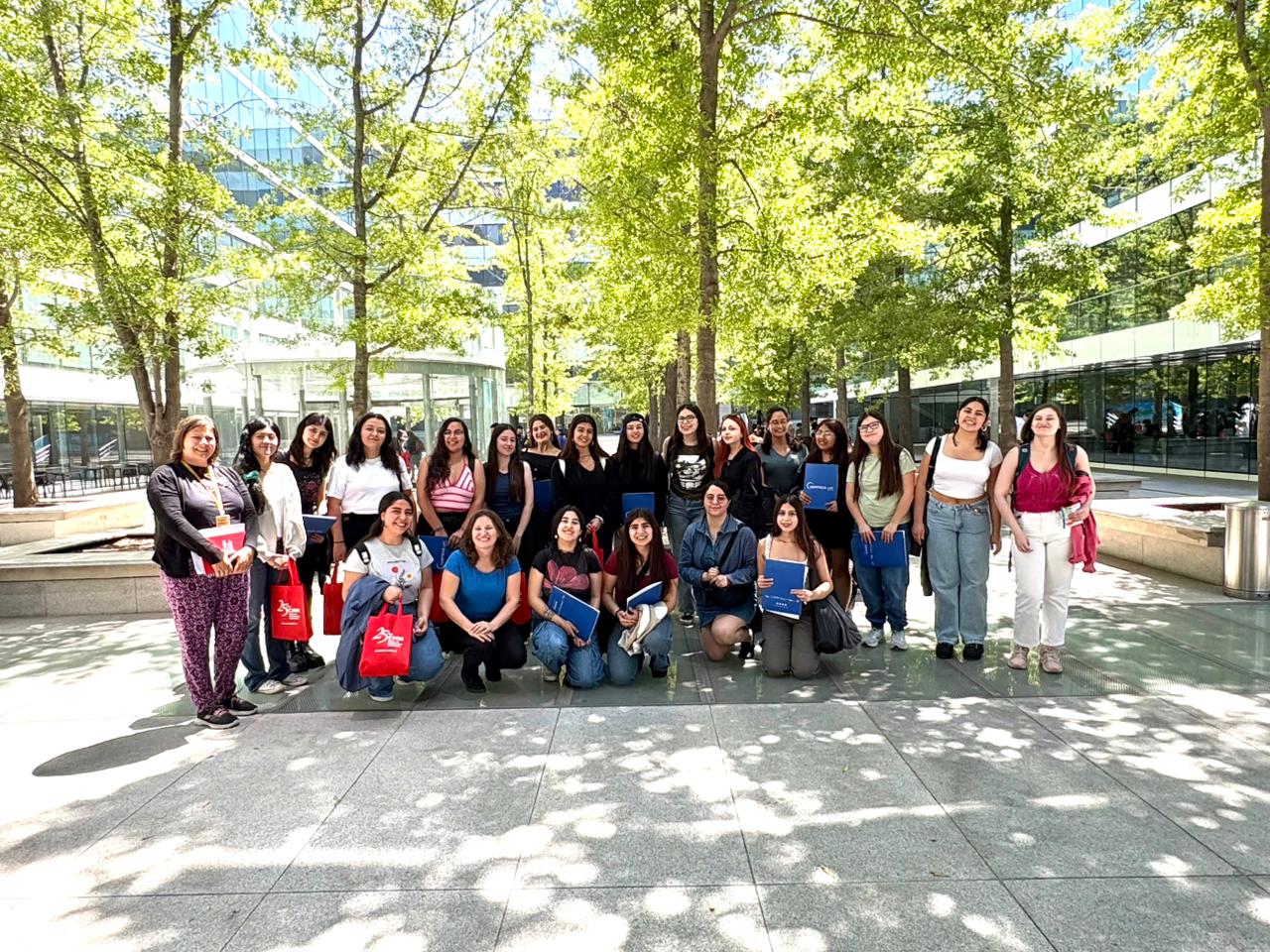
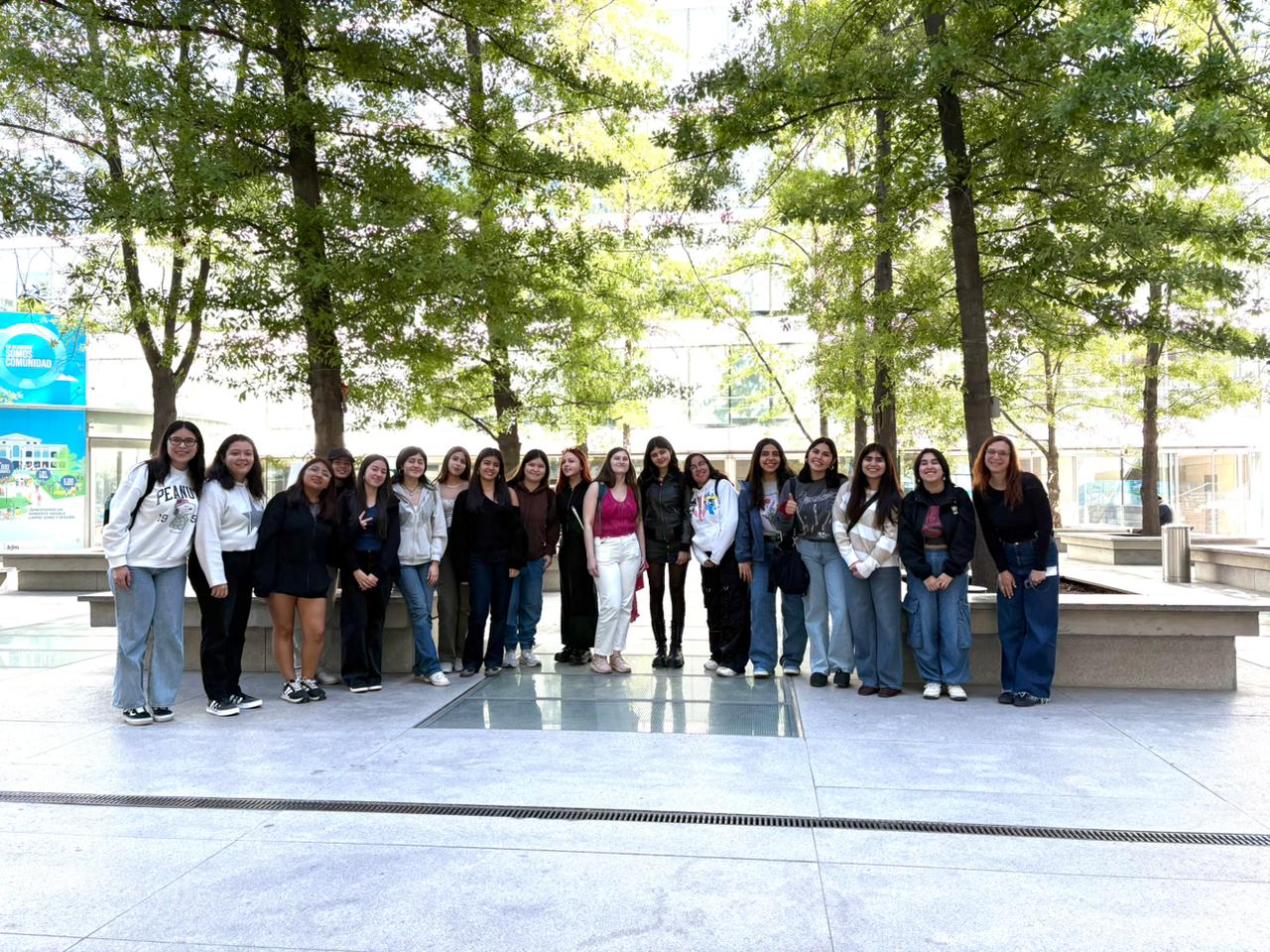
On Thursday, October 30, a group of students from the EMMA Program (Women in Mathematics Gathering) of the Technical University Federico Santa María visited the Center for Mathematical Modeling (CMM) of the Faculty of Physical and Mathematical Sciences at the University of Chile, in a day that blended curiosity, science, mathematical models, and female inspiration.
The group, which traveled from Valparaíso, entered through the emblematic Beauchef 851 entrance, where the hum of research merges with the echo of those who believe that mathematics not only explains the world but also transforms it. There, they were welcomed by Prof. Darinka Radovic, Deputy Director of Diversity and Gender at the FCFM and Chair of the CMM Gender Committee, who greeted them warmly and guided them through a diverse, inquisitive, and ever-evolving scientific community.
Mathematics as a Universal Language
The visit began in the CMM Hall named after Amalie Emmy Noether (March 23, 1882 – April 14, 1935), the German mathematician who made groundbreaking contributions to abstract algebra and modern physics. Regarded by figures such as Albert Einstein, Hermann Weyl, and Norbert Wiener as the most important woman in the history of mathematics, Noether developed theories of rings, fields, and algebras that reshaped the discipline. In physics, her celebrated theorem reveals the profound link between the universe’s symmetries and conservation laws—a principle that underpins much of contemporary physics.
Inspired by this legacy, the students moved to one of the CMM rooms, where they were received by Prof. Héctor Ramírez, Director of the CMM. In his welcoming remarks, he emphasized the role of mathematics as an essential tool for understanding and transforming the world:
“We are very pleased to welcome the future mathematical engineers from Universidad Santa María, an institution associated with the CMM, so they can get to know our facilities and the work carried out by our researchers and professionals across different areas. Mathematics allows us to solve complex problems of various kinds. It enables us to imagine them from different angles, rewrite them, and search for the patterns that lead us to a solution… it allows us to observe and model reality,” he stated.
Exploring, Asking, Discovering
Following the welcome session, the students toured the CMM’s main infrastructure and research laboratories, where mathematics meets some of today’s most pressing global challenges:
-
In the NLHPC, they discovered the heart of Chilean supercomputing, where millions of data points are transformed into knowledge.
-
At CopernicusLAC Chile, they learned how satellite observation and artificial intelligence are used to monitor soil coverage and coastal ecosystems.
-
At ALeRCE, they were fascinated by the dynamic universe of astronomical phenomena that mathematics helps decode in real time.
Each stop served as a reminder that behind every equation lies a story—a curious mind and deeply human intuition. In every laboratory, the students encountered multidisciplinary teams, including women leading and contributing from their respective specialties.
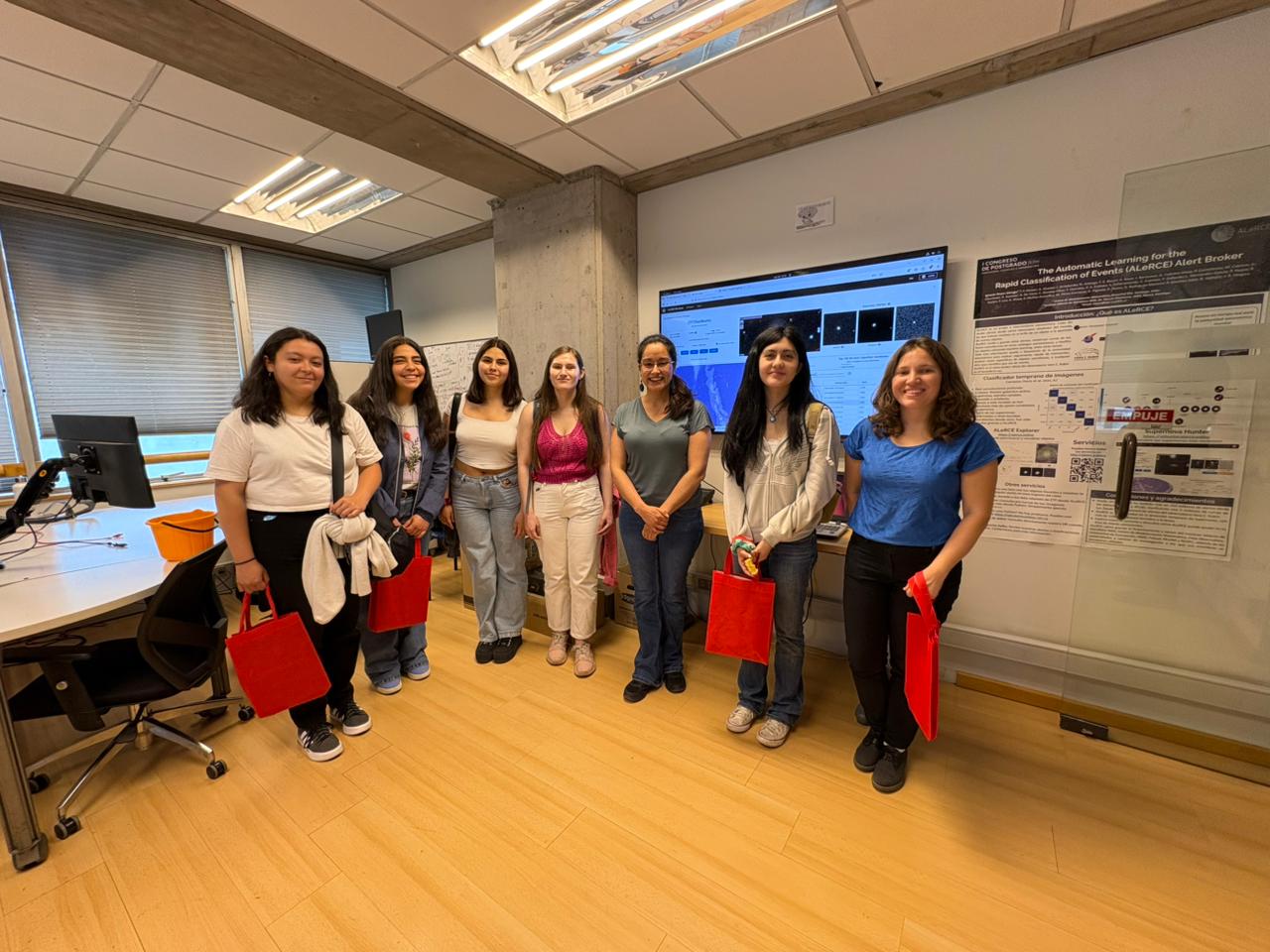
Alejandra Muñoz Arancibia, astronomer at the Millennium Institute of Astrophysics and ALeRCE member, noted: “Mathematics underpins many advances in astronomy, such as image processing and the classification algorithms we use to find supernovae, for example. Interdisciplinary work is becoming essential today, and opportunities like this help students learn about successful initiatives being led right here. I believe getting to know these projects early in their careers will help students make more informed choices about their own paths.”
Women Who Research, Inspire, and Lead the Way
The day concluded with the session “Women Researching in Mathematics at the CMM,” where six researchers shared their career paths, ideas, and challenges: Laura Jiménez discussed the connection between Ecology and Mathematics; Melanie Sánchez shared her story in My Journey into Mathematics; Javiera Gutiérrez presented My Journey in Mathematics; Carolina Chiu addressed the Applications of Probability Functions in Optimization Algorithms; Helena Montenegro spoke on Crossing Borders: Psychology and Mathematics Education in Dialogue; and Alejandra Muñoz Arancibia turned the focus to the cosmos with The Variable Universe.
It was an open space for dialogue, in which the students saw themselves reflected in the researchers’ stories—not only as scientific role models but also as human references. Amid laughter, questions, and attentive silence, reflections emerged on vocation, curiosity, and perseverance.
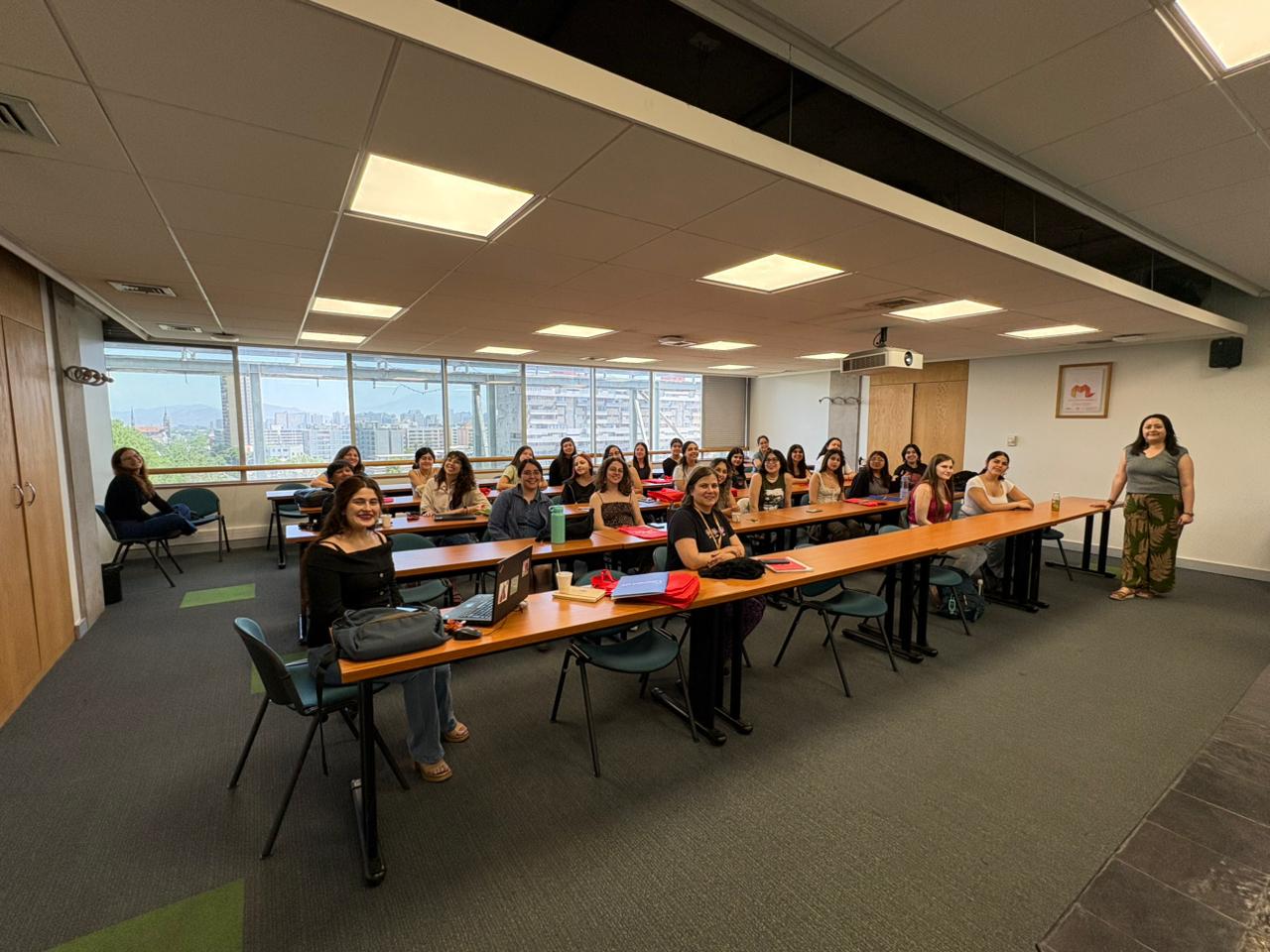
“This experience allowed me to learn about female role models working in applied areas. I was surprised by how many women conduct research here and how they are able to apply knowledge to solve real-world problems,” said Javiera Pérez, a sixth-year student of Mathematical Civil Engineering at USM.
Inspiration as a Starting Point
The visit closed with a message that lingered in the air: science built through diversity and collaboration. Prof. Darinka Radovic highlighted the significance of these encounters for shaping new generations:
“Every woman who enters a laboratory, every student who dares to ask questions, expands the boundaries of what is possible. World mathematics has seen figures like Emmy Noether and Maryam Mirzakhani, and each of them opened a door. Today, those doors are also here, in Chile, at the CMM—and we want more women to walk through them.”
For her part, Catherine Lemun, a doctoral student from the Department of Mathematical Engineering who accompanied the students throughout the visit, reflected on the symbolic and emotional value of the day:
“Opportunities like this are incredibly enriching early in one’s studies, because many people begin a mathematics degree with distant or intimidating ideas, thinking one must be a genius. But getting to know women from Latin America doing cutting-edge science shows that mathematics can also be a tool for social change and for addressing challenges as important as climate change.”
Thus, amid data, equations, and conversations, the visit to the CMM became more than an academic activity: it was an encounter with the living history of mathematics—and with the possibility of imagining a future in which women continue shaping, through science, new ways of understanding the world.
Written by Cintia Beltrán, CMM Communications
