


 Noticias en español
- Researchers from various disciplines gathered in Valparaíso from November 3 to 7 for the 2nd BIO-CIVIP Workshop to develop innovative solutions based on mathematics, biology, and ecology that contribute to the control of pests and insect-borne diseases.
Last week, the 2nd Workshop BIO-CIVIP – Biological Control of Insect Vectors and Insect Pests was held in Valparaíso, co-organized by researchers from the Center for Mathematical Modeling (CMM) of the Faculty of Physical and Mathematical Sciences of the University of Chile and the Federico Santa María Technical University (USM).
With 19 presentations spread over five days, given by specialists from different fields—such as public health, ecology, mathematics, and biology—from countries in Europe and South America, the event sought to promote international and interdisciplinary collaboration on innovative strategies for the biological control of disease-carrying insects.
The organizing committee was made up of Gloria Henríquez and Víctor Riquelme, representing the CMM, and Pablo Aguirre and Ronny Vallejos, representing the USM.
“This meeting was a very interesting opportunity to learn about what other countries are doing to understand the dynamics and control of vector-borne diseases, as well as to generate opportunities for collaboration between researchers and centers in the different participating countries”, Víctor Riquelme said.
This event is part of the STIC AMSUD230013 project ‘BIO-CIVIP – BIOlogical Control of Insect Vectors and Insect Pests’, which involves scientists from various countries: France, Chile, Colombia, Brazil, and Paraguay. “Each country”, Riquelmeexplained , “participates in the project through a group of researchers from that country, one of whom holds the position of national coordinator, and it is they who coordinate who can participate in the workshop according to availability and feasibility”.
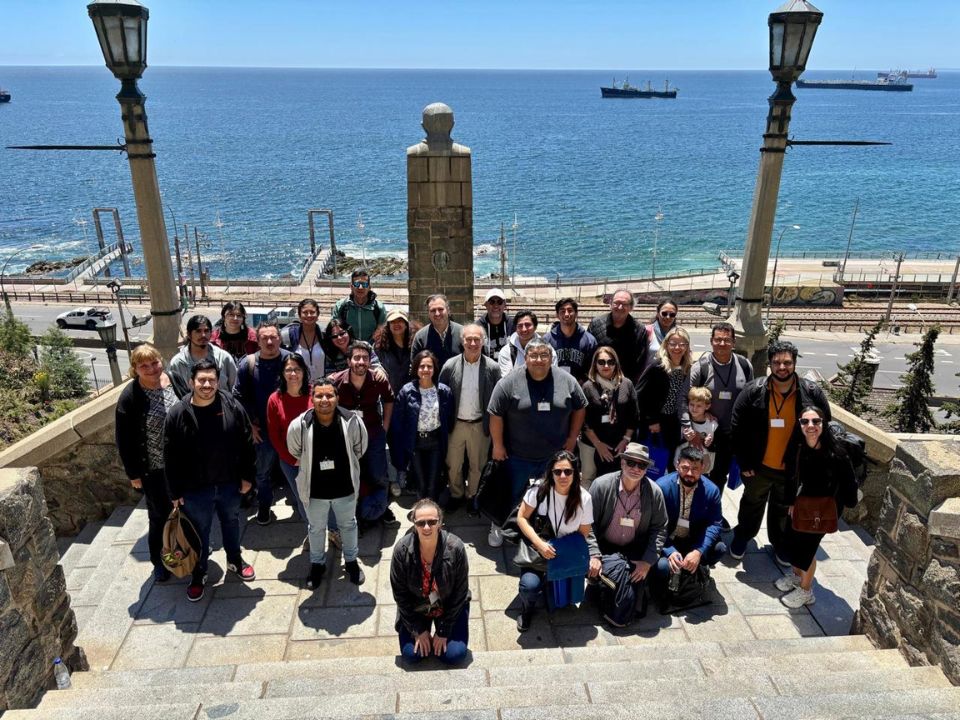
For his part, and in terms of the results of the meeting, Pablo Aguirre from USM highlighted that “I was very satisfied with the scientific level and the diversity of approaches presented”.
“The talks showed a very valuable integration between mathematical modeling, experimental studies, and real vector control strategies, especially on topics such as Wolbachia, dengue, HLB, and epidemiological surveillance”, he elaborated, adding that “I especially appreciate the collaborative atmosphere that was generated: the working sessions allowed for in-depth discussions and concrete connections between groups from different countries”.
“Overall, the workshop was fluid, productive, and strengthened an active community that will continue to advance innovative solutions for the control of vector-borne diseases”, Aguirre concluded.
Meanwhile, CMM director Héctor Ramírez participated in the scientific committee of the meeting and commented that “it is essential for the CMM to participate in collaborative and joint research projects on issues of such relevance to the region”.
“Although these types of diseases are considered to be under control in Chile (we are mainly talking about dengue and Chagas disease here),” he elaborated, “this is not the case in other South American countries, with which we have researched control strategies for these diseases using mathematical models”.
“The impact of possible vector-borne pests on agriculture is also of great relevance to Chile. From a modeling perspective, these pests behave similarly to diseases that affect humans”, explained Ramírez.
The other members of the scientific committee were Heliana Arias from the Universidad del Valle in Colombia, Pierre-Alexandre Bliman from Inria in France, Claudia Pio Ferreira from the Universidade Estadual Paulista in Brazil, and Christian Schaerer from the Universidad Nacional de Asunción in Paraguay.
The BIO-CIVIP 2025 conference was held at the USM headquarters and was supported by the Chilean National Research and Development Agency, the Ministère de l’Europe et des Affaires Étrangères and Centre National de la Recherche Scientifique, both from France, the Coordenação de Aperfeiçoamento de Pessoal de Nível Superior from Brazil, the Ministry of Science, Technology, and Innovation from Colombia, and the National Council for Science and Technology from Paraguay.
By Iván R. Tobar Bocaz, CMM Communications
Posted on Nov 14, 2025 in News
