


 Noticias en español
- Over the course of three days, four talks and two short courses were held on two lines of research in this area of knowledge.
Co-organized by a researcher from the Mathematical Modeling Center (CMM) at the University of Chile, the Spring 2025 School of Applied Mathematics (EMA-P2025) was held at the Catholic University of the Most Holy Conception (UCSC) from Tuesday, October 28, to Thursday, October 30.
This event, which has been held since 2016, seeks to disseminate the lines of research currently being developed in the Master’s Degree in Applied Mathematics (M2A) at that university: Numerical Analysis of Partial Differential Equations (NA of PDEs) and Dynamic Systems.
The event was organized by academics from the Department of Applied Mathematics and Physics of the UCSC Faculty of Engineering: Dr. Marco Uribe Santibáñez, Dr. Jhon Vidarte Olivera, and Dr. Sergio Cauco Paillán, who is also a researcher at the CMM. Meanwhile, Dr. Jessika Camaño Valenzuela and Dr. Luis Gatica Simpertigue, both also academics at UCSC and members of the CMM, also participated as M2A teachers.
EMA-P2025 included two short courses corresponding to each of the aforementioned lines, as well as four specific thematic talks on ongoing research projects.
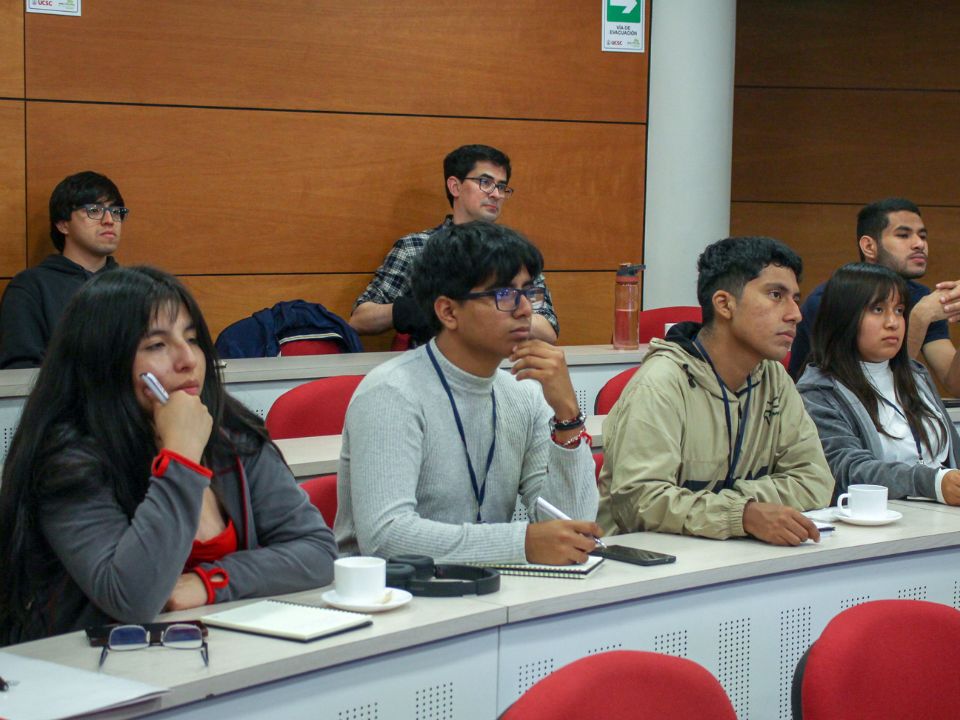
One of the attendees was Andrés Andrades Saldías, a student of Secondary Education in Mathematics at UCSC, who explained that “my main objective was to talk to the master’s students to find out more or less what they had faced, what they thought of it, and what their experience had been like”.
“And also to talk to the professors because, since I’m studying education, mathematics is different from what graduates bring with them”, he explained, “and I achieved my goals because I was able to feel confident that it is possible to get in and that it would take a lot of effort, but that it can be done, especially because a classmate I had in college, in some courses, entered the master’s program and is already in her second semester”.
“I am interested in the area of numerical analysis because of how they solve problems on the computer, and there you have to program a little and refine the meshes, and the approximate solution gets closer to the real one”, he emphasized.
Meanwhile, Alejandra Lafuente Luizaga, a mathematics student at the Universidad Mayor de San Andrés in La Paz, Bolivia, said she was interested in attending EMA-P2025 because “I thought it was an extremely interesting opportunity because it brought together topics that connect mathematical theory with its application in real phenomena” and because of “the possibility of getting to know the program’s teachers and researchers up close”, since “it allowed me to explore future specialization options and better understand the lines of research being developed”.
“My objectives were fully met and even exceeded”, she emphasized, adding that “the program exceeded my expectations not only because of the quality and depth of the presentations, but also because it allowed me to discover specific academic opportunities offered by the master’s degree, both in the field of education and in applied research”. He also highlighted that “the experience helped me expand my network of academic contacts, generating links with people who share interests and could become future collaborators or references in my career”.
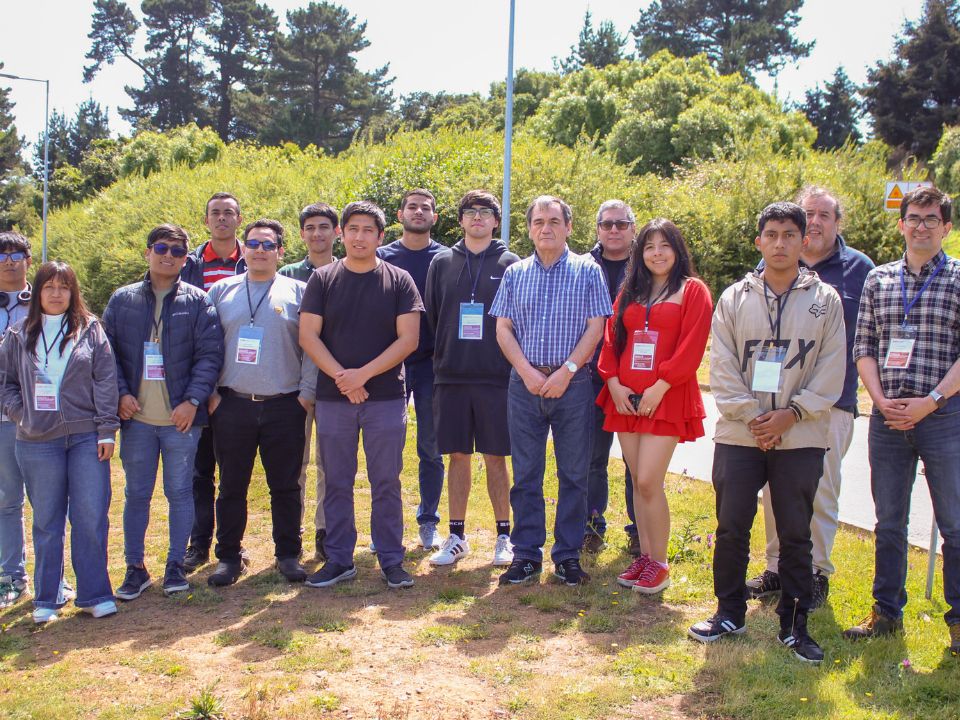
“The content that most captured my interest”, he explained, “was related to dynamic systems, especially the talk on the Hénon–Heiles Hamiltonian system. I found it extremely interesting because it shows how seemingly simple structures can give rise to extremely complex, even chaotic, behavior from small perturbations”.
Meanwhile, Prof. Caucao noted that “this is the third School of Applied Mathematics that I have co-organized since joining UCSC in 2020, and it is always a pleasure to share with students interested in applying to our Master’s program in Applied Mathematics. The energy and interest conveyed by undergraduate students is contagious and motivates me to devote my work and time to organizing these types of activities”.
The researcher also gave a talk in which he presented a research project recently developed in collaboration with his colleague Jessika Camaño (UCSC and CMM) and Lady Angelo, a former M2A student. “This work was part of Lady’s duties as a research assistant, a position she held between August 2023 and January 2024, with funding from the CMM, after completing her master’s degree”, Caucao said.
International interest
Meanwhile, his colleague at UCSC, Dr. Abner Poza Díaz, head of the M2A program, highlighted that “we had very good participation, with four attendees from Bolivia and Peru. In addition, there was great interest in participating, as we had foreign applicants who, for economic reasons, were unable to travel”.
“I believe that the objectives were met, and that we will have a good number of people interested in applying to the program for admission in 2026; in fact, we already have two complete applications”, Prof. Poza added.
“The event was of a very high standard, with two short courses corresponding to each line of research, taught by faculty members, and four talks given by colleagues and graduates of the M2A”, he added.
One of the two short courses included in the three-day scientific event was given by Dr. Luis Gatica Simpertigue, a UCSC academic and CMM researcher, entitled ‘Introduction to Numerical Analysis with Finite Elements for Elliptic PDEs’. The five-hour workshop, the researcher said, “aimed to give participating students a basic idea of what the finite element method applied to solving boundary value problems defined by elliptic PDEs consists of”.
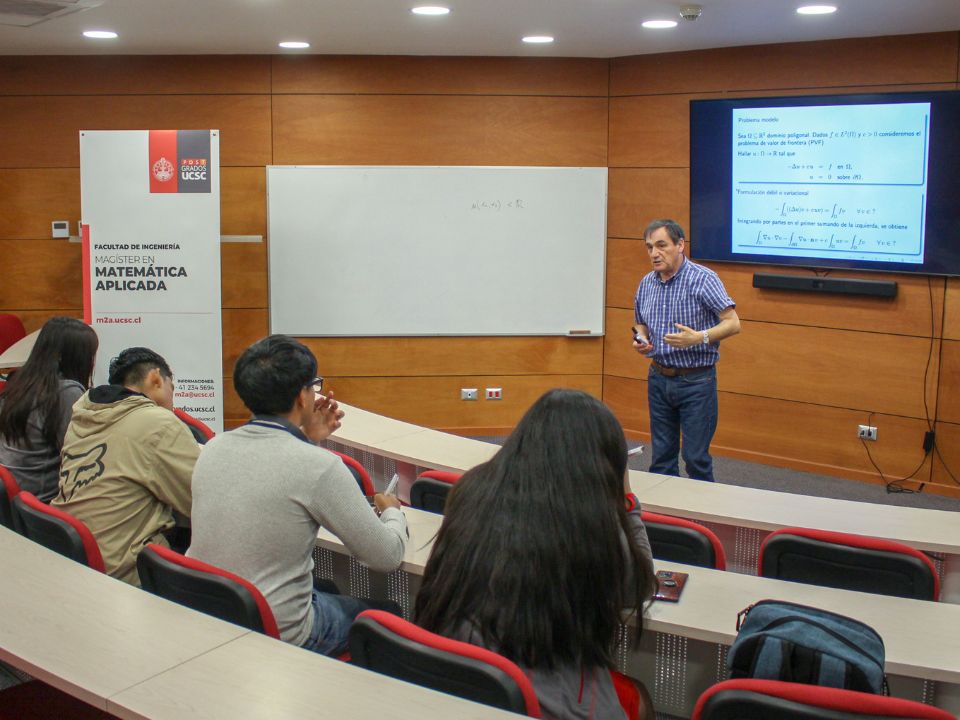
Prof. Gatica highlighted the interest and participation of the students in attendance in the content presented, given that, he said, “they need to understand, in a simple and understandable way, what one of the program’s current lines of research consists of”, information that, he explained, will allow them to decide whether to enroll in the M2A and, if so, in which area to focus their research.
The scientist also praised the EMA-P2025 event, stating that “this type of outreach event attracts very talented students in mathematics and related fields from different parts of the country and some neighboring countries, whose talents, skills, curiosity, and abilities compel us researchers to stay current and well prepared”.
Academics Jessika Camaño, Sergio Caucao, Luis Gatica, and Abner Poza are also members of the Numerical Analysis and Scientific Calculation Research Group, GIANuC², at UCSC, which was formally established in 2023 to develop and analyze new numerical methods for physical models described by partial differential equations from continuum mechanics and found in various fields of knowledge, such as engineering, physics, chemistry, and biology, among others.
By Iván R. Tobar Bocaz, CMM Communications.
Cover image credit: Sergio Caucao, CMM.
Posted on Nov 7, 2025 in News
