
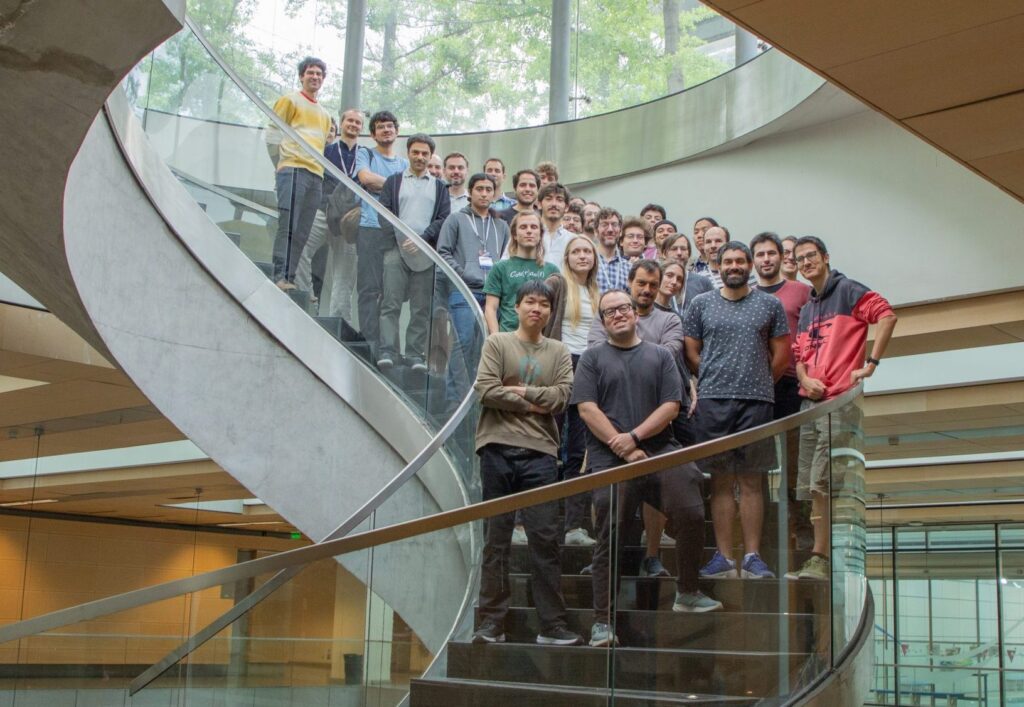
More than 60 international speakers participated in the workshop “The Topological Phase Transition and Localization of Random Fields,” devoted to presenting the latest advances in spin systems with continuous symmetry. The meeting placed particular emphasis on Berezinskii–Kosterlitz–Thouless (BKT)–type phase transitions and their connection to localization and delocalization phenomena in integer-valued random fields.
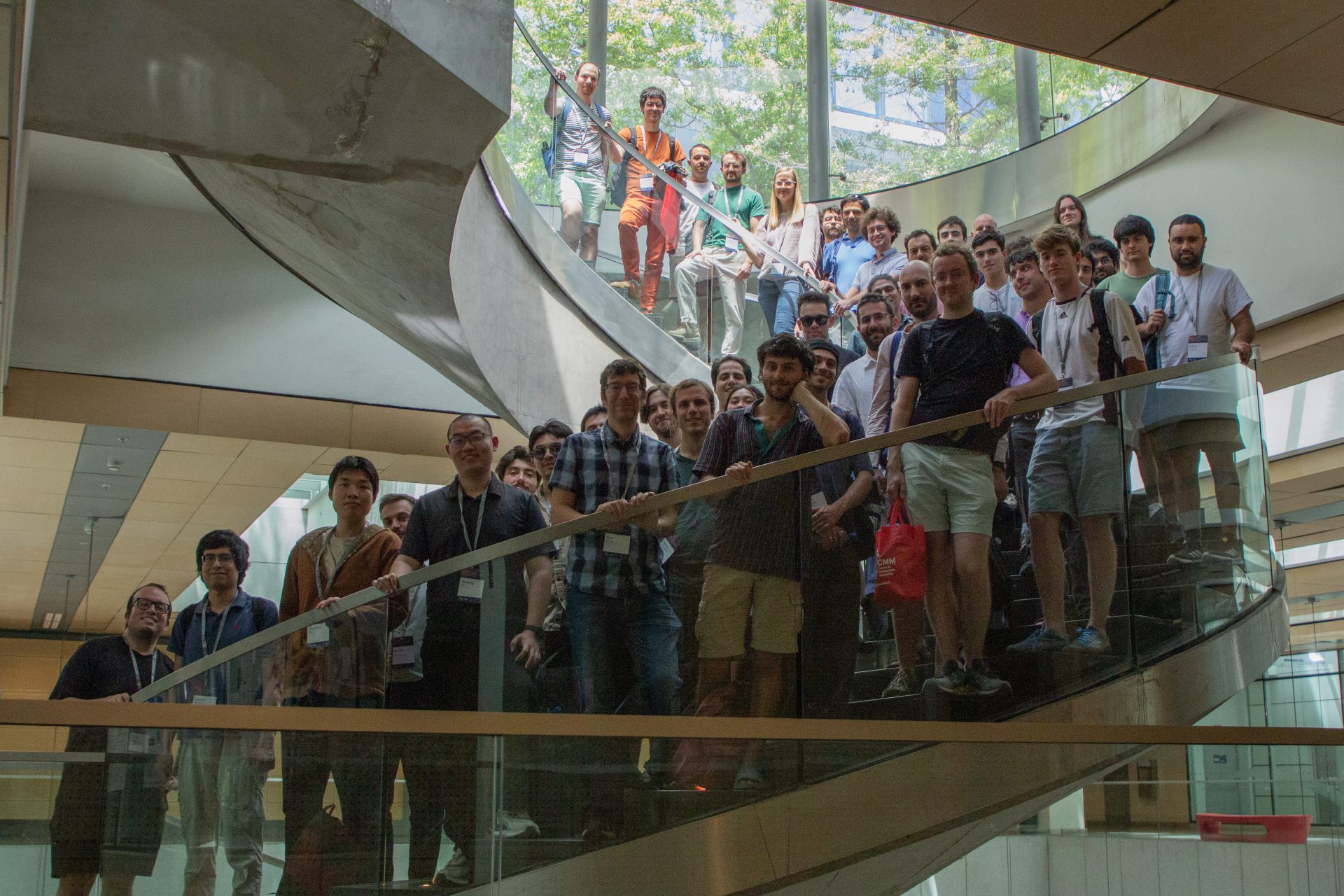
Organized by the Center for Mathematical Modeling (CMM) of the Faculty of Physical and Mathematical Sciences at the University of Chile, with support from European Research Council (ERC) funding, the workshop was held from December 1 to 12, 2025. The event further positioned Chile as a significant international hub at the interface between mathematical physics and probability theory.
Over the course of two weeks, the conference was held at the Beauchef Poniente campus, bringing together researchers from the Americas, Europe, and Asia. The central objective of the event was to present recent results on probabilistic models motivated by or originating in the study of statistical physics. Particular emphasis was placed on critical phenomena, topological phase transitions, and localization problems, with contributions showcasing techniques and findings at the intersection of probability theory, statistical mechanics, and field theory.
In this context, the conference reaffirmed CMM’s strategic role as a platform for international scientific leadership, capable of convening leading experts, fostering high-level academic exchange, and strengthening the global visibility of research conducted in Chile. Through initiatives of this kind, CMM has consolidated its position as a key actor in the development of international research networks, advanced training of human capital, and the transfer of knowledge in frontier areas of mathematics and physics.
The workshop was held within the framework of the ERC-funded VORTEX project, directed by Christophe Garban (Université Lyon 1). The project, of which CMM is a participating institution, seeks to understand how topological defects account for the Berezinskii–Kosterlitz–Thouless (BKT) phase transition. The project currently involves more than six researchers based in France and Chile, all of whom were present throughout the two-week workshop.
In this regard, Avelio Sepúlveda, Associate Researcher at CMM and co-organizer of the workshop, stated: “This activity achieved two fundamental objectives for the project: updating the technical expertise of the researchers involved and fostering collaborative networks among different actors—particularly between project members and other leading researchers in the field”.
Dr. Sepúlveda further noted: “The event provided Chilean graduate students with exposure to current research topics. At the same time, it demonstrated that the mathematics conducted in the country is of world-class standard”.
Specialized Mini-Courses
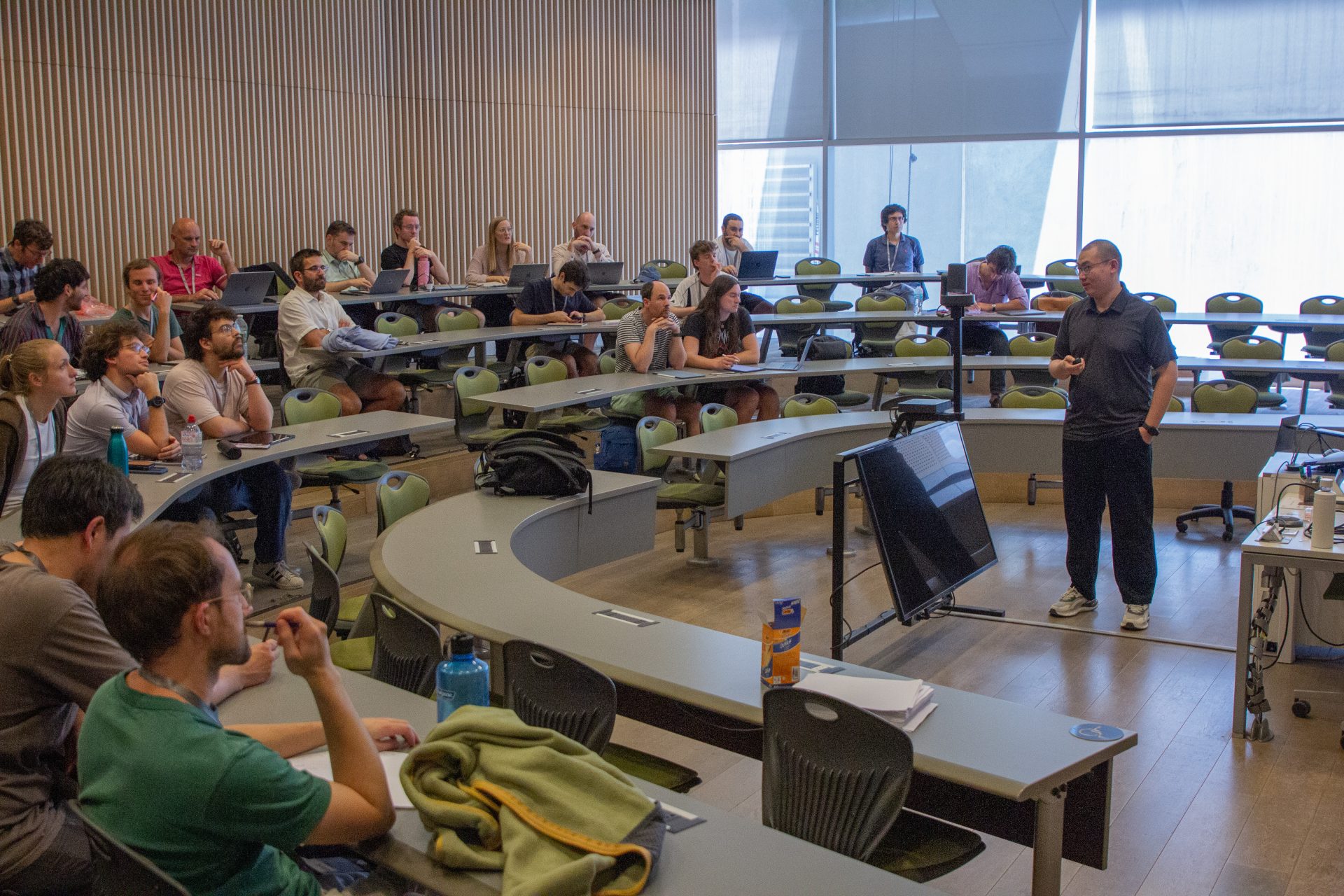
A central component of the conference was a series of advanced mini-courses delivered by leading scholars from internationally renowned institutions. These courses were designed to provide in-depth exploration of foundational concepts and recent breakthroughs in the field.
Marcin Lis (TU Wien) delivered the course “The Ising Magnetization Field and the Gaussian Free Field,” presenting a novel representation of the Ising model based on double random currents, together with a natural coupling between the Ising magnetization field and the Gaussian Free Field (GFF). This framework offers a renewed perspective on the bosonization of the Ising model and opens promising directions for related systems, including the Ashkin–Teller model.
Malin Palö Forsström (University of Gothenburg) presented “An Introduction to Lattice Gauge Theories and Equivalent Models,” introducing gauge theories on graphs as natural generalizations of classical spin systems. Through duality methods, the course examined equivalent formulations that shed light on fundamental structural properties of gauge theories, both with and without external fields.
Ron Peled (University of Maryland) led the mini-course “Magnetization in the Random-Field Ising and XY Models,” focusing on magnetization phenomena in disordered spin systems. The course highlighted recent rigorous results establishing exponential decay of correlations in two dimensions and discussed major open problems in the random-field XY model.
From Durham University, Tyler Helmuth delivered “The Arboreal Gas and Fermionic Field Theory,” exploring the arboreal gas model—random forests on graphs—and its reformulation as a fermionic field theory. The course introduced Grassmann calculus and connections to nonlinear O(N)-type models.
Piet Lammers (Sorbonne Université) presented “GFF Convergence of the Six-Vertex Model for −1 ≤ Δ ≤ −1/2,” detailing recent results demonstrating convergence of the six-vertex model to the Gaussian Free Field in this regime, with implications for related critical models such as the random-cluster and Ashkin–Teller models.
Finally, Jeanne Boursier (Columbia University) delivered “Phase Transitions for the 2D Two-Component Coulomb Gas,” offering a rigorous treatment of the two-dimensional two-component Coulomb gas. Her work addressed an infinite sequence of phase transitions accumulating at the critical temperature associated with the BKT transition, based on a novel framework combining adaptive cluster expansions and refined electrostatic estimates.
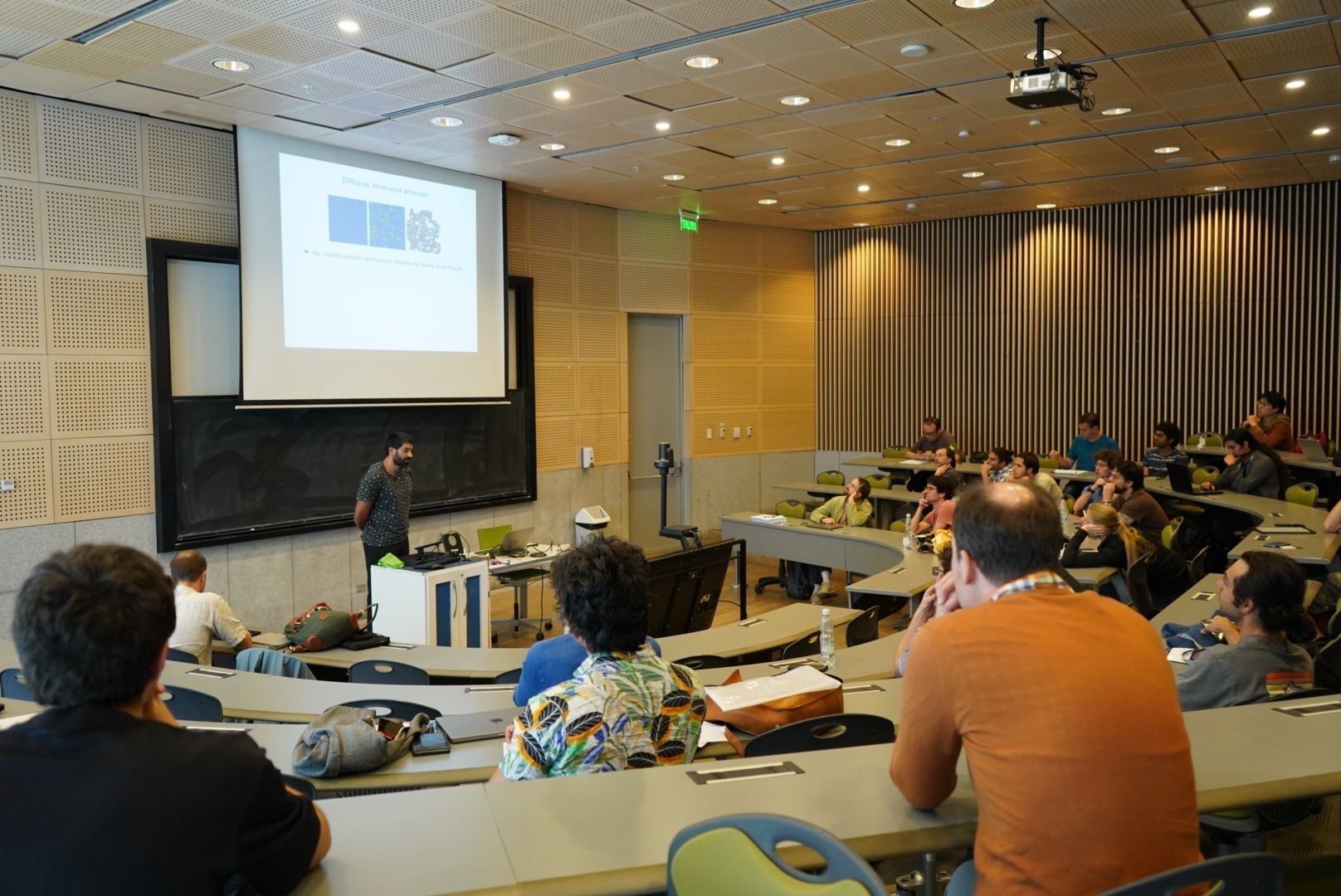
Christophe Garban, Professor at Université Lyon 1 and co-organizer of the workshop, noted: “Over the course of two weeks, the meeting addressed topics in probability theory and mathematical physics, with particular emphasis on models arising in superfluid systems and related phenomena, notably those associated with Berezinskii–Kosterlitz–Thouless (BKT) vortex dynamics”.
Philémon Borderau, doctoral candidate at the École Polytechnique Fédérale de Lausanne (EPFL), underscored the thematic breadth of the event and the value of the academic exchange: “The conference has been highly engaging. My current research focuses on objects more closely related to continuous probabilistic models. Many of the talks, however, were rooted in discrete frameworks, and I learned a great deal. I will return to Switzerland with many new ideas. I am very grateful to the organizers of the event”.
Organizing Committee and International Participation
The organizing committee consisted of Christophe Garban (Université Lyon 1) and Avelio Sepúlveda, researcher at CMM and faculty member of the Department of Mathematics (DIM) at the University of Chile.
The conference brought together researchers from an extensive network of leading institutions worldwide, including the University of Chile, Princeton University, TU Wien, University of California San Diego, École Polytechnique Fédérale de Lausanne (EPFL), University of Pennsylvania, Columbia University, Université Lyon 1, Universidade de São Paulo, Sorbonne Université, University of Münster, Pontificia Universidad Católica de Chile, University of Innsbruck, Northeastern University, University of Vienna, University of Durham, KTH Royal Institute of Technology, IMPA, Université de Paris, Université Paris Cité (formerly Paris V), UCLA, the Courant Institute of Mathematical Sciences, University of Geneva, Chalmers University of Technology, University of Bonn, Tel Aviv University, Aix-Marseille Université, Universidad Andrés Bello (UNAB), Northwestern University, and the University of Cologne, among others.
The event was supported by CMM through its ANID Basal Project FB210005, reaffirming the Center’s commitment to research excellence and its leadership in organizing high-impact international scientific gatherings.
Written by Cintia Beltrán, CMM Communications
Images courtesy of the Department of Mathematics (DIM) and CMM
