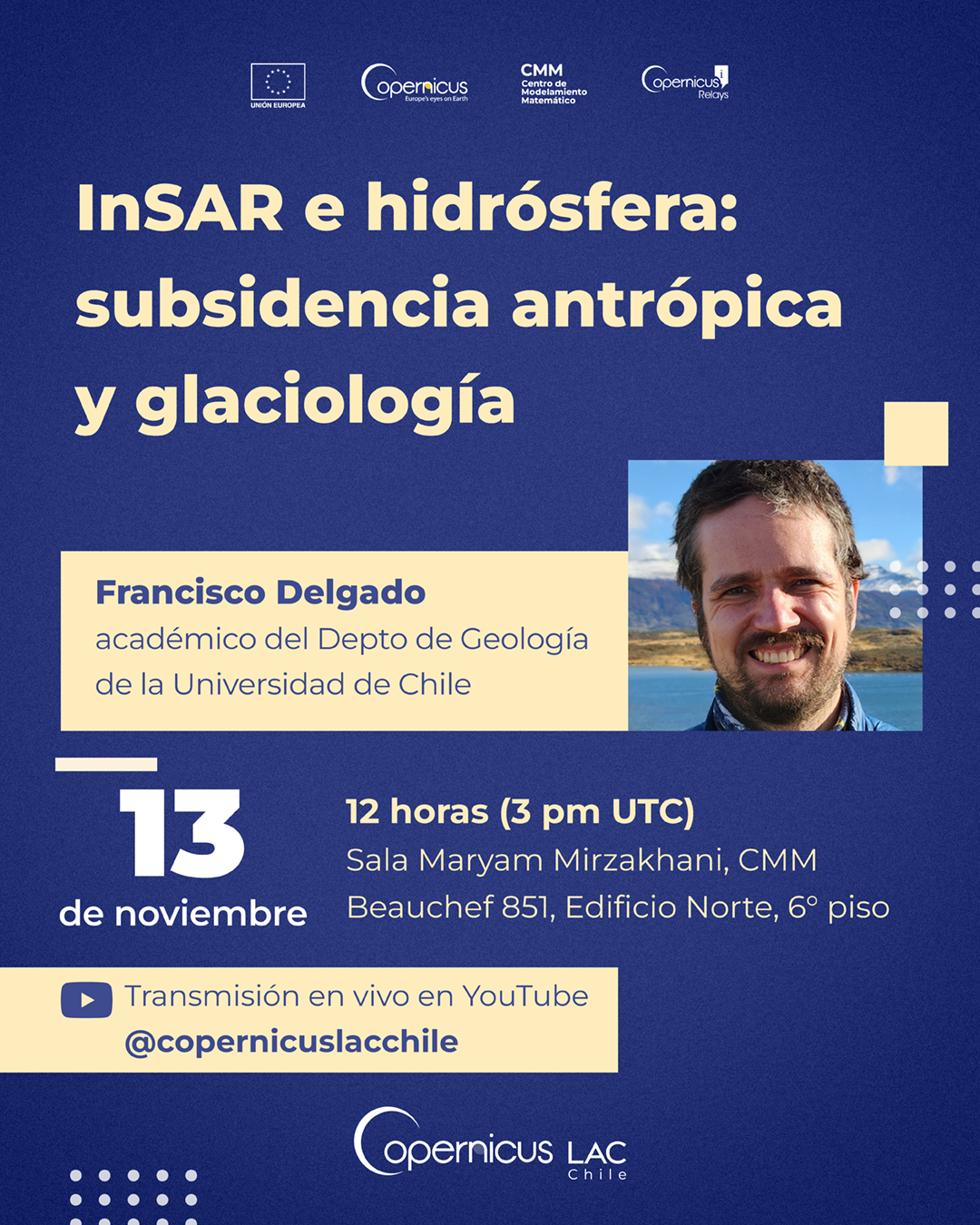
InSAR and the hydrosphere: anthropogenic subsidence and glaciology
Abstract: In this new Copernicus Seminar, Francisco Delgado, a geologist with a Master of Science degree specializing in geophysics from the University of Chile and a PhD in geological sciences from Cornell University, will be presenting. He completed part of his doctoral thesis at theJet Propulsion Laboratory (JPL) of NASA/Caltech, was a NASA doctoral fellow, and a postdoctoral researcher at the French National Centre for Space Studies (CNES).
He is currently an assistant professor in the Department of Geology at the University of Chile, and his research focuses on the use of radar interferometry to study processes associated with geological hazards (volcanoes, earthquakes, and active faults) and terrestrial changes (glaciers, anthropogenic subsidence). He also has active research projects with various space agencies and satellite companies, such as the National Commission for Space Activities (CONAE), the Japan Aerospace Exploration Agency (JAXA), and HISDESAT.
During his presentation, he will address two issues related to the dynamics of the Earth’s hydrosphere. First, he will discuss the areas and rates of subsidence in Chile related to groundwater extraction, using the Atacama Salt Flat and Central Chile (Valparaíso, Metropolitan, and O’Higgins regions) as case studies, and referencing time series data from the Sentinel-1A/B, SAOCOM-1A/B, and PAZ missions.
Secondly, it will address how the Patagonian Ice Fields move in response to climate change, using a unique set of interferograms of the one-day tandem phases of ERS-1/2 in 1996 and Sentinel-1C/D in 2026, separated by 30 years.
It will also show the potential and limitations of SAOCOM-1A/B and NISAR for glaciology.
Live stream on YouTube: https://go.cmm.
Speaker: Francisco Delgado, lecturer in the Department of Geology at the University of Chile