


 Noticias en español
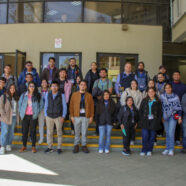
During a full week, EPANUM 2024 was held, an event in which the research topics of Numerical Analysis developed in four graduate programs in the area were disseminated.
Panama, Ecuador and Colombia are some of the countries from which the 32 participants of the event ‘Spring School in Numerical Analysis of Partial Differential Equations – EPANUM 2024‘, organized by researchers from the Center for Mathematical Modeling (CMM) of the University of Chile and also from the Center for Research in Mathematical Engineering, CI²MA, of the University of Concepción, came from.
The objective of this meeting was to inform Chilean and foreign students about the line of Numerical Analysis of Partial Differential Equations (NA of PDEs) that is developed in the graduate programs in Applied Mathematics taught by the three main universities of the regions of Biobío and Ñuble, of which the organizers are academics: Universidad de Concepción (UdeC), Universidad del Bío-Bío (UBB) and Universidad Católica de la Santísima Concepción (UCSC).
The activities took place from Wednesday, October 2 to Wednesday, October 9 at the campuses of the three universities in the peninsula and included courses and talks on the main topics and lines of research being developed in the respective programs.
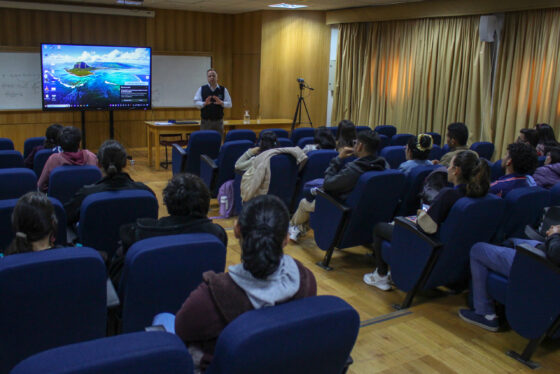
“I consider it a great success that the call to participate in the event, despite the short deadlines, had a good response and finally we had the presence of 20 Latin American students, 13 of whom requested to be interviewed on the last day of the event with a view to the process of application and insertion in one of the specific programs”, commented Raimund Bürger, director of the PhD Program in Applied Sciences with mention in Mathematical Engineering and president of the organizing committee of the meeting, which was also integrated by Jessika Camaño Valenzuela (UCSC), David Mora Herrera (UBB) and Manuel Solano Palma (UdeC).
One of those attending the event was Christopher López Ortega, an electronics and telecommunications engineer from the Technological University of Panama, where he is currently pursuing a master’s degree in Mathematics. “I am in the second semester of my master’s degree, we were contacted by Dr. Yolanda Vásquez, who was a student of Dr. Bürger,” he explained.
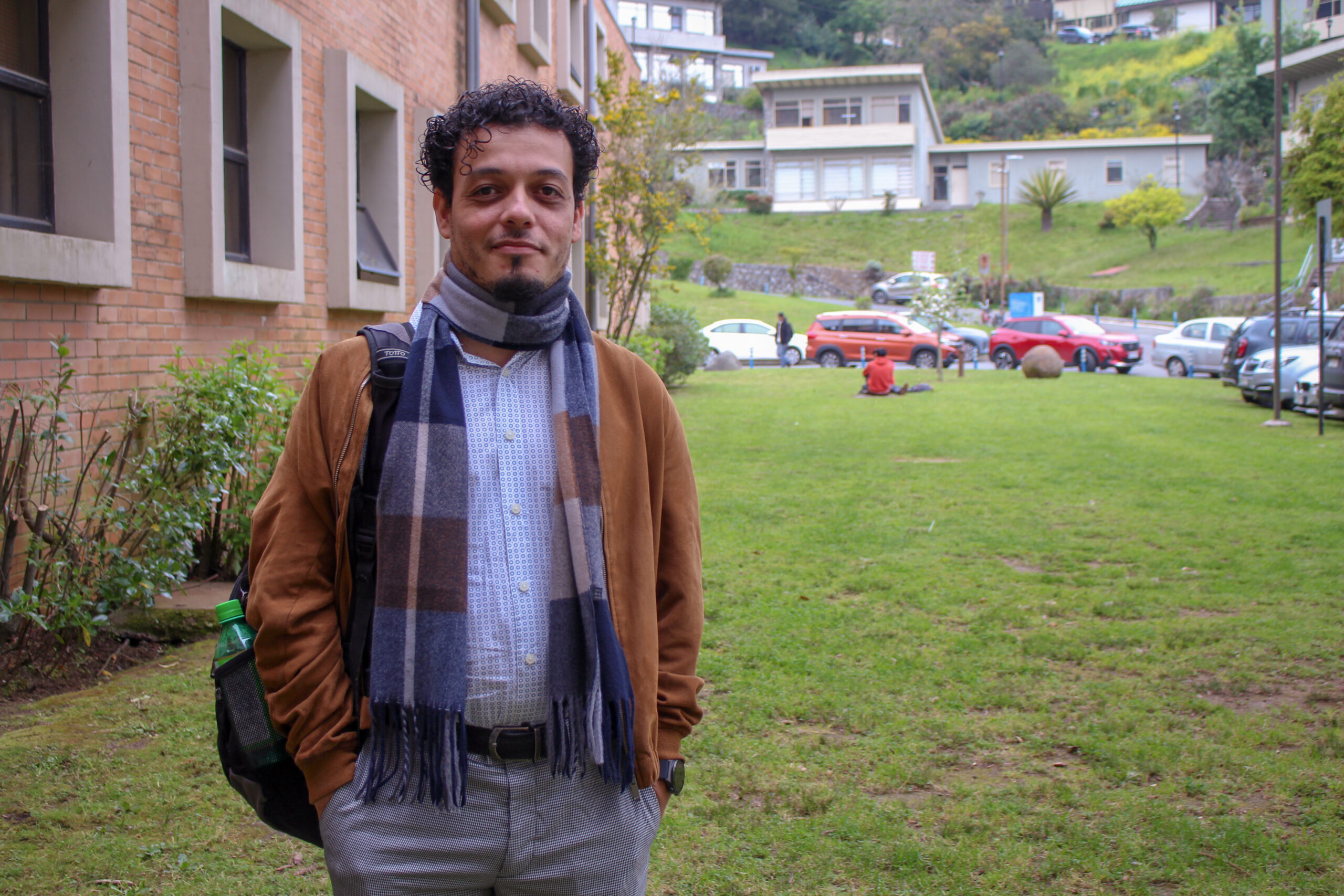
For Christopher, EPANUM was a “very enriching experience, especially because of the courses. In fact, there are concepts that I came to understand much better here in the short courses, even though they were quite summarized to give them in a week, compared to the courses I had already taken there.
“The didactics they use here is very good,” he said. “I also liked the examples visually very much, as well as the part when they implemented the software, both with Dr. Anaya and Dr. Villada and Jesús Vellojín who was explaining different types of software to better visualize the process of meshing and division, because, at least for us in Panama, we are currently working with Python and MathLab and, to tell the truth, these softwares are a much greater advance.”
And, about some of the lessons learned from EPANUM, Christopher highlights “the topic of the variational formulation, the way they explained it made my head explode and made me understand many more things”.
Meanwhile, Nelly Abril Buenaño is a mathematical engineer at the Universidad Central del Ecuador. “Through the university’s networks I found out about this year’s EPANUM school, which I attended for the whole week and it was an excellent event. We learned a lot about differential equations, mathematical modeling, simulation. The professors have an excellent level and, at the end, they gave us a diagnostic exam, which I also thought was a very good idea to finish the school”.

“Currently, I am finishing my master’s degree in Applied Statistics, which I will finish in February or March of next year, also at the Central University, and the professors told me that with that I can apply for a doctorate at the University of Biobío, which is what I am interested in”.
“I really liked the talk that closed the school, which was about epidemiology and the mathematical model of COVID, it was very interesting and shows that, as we know, mathematics is applicable in every career”, added Nelly. “And I also liked the one about the mechanical engineer who simulated all the parts of the tools for uses in mining.”
The programs promoted at EPANUM 2024 were:
- Ph.D. in Applied Sciences with mention in Mathematical Engineering, UdeC.
- Master’s Degree in Applied Mathematics, UBB
- Doctorate in Applied Mathematics, UBB
- Master’s Degree in Applied Mathematics, UCSC
From the UBB, Dr. David Mora Herrera commented that “several students, with a very balanced participation between men and women, were recommended by professors who are part of existing collaborative networks with Latin American universities. This helps the internationalization of our programs” and highlighted that ‘a session was coordinated where the students themselves presented their work, which was highly valued by the participants’.
“We were able to strengthen inter-university cooperation in Numerical Analysis between our universities. It was possible to make our research and recent work visible to all the participants of the School”, added Mora.
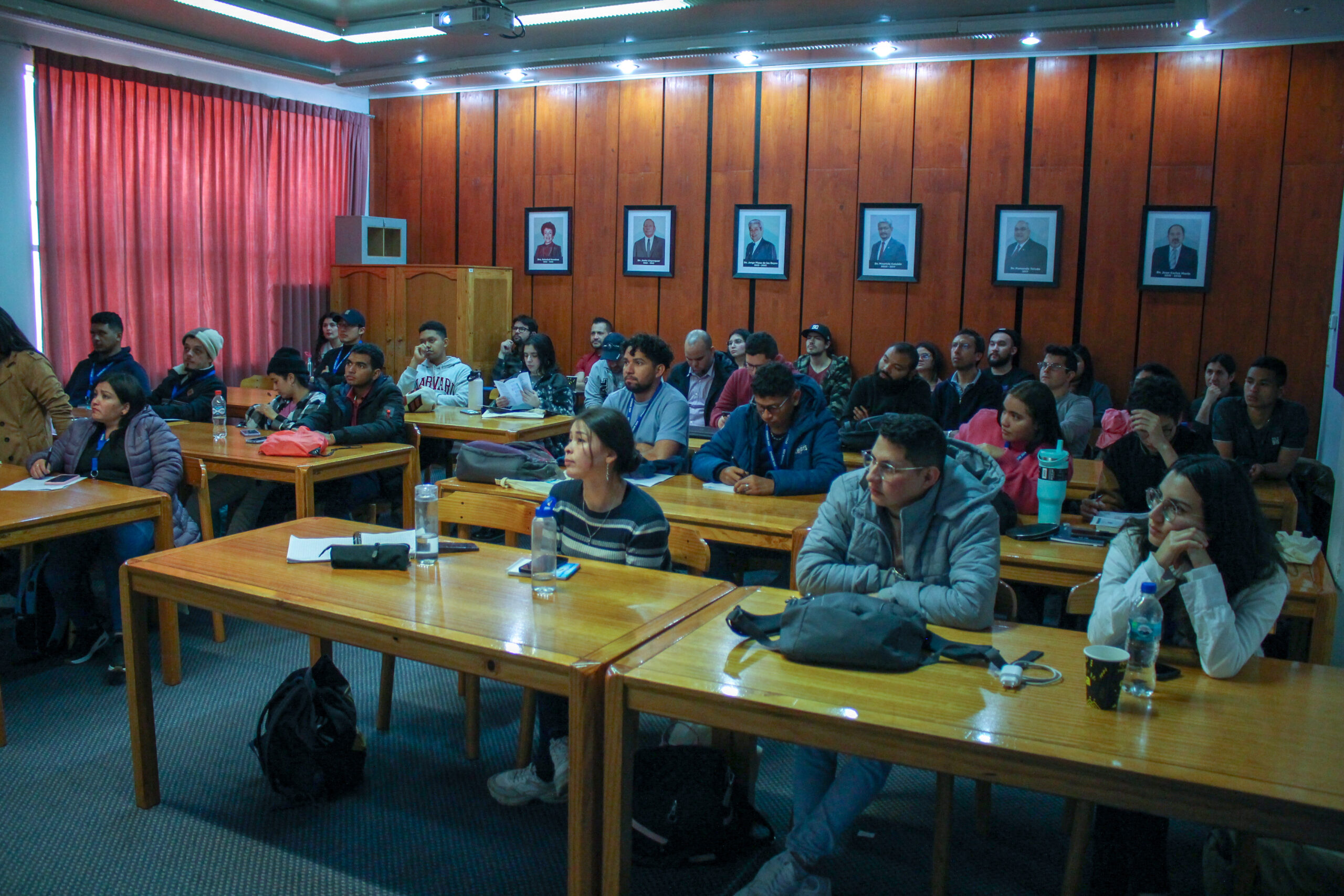
Dr. Jessika Camaño Valenzuela of UCSC said that “the EPANUM turned out quite well. The students who attended the school had access during these days to a brushstroke of the topics we work on in Concepción, and at the same time they were able to learn about the programs we offer. During the course I gave at EPANUM, I was able to observe the interest and participation of the students, which made me very happy and satisfied with the work done”.
In addition to the CMM (Basal project FB210005), the event also had the support of the Mathematical Engineering Research Center, CI²MA, the Faculty of Physical and Mathematical Sciences, and the Center for Water Resources for Agriculture and Mining, CRHIAM (project ANID/FONDAP/15130015 and ANID/FONDAP/1523A0001), both from UdeC, and the National Agency for Research and Development (ANID) Ring projects ACT210030 and ACT210087.
“Thanks to the contribution of these initiatives, a visible and important contribution has been made to increase enrollment, particularly of foreigners, in the aforementioned graduate programs, especially the UdeC program,” commented Dr. Bürger.
By Iván R. Tobar Bocaz, journalist of the Center for Mathematical Modeling, Concepción.
Posted on Oct 11, 2024 in News
