

With an extensive track record of international collaboration, UdeC academic Fabián Flores Bazán has been a member of the Working Group on Generalized Convexity (WGGC) since 2006, which held its fourteenth world meeting a few weeks ago.
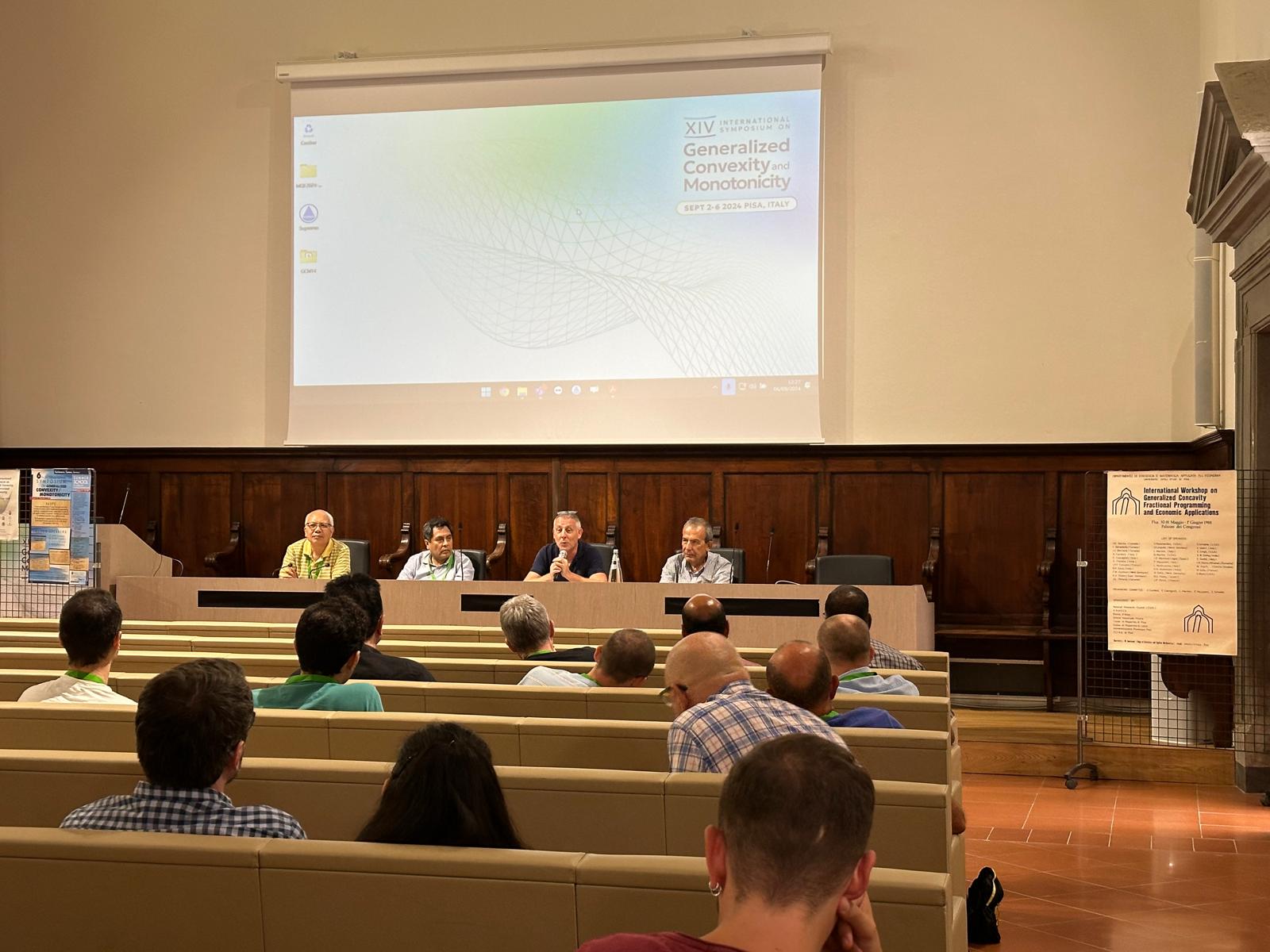
In early September, the 14th International Symposium on Generalized Convexity and Monotonicity, an event organized every three years by the Working Group on Generalized Convexity (WGGC), was held at the Università di Pisa, in Italy.
On this occasion, Dr. Fabián Flores Bazán, academic of the Universidad de Concepción (UdeC) and researcher of the Center for Mathematical Modeling (CMM) of the U. de Chile, participated in the scientific committee of the event, was in charge of one of the talks and, in addition, was elected to chair the WGGC for the period 2025-2028 and, therefore, head the organization of the fifteenth international symposium, through the institution selected by the WGGC, among those applicants for this purpose.
World-class optimization
“The WGGC”, explains Flores, ”is an interdisciplinary group that brings together more than five hundred mathematicians or professionals( from more than 50 countries) in related areas, whose common interest, and so it was conceived at the beginning, is to deal with problems in mathematical optimization without hypothesis of convexity (on the functions involved) or monotonicity (on their derivatives or operators). Currently, I am one of the seven members of its scientific committee, which is renewed or elected every three years by electronic voting”.
“The scientific committee (SC), through the topics presented by the select group of plenary speakers at the triennial event, tries to delineate in some way the work topics in the area of Generalized Convexity and its consequences in Optimization, as it is one of the most important branches of Applied Mathematics; but also in those disciplines where the idea of generalized convexity arises naturally, such as economics, for example.
“In addition, the CC is responsible for openly inviting colleagues and institutions to submit proposals of interest in organizing the triennial event, and to decide which one will finally organize it”, explains the professor of the Department of Mathematical Engineering of the UdeC.
.

Prior to Italy, some of the host countries have been Canada, France, Taiwan, Romania, Greece, Peru, Hungary and Brazil. “The scientific committee has tried to represent geographically the places where this line is developed”. In this sense, the researcher emphasizes that “in Chile, there are a good number of specialists who have been trained at the Universidad de Concepción, currently located in different parts of the country such as Iquique, Valdivia, Arica and Temuco. We hope that this community will continue to grow”.
The researcher is also one of the guest-editors of the special issue to be published by the Journal of Optimization Theory and Applications with, Flores explains, “articles related to the subject in question, following the demanding review process of the journal, where originality and relevance will be the main criteria for their selection”.
From the theoretical to the practical
Regarding the subject matter of the symposium, Dr. Flores pointed out that “the topics addressed are quite broad, although always around optimization problems under ‘generalized convexity’ conditions. Problems ranging from mathematical programming, continuous or discrete, to the study of optimal control problems; both from the analytical point of view, as well as numerical methods. Special interest has been highlighted by presenting new formulations of Nash equilibrium problems, which model concrete problems, for example in the electricity market”. The lack of classical convexity in some application problems has led to the development or creation of new mathematical tools in variational analysis, asymptotic analysis, non-smooth analysis, some of them with utility in other fields such as Partial Differential Equations”.
“There were also talks focused on presenting models and solution alternatives in the field of packing or allocation, where it is essential to propose variants of existing algorithms that are more efficient in the computational process. In summary, there have been talks both of an analytical-theoretical, fundamental nature, others of a methodological nature, and also on applications where new algorithms have been presented”.
.





“The view of generalized convexity is a broad concept and allows to address recent problems that arise in applications, and where convexity in the classical sense, is not present; it is this view that has driven my research work. Basically, the problems I deal with either in the field of optimization and within the Calculus of Variations, are not convex in the standard way. Lately I have been studying non-convex quadratic functions, but suddenly, if one studies them with a certain rigor, some properties emerge that are typical of convex functions, but that had not been discovered”, Dr. Flores said.
Regarding the talk he presented at the event, the scientist explained that “I addressed a very specific class of problems involving quadratic functions that are not necessarily convex, which has several applications and correspond to problems in homogeneous optimization. Together with Felipe Opazo, a former student of ours, we obtained some algebraic conditions, under which the class of optimization problems introduced has the property of strong duality, a property that plays a very important role in the elaboration of resolution algorithms. The result obtained is still preliminary, and we are still in the process of interpretation.”
“A thorough and rigorous study was carried out, trying to extract the maximum amount of properties of the problem thanks to its quadratic structure and, thus, to visualize in greater detail the intrinsic phenomenon behind it. Their knowledge will finally allow us to identify quite reasonable conditions that will lead to the resolution of the problem,” he detailed.
By Iván R. Tobar Bocaz, journalist of Center for Mathematical Modeling, Concepción.
