


 Noticias en español

During three days, the thirty-second version of the traditional congress was held at the U. de Tarapacá.
From Wednesday, July 31 to Friday, August 2, the XXXII Congress of Mathematics Capricorn, COMCA 2024, was held at the University of Tarapacá.
This traditional annual meeting has been held since 1991 to promote the development of the different areas of mathematics and statistics in the north of Chile, being its host institutions the universities of Tarapacá, Arturo Prat, Católica del Norte, Antofagasta, Atacama and La Serena.
On this occasion, five researchers from the Center for Mathematical Modeling (CMM) of the University of Chile had various participations. They were Dr. Soledad Torres Díaz, academic from the U. de Valparaíso; Dr. Rafael Correa Fontecilla, academic from the U. de Chile; and academics from the U. del Bío-Bío Dr. Verónica Anaya Domínguez, Dr. David Mora Herrera and Dr. Pablo Venegas Tapia.
In the case of Prof. Correa, he took advantage of his stay in the north to accept two invitations to give the inaugural plenary talks at two events. The first was the WIMA (Iberoamerican Workshop on Applied Mathematics) and the second, the COMCA. On both occasions, the scientist gave himself the opportunity to make a historical review of the development of the discipline.
.
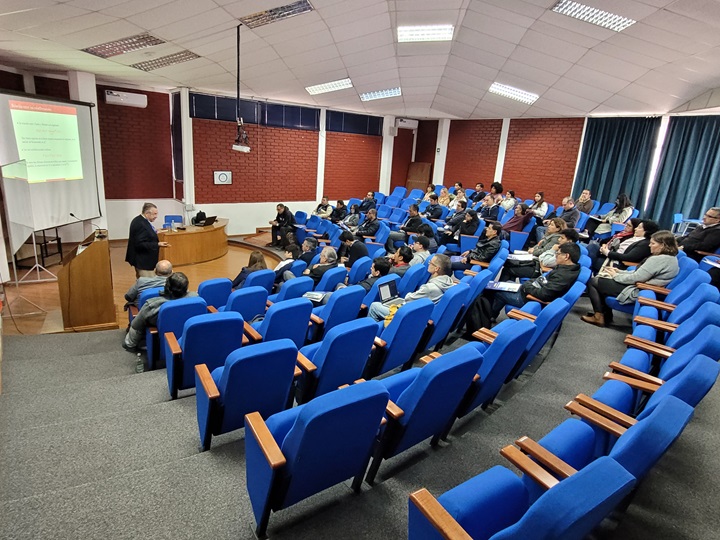
Charla del Prof. Rafael Correa en WIMA
“At WIMA,” he explained, ”I presented something more related to my research topic, which is convex analysis, I told a little of the history of a very important property that we demonstrated here at the CMM with the Optimization team some years ago, which is the relationship of a function between its convexity and the monotonicity of its subdifferential. This is a well solved problem, well known since the beginning of convex analysis, but the result was not well known when the function was defined in non-finite dimensional spaces. So, here we managed to prove what was until then a conjecture”.
“At the inauguration of COMCA, as it is a congress for mathematicians in general, I was asked to give a talk that was somehow interesting, entertaining, understandable for mathematicians from all areas. So I gave a talk about the history of Convex Analysis, I analyzed the history from the founders of convex analysis, starting with Minkowski at the beginning of the 20th century, and then continuing with mathematicians like Moreau until reaching Rockafellar, who is a great acquaintance, a great friend of ours and who comes here every year”.
Prof. Correa explains that more than 30 years ago he participated in the second COMCA, at the same University of Tarapacá. “Some of those who were there at that time were also there now and we had the opportunity to reminisce”.
Meanwhile, Prof. Soledad Torres commented that, together with her colleague Marco Corgini from the U. de La Serena, she has been attending several versions of the congress, participating in the organization of the invited session on ‘Stochastic Analysis and Mathematical Physics’.
“Last year I gave one of the plenary lectures, in addition, and every year we make a call for participation and we always have several exponents who support us and contribute with their communications in the session.”
“The COMCA”, Torres emphasizes, ‘brings together the entire mathematical community of Chile around invited sessions, conferences and workshops and also includes students to present their work, and there is much collaboration from the mathematical scientific community and it is one of the few meetings of all mathematics in the country’.
Dr. Anaya, meanwhile, participated as co-organizer of the session ‘Numerical Analysis of Partial Differential Equations’, also presenting the talk ‘Mixed Finite Element Method for the Brinkman-Forchheimer equations‘.
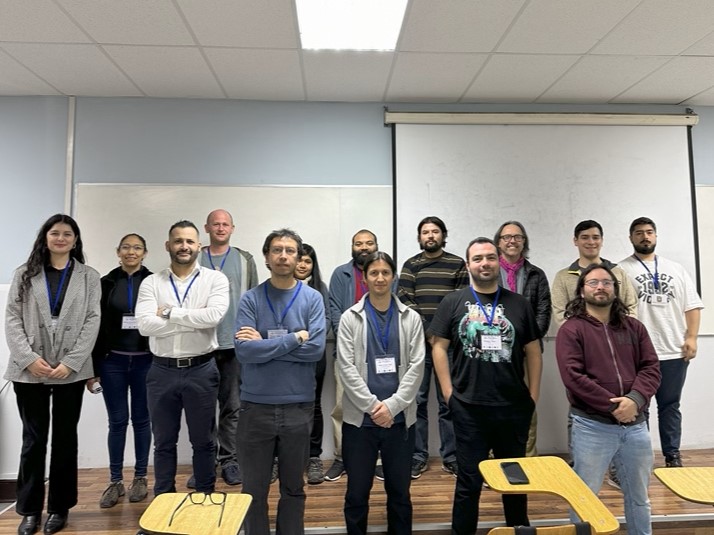
Participantes de la sesión de ‘Análisis Numérico de Ecuaciones Diferenciales Parciales’
“Of the fourteen invited sessions of the congress, ours was the largest, since we had 14 speakers. It was an excellent opportunity to present our research and to learn about activities developed by professors and students from other universities,” said the alternate director of the DSALT Ring Project (ACT 210087).
Dr. Venegas presented the talk ‘Mathematical and numerical analysis of an axisymmetric thermoelectrical problem‘ which, he explained, is the result of his collaboration with his colleagues Bibiana López Rodríguez from the U. Nacional de Colombia, Dolores Gómez and Pilar Salgado from the U. de Santiago de Compostela, Spain. “In particular, Bibiana completed a one-month stay in 2023 and 2024, funded by the MWC Basal project, in which we advanced this and other work.”
For his part, Dr. Mora participated as a speaker in the session co-organized by Prof. Anaya presenting ‘A stream virtual element discretization for the Navier-Stokes equations‘ which, he explains, “arose as a continuation of Alberth Silgado’s thesis work, and in the framework of the MWC DSALT and Basal projects.”
“The works presented by colleagues from PUC, PUCV, UTFSM universities in the session allow us to visualize some collaborations in topics related to fluid problems and in particular, to desalination phenomena”, added Mora.
By Iván R. Tobar Bocaz, journalist of the Mathematical Modeling Center, Concepción.
Posted on Aug 23, 2024 in News
