


 Noticias en español
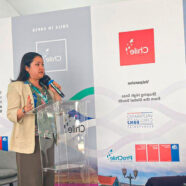
At this Biodiversity Summit, the Franco-Chilean project led by Alejandro Maass at CMM and developed in collaboration with the Tara Ocean Foundation and the University of Nantes, demonstrated how the integration of mathematical modeling, systems biology, and remote sensing enables monitoring of ocean microorganism diversity and functionality.
Within the framework of COP16 Peace with Nature held in Cali, Colombia, from October 25 to November 1, the Tara Ocean Foundation and the Center for Mathematical Modeling (CMM) of the University of Chile organized a side event: “New ideas based on omics sciences, mathematical modeling, and remote sensing for ocean conservation tools.”
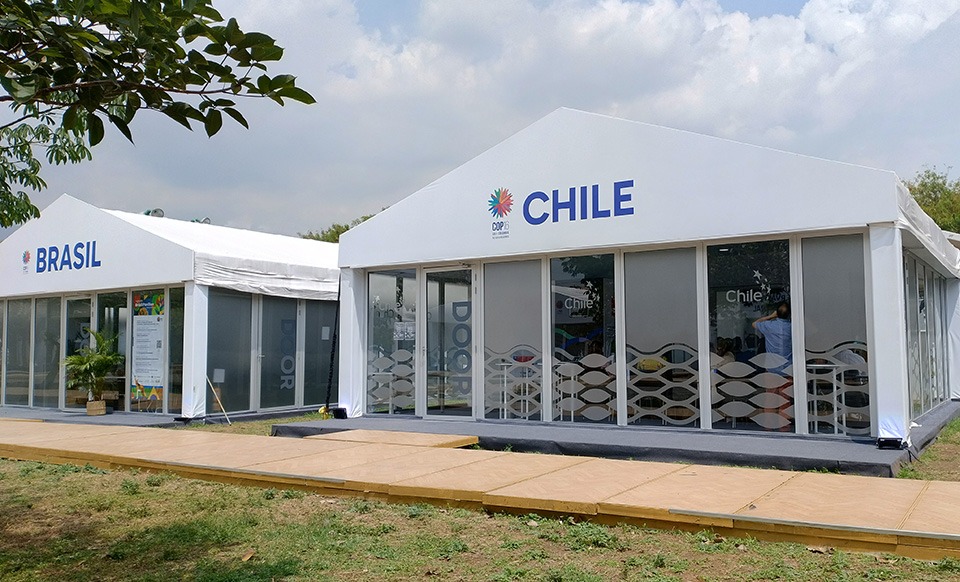
Chile Pavillion at COP16 Colombia
The meeting, held on October 29 in the Chile Pavilion, brought together representatives of the Chilean government and France’s scientific funding agencies, such as the French Global Environment Facility (FFEM). A panel of young researchers from both countries also participated, presenting innovative ideas and tools for ocean conservation.
Senator Ricardo Lagos Weber
Senator Ricardo Lagos Weber of Chile emphasized the need for science-based decisions, stating, “We need to make decisions based on science. This space is important for policymakers and for the way we make decisions in the legislative system. Ocean protection is essential, and to make informed decisions, it is necessary to collect and analyze data. We must understand the oceans, how and why they function. And, above all, we must improve the tools to achieve this.”
Following Senator Lagos, Olivier Thibault, director of the French Biodiversity Agency (OFB), highlighted collaboration with researchers “to strengthen global ocean governance,” while Stephanie Bouziges-Eschmann, Secretary General of FFEM, remarked that “it is crucial to contribute to defining high-seas biodiversity areas and reducing ocean pollution by supporting knowledge acquisition, capacity building, and partnerships.”
KOPAs Project
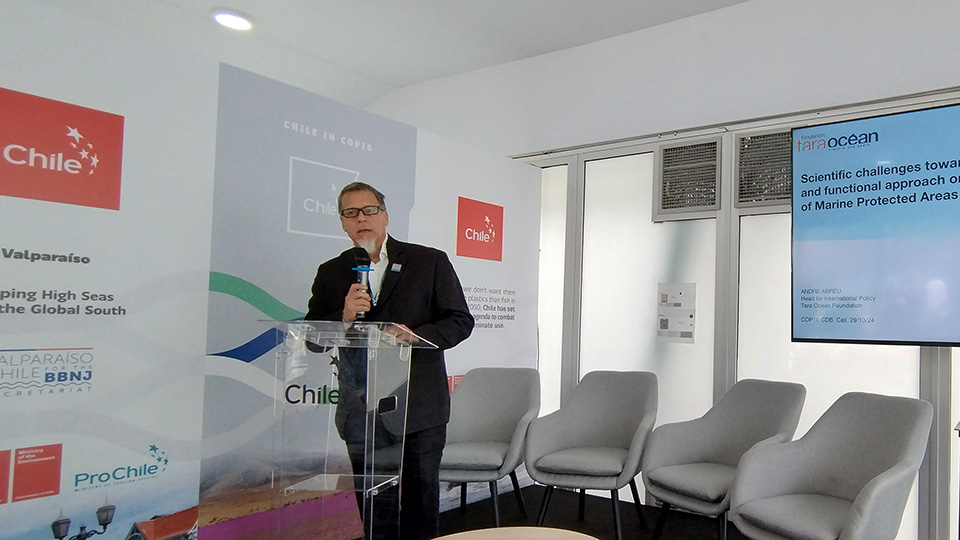
André Abreu, Head of International Policy at the Tara Ocean Foundation, presented a talk on “the need to innovate in scientific tools for marine conservation,” stating, “Historically, ocean conservation and marine policies have focused on species protection. In the 1970s, Greenpeace and the entire marine conservation community primarily focused on charismatic megafauna like sharks, whales, and turtles. From the 1970s to now, the ocean microbiome and plankton have been largely invisible.”
André Abreu, Head of International Policy at the Tara Ocean Foundation.
Abreu shared current ocean policy tools—most of which use a taxonomic/phylogenetic approach—such as EBSAs (Ecological and Biologically Significant Areas), OHI (Ocean Health Index), PCI (Conservation Priority Index), and VMEs (Vulnerable Marine Ecosystems), emphasizing that “DNA sequencing and omics sciences, particularly systems biology, are bringing new and functional approaches to marine life, allowing us to better understand impacts and make more precise predictions to adapt.” Examples included the Biocean5D project, which integrates social sciences, nature valuation, and functional marine diversity, and the PlanktECO project with its KOPAs tool (Key Ocean Planktonic Areas).
Regarding KOPAs, he explained that the project is focused on “building methodologies and metrics to inform decision-makers on where ecosystem services are provided and where it is most essential for marine life and human societies, as well as the planet as a whole.”
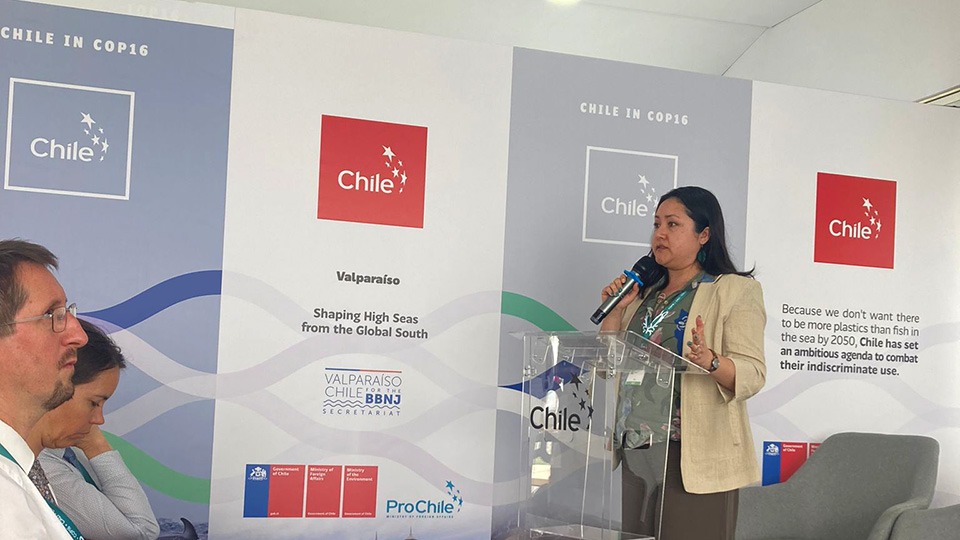
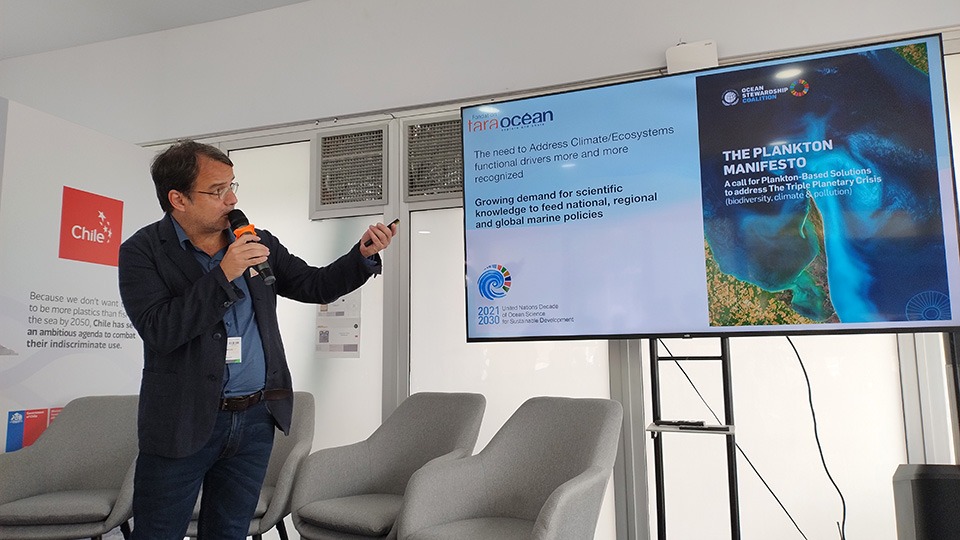
Laura Jiménez, researcher at CMM Climate and Biodiversity group.
CMM researcher Laura Jiménez, part of the Climate and Biodiversity group and the CMM-CNRS chair, presented KOPAs as a collaborative effort between Chile and France. She emphasized, “The marine microbiome is the planet’s largest ecosystem and forms the basis of all marine life. It provides three essential ecosystem services: it absorbs atmospheric carbon, regulates and connects different ocean regions, and serves as the foundation for all marine food chains. These services are impacted by human activities like pollution and climate change,” she noted.
“To better understand and predict the marine microbiome’s response to climate stressors, we are developing a new concept for tracking Key Ocean Planktonic Areas (KOPAs). This project aims to build methodology and metrics to identify where oceans and microscopic life provide essential services. We are using mathematical modeling and advances in machine learning, artificial intelligence, and remote sensing to combine information from both genomic and satellite data,” Jiménez said.
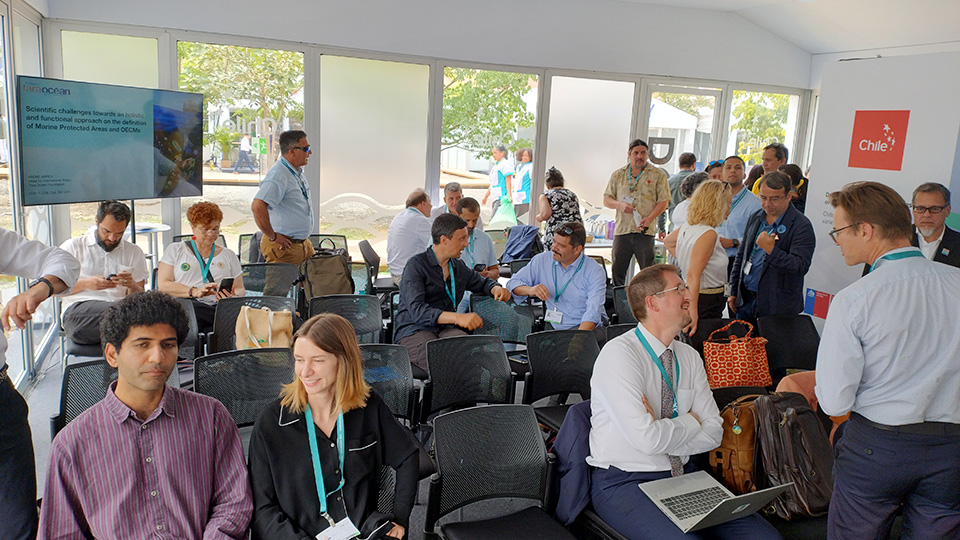
Jiménez further explained, “Our goal is to develop tools that help us quantify not only the diversity and distribution of marine microorganisms but also to assess how climate change and human disturbances may impact ecosystem services provided by the marine microbiome. The water samples are processed to obtain genomic data of the marine microbiome, followed by various omics sciences and metagenomics techniques to build a comprehensive database with functional descriptions, taxonomic composition, and observed chemical parameters. This information is organized into matrices to establish mathematical relationships between functions and the environment through machine learning and artificial intelligence.”
“We propose to integrate omics, environmental, and satellite data into a mathematical model capturing functional traits and their effects on the three essential ecosystem services provided by the marine microbiome. KOPAs is a first step towards creating mechanisms to protect marine areas and manage marine biodiversity. It could become a vital tool for decision-makers in managing biodiversity in the high seas and provide scientifically based references for establishing marine protected areas,” she concluded.
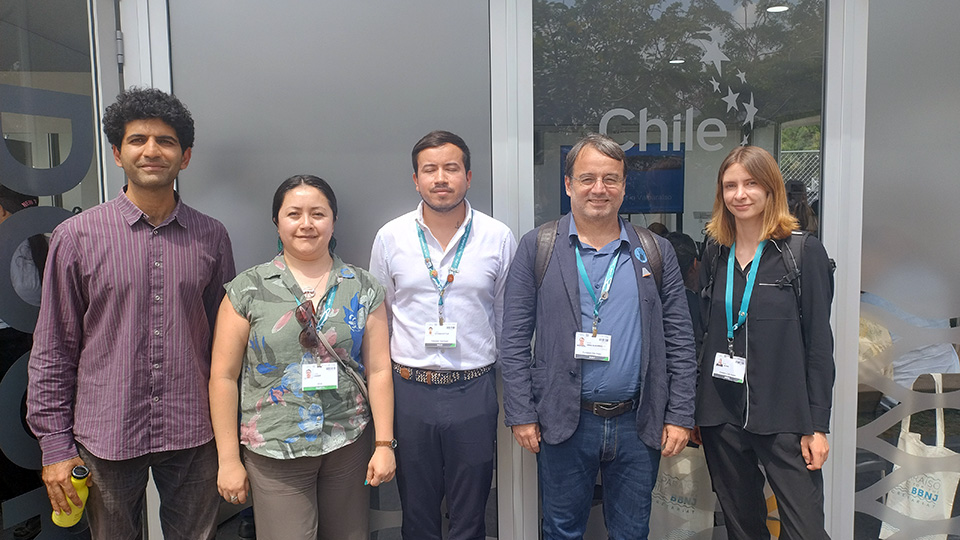
Subsequently, researchers from the French National Centre for Scientific Research (CNRS), the École Normale Supérieure (ENS) in Paris, and the Jean Nicod Institute, Umer Gurchani, Julián Esteban Cantillo, and Eva Wanek, discussed the importance of focusing on functional traits for ocean conservation, the effectiveness of ocean conservation strategies, and the economic valuation of coastal and marine ecosystem services, respectively.
Chile-France Collaboration
Alejandro Maass, director of International Relations at CMM and CNRS Fellow Ambassador, highlighted the extensive collaboration with France on ocean issues: “A milestone was the TARA schooner expedition along Chile’s coast in 2021, in partnership with the CEODOS consortium, led by the CMM of the University of Chile—CNRS’s first international unit—and the COPAS center at the University of Concepción. Its findings are invaluable for studying biological pumps in the Southern Hemisphere.”
“A highly relevant example of the implications of this expedition is the established collaboration between both countries on ocean environmental issues through the PlanktEco project, funded by the French Global Environment Facility (FFEM). This project involves the Tara Ocean Foundation (France), the CMM of the University of Chile, the COPAS center at the University of Concepción, the ENS in Paris, and various units of the CNRS. Together, they are using cutting-edge scientific tools in data science, mathematical modeling, genomics, and remote sensing for ocean monitoring and conservation,” added Maass, who is also the coordinator of the Climate and Biodiversity research line at CMM.
Watch the event in Colombia:
Center for Mathematical Modeling
The CMM is today the most active scientific research institution in mathematical modeling in Latin America. It is a center of excellence of the National Agency for Research and Development (ANID) of Chile, integrated by eight partner universities and located at the Faculty of Physical and Mathematical Sciences of the University of Chile. It is also the International Research Laboratory (IRL) #2807 of the French National Center for Scientific Research (CNRS).
Its mission is to create mathematics in response to problems in other sciences, industry and public policy. It seeks to develop science with the highest standards, excellence and rigor in areas such as data science, climate and biodiversity, education, resource management, mining and digital health.
Alonso Farías Ponce, journalist of the Center for Mathematical Modeling.
Posted on Nov 19, 2024 in News
