


 Noticias en español

Chile’s pavilion at the Universal Exposition seeks to promote the country’s astronomical leadership, combining science, art and technology, with academic activities and others focused on the general audience.
As part of Chile’s participation in the Osaka 2025 Universal Expo, the Chile Pavilion inaugurated the second thematic week of the program’s calendar, corresponding to Astronomy Week, which took place between May 19 and 25.
Under the slogan “Infinite Innovation: Exploring the limits of the universe and creativity”, this week aimed to position Chile as a world reference in astronomical research, as well as to bring people closer to astronomy through artistic cultural performances in areas such as music, theater and visual arts.
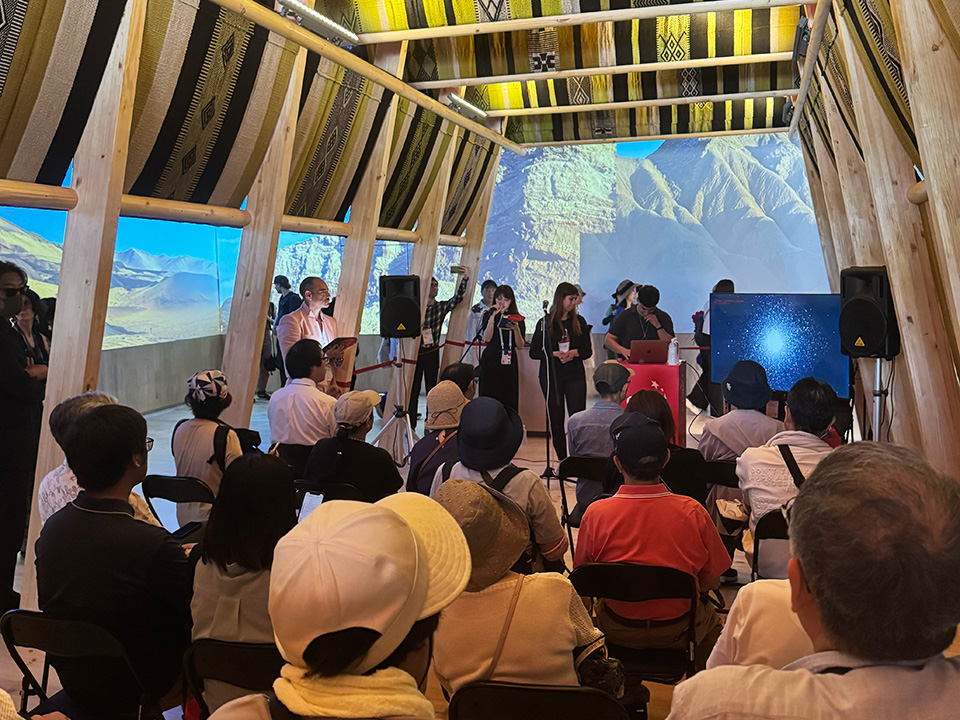
The objective of this thematic week was to highlight the exceptional quality of the Chilean skies, recognized as the clearest and most pristine on the planet, and the leading role that the country plays in observing the universe.
It is projected that Chile will host more than 50% of the world’s astronomical capacity by 2030, with observatories such as ALMA, Paranal, La Silla, Vera C. Rubin, or the TAO project. Rubin of the University of Tokyo, located on Cerro Chajnantor, in the Atacama Desert, at 5,640 meters above sea level, which is the observatory located at the highest altitude in the world.

“Astronomy is one of the most powerful expressions of Chile’s capacity to generate frontier knowledge. From the Atacama Desert, our observatories not only explore the universe, but also drive advances in artificial intelligence, medicine, communications and sustainability. This week in Osaka has been an opportunity to show the world how Chile observes the stars to transform life on Earth and how Chilean astronomy contributes to addressing global challenges such as climate change, in line with the Expo’s slogan (Designing the Future Society for Our Lives) and the ‘Saving Lives’ sector, which is where Chile’s pavilion is located,” said Paulina Nazal, Chile’s Commissioner General for Expo Osaka 2025.
The Astronomy Week program included a series of activities that sought to bring Chilean astronomy closer to the Japanese and international public.
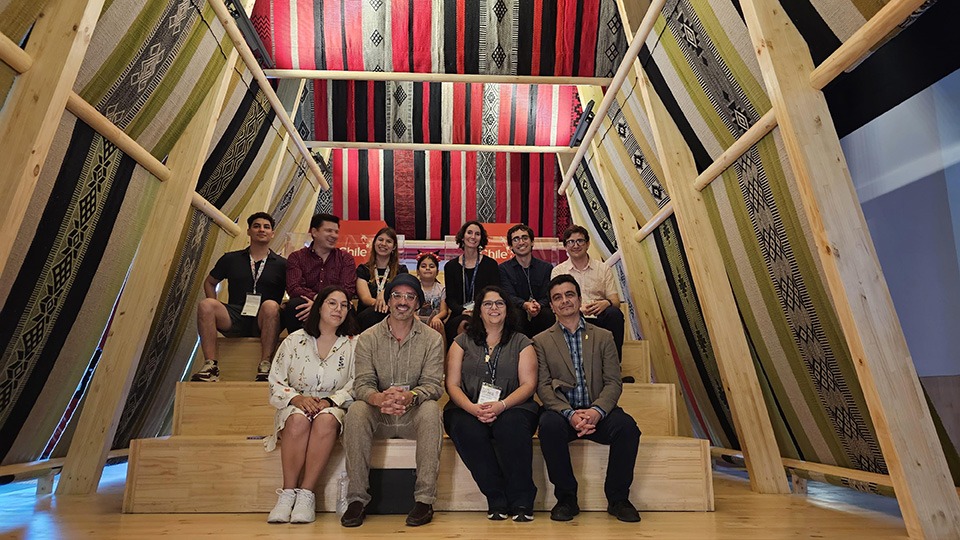
For example, the scientific infrastructure has allowed the development of an active and globally recognized astronomical community. Thus, eight scientists from the Center for Astrophysics and Related Technologies (CATA) and the Department of Astronomy of the University of Chile were part of the official delegation, who participated in panels and talks on astrophysics, astronomical instrumentation, technology transfer, innovation and the social impact of astronomical knowledge.
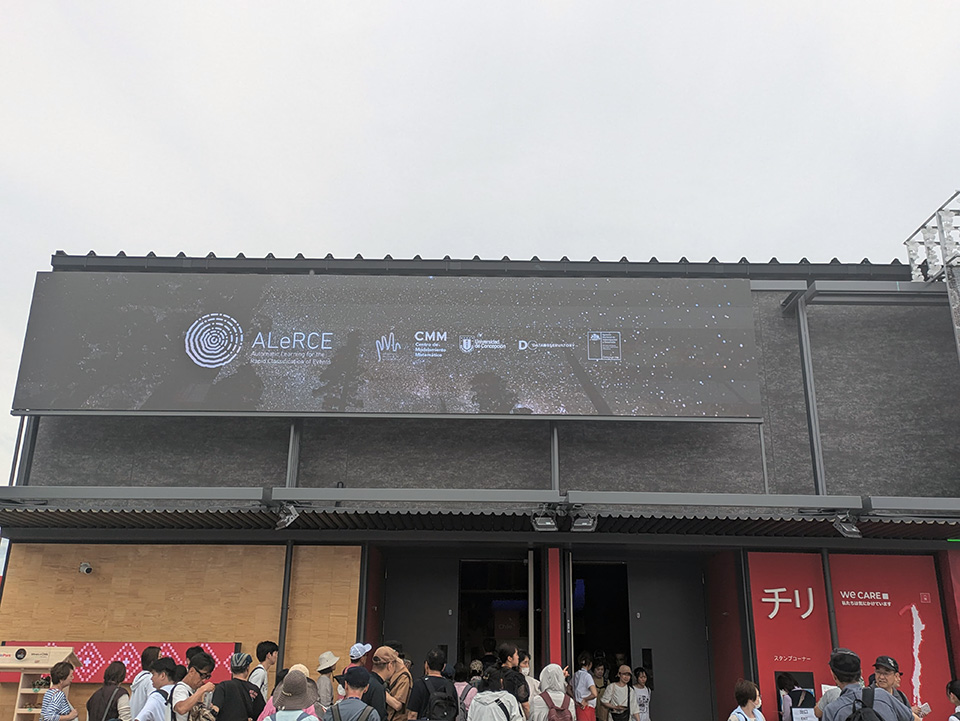
In addition, observations were made with solar telescopes, audiovisual projections and interactive experiences that allowed visitors to explore the southern sky from Japan. Among them was ALeRCE, an innovative Chilean project -driven by the Center for Mathematical Modeling (CMM), the Millennium Institute of Astrophysics (MAS), the Data Observatory (DO) and the University of Concepción- that uses artificial intelligence to detect and classify in real time transient astronomical phenomena, such as supernovae, based on millions of alerts from different observatories, positioning Chile at the forefront of data astronomy.
Cultural activities
Another important aspect is how astronomy and the exploration of the cosmos connects with different artistic expressions. To this end, three important national referents were presented at Expo Osaka.
The first is the renowned visual artist Iván Navarro, whose light installations explore the relationship between time, space and perception. In his work “Celestialand”, which was presented digitally, Navarro fused the cold of the mirror, neon lights and icy LEDs with warm eruptions of color to replicate the abstract and chimerical formations of celestial phenomena.

Also participating was the young Chilean musician Flangr, who fuses real space sounds captured by the ALMA observatory with electronic music, in a proposal he calls “astro pop”. This is the second time this band has performed at a Universal Exposition after Expo 2020 Dubai.
In addition, the company Tryo Teatro Banda presented the play “Foster”, which tells the story of the Foster Astronomical Observatory, a Chilean science heritage landmark located on Cerro San Cristóbal in Santiago.
Expo Osaka 2025, whose slogan is “Designing the Society of the Future for Our Lives”, lasts 184 days and is expected to be attended by close to 30 million people during its 6-month duration.
Among the objectives of Chile’s participation is to continue diversifying the Chilean export matrix, where Japan is positioned as the country’s third largest trading partner; to increase Japan’s investments in Chile (according to InvestChile, Japan is the main Asian investor in Chile) and to strengthen Chile’s country image in the world.
Chile’s presence at the Expo is being coordinated by the Ministry of Foreign Affairs through ProChile, an institution that has organized the programming of 20 thematic weeks in areas such as agricultural industry, astronomy, clean energy and green hydrogen, gender, mining, among others.
By ProChile Communications, Ministry of Foreign Affairs
Posted on May 25, 2025 in News
