
The Center for Mathematical Modeling (CMM) of the Faculty of Physical and Mathematical Sciences at the University of Chile, together with the French Research Institute for Digital Sciences and Technology (Inria), held the second edition of the PANDA Workshop on Tuesday, December 9. The event brought together leading international researchers in dispersive partial differential equations, nonlinear analysis, and numerical simulation.
The workshop is part of the PANDA associated team (Partial Differential Equations, Dispersive Models and Nonlinear Analysis), a collaborative project between Chilean and French institutions dedicated to the study of dispersive systems of equations and their applications, particularly in the modeling of wave propagation on the ocean surface under realistic conditions.
During this new edition, experts involved in the project presented their most recent developments in nonlinear analysis and complex mathematical models. The workshop aimed to strengthen academic exchange, showcase results obtained within the framework of this international collaboration, and foster new research directions. For the organizers, bringing together the scientific community represents a strategic opportunity to consolidate partnerships and promote cutting-edge research in applied mathematics.
In this regard, Ricardo Freire, postdoctoral researcher at the University of Chile, emphasized that “this workshop is a key milestone for the development of the PANDA project, as it allows us to bring together, in a single space, high-level researchers who are driving advances in dispersive equations and nonlinear analysis. These meetings strengthen collaboration between Chile and France, consolidate research networks, and enable us to project new lines of research that keep the CMM at the forefront of mathematical knowledge”.
María Eugenia Martínez, associate researcher at the CMM, explained that “the central objective of the project has been to provide a mathematically rigorous description of fluid behavior. Although many phenomena can be observed experimentally or described from a physical perspective, there remain processes that are not yet fully understood either by physics or mathematics. This is why it is essential for different disciplines—mathematics, physics, biology, and ecology—to advance in a coordinated manner.”
She added that “our aim is to provide a solid mathematical foundation for behaviors that are already known empirically but still lack a rigorous formulation. In this context, the results obtained focus on two main advances: first, the theoretical study of the behavior and interaction of water waves over variable bottoms in shallow fluids; and second, the numerical analysis of how a wave interacts with the seabed”.
Equations, Models, and Advanced Simulations
The workshop opened with a lecture by Professor Rafael Granero-Belinchón (University of Cantabria), who presented several partial differential equations modeling nonlinear waves, highlighting their nonlocal character and the associated mathematical challenges.
This was followed by a presentation by Prof. Raimund Bürger, principal investigator at the CMM and faculty member at the University of Concepción, who introduced a multilayer model to study the interaction between tsunamis and coastal forests. The model is based on non-hydrostatic approximations and validated using experimental and field data. This research is being carried out in collaboration with researchers from Spain and Chile.
Special Connection: 2025 Ramanujan Prize Ceremony
During the workshop, participants also connected live to follow the 2025 Ramanujan Prize Ceremony, where the award was presented to Professor Claudio Muñoz, principal investigator at the CMM and member of the workshop’s organizing committee. The prize recognizes his fundamental contributions to dispersive partial differential equations and to the study of the asymptotic behavior of solutions in mathematical physics.
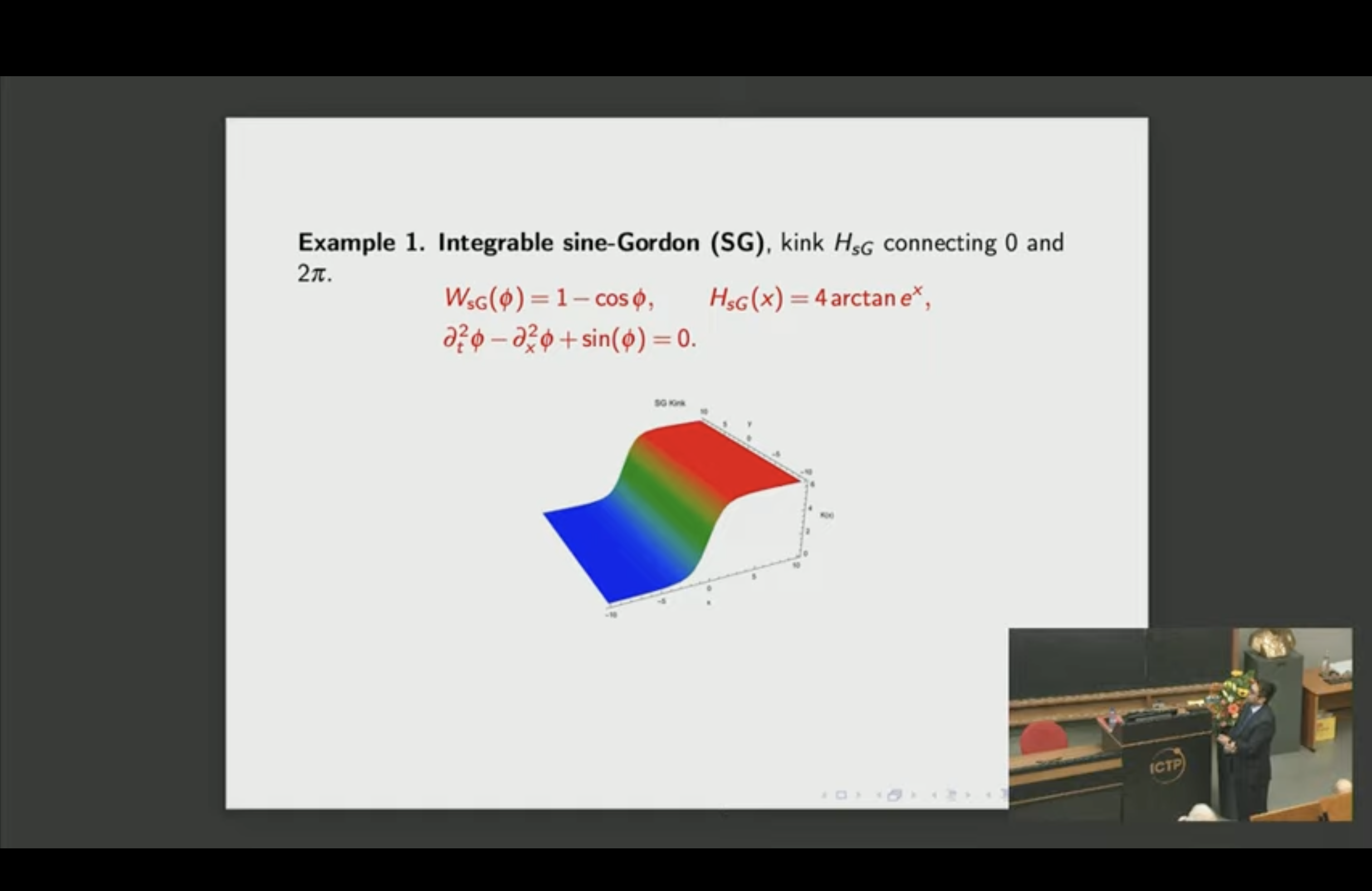
The workshop community followed the ceremony held at the Budinich Lecture Hall, where Professor Muñoz delivered the lecture “The Asymptotic Stability of Kinks in Scalar Field Models”. His international recognition gave this edition of the PANDA Workshop a particularly meaningful dimension, underscoring the global impact of research conducted in Chile in the field of applied mathematics.
Professor Muñoz noted that “receiving this recognition in parallel with the PANDA workshop has a special significance. It is a reminder that the work we do, from Chile and through international collaboration, is contributing in a meaningful way to advances in dispersive equations and to the understanding of fundamental models in mathematical physics. Knowing that PANDA researchers followed the ceremony was deeply meaningful and reaffirms the importance of continuing to promote frontier research”.
Mathematical Knowledge to Address Open Questions
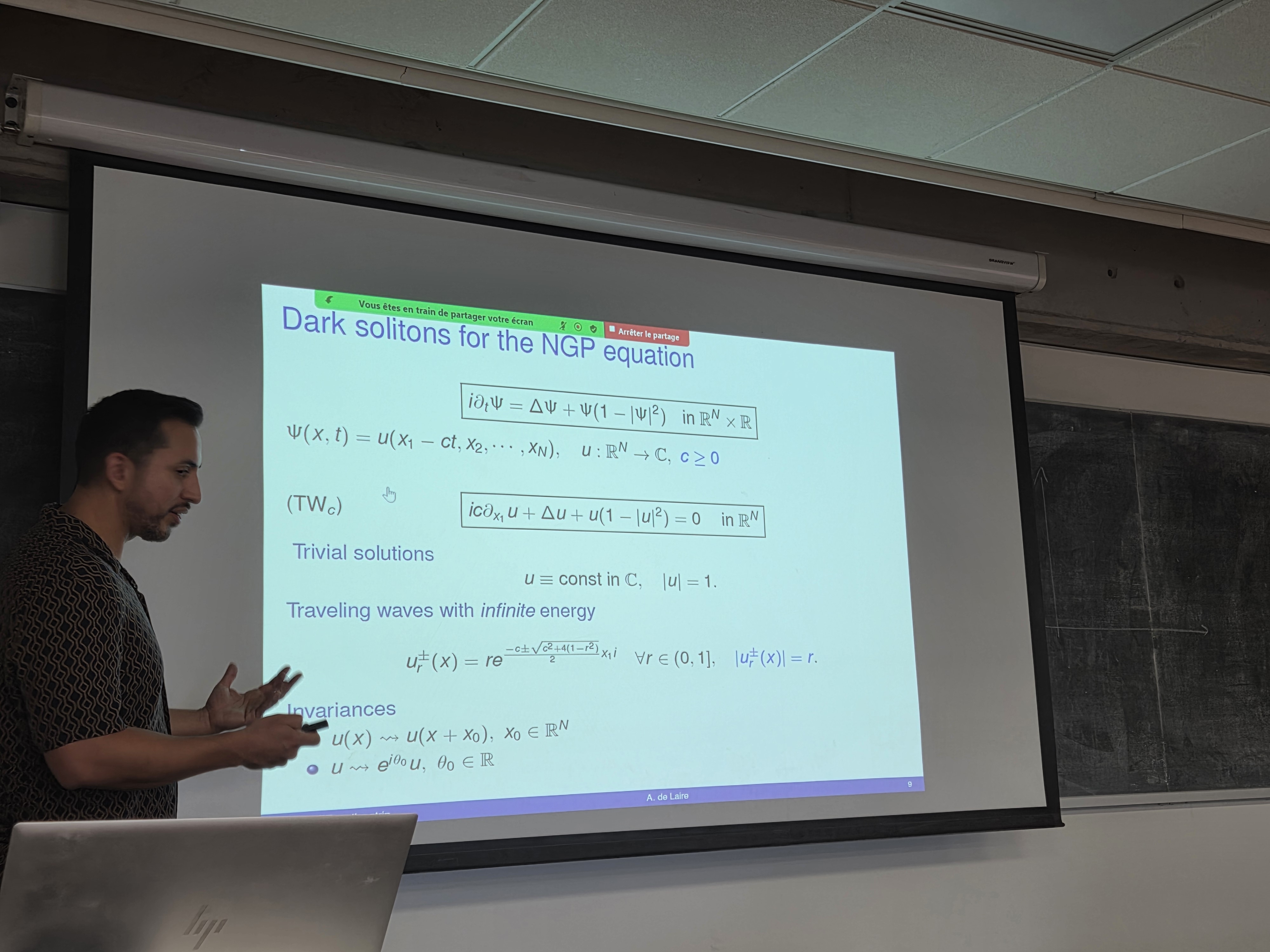
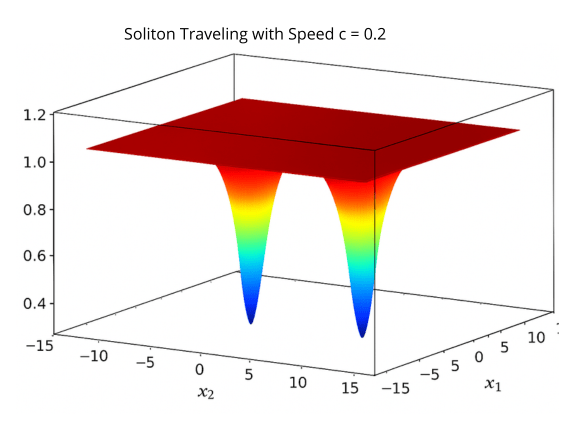
In the afternoon session, André de Laire, researcher at Université de Lille and Inria, addressed the existence of minimizing traveling waves for the Gross–Pitaevskii equation in a two-dimensional channel geometry. His talk highlighted critical bifurcations separating one-dimensional solutions from genuinely two-dimensional solitons and was based on joint work with Didier Smets and Philippe Gravejat.
De Laire explained that “this project was designed to run for three years and will conclude in 2026. We then intend to expand its scope by applying for new initiatives, for example, an international CNRS project, considering that the CMM is an International Research Laboratory (IRL) of the CNRS. This could provide greater long-term stability, allowing us to continue the collaboration and sustain, for many years, the exchange of PhD students and postdoctoral researchers between France and Chile”.
New Numerical Approaches and Soliton Stability
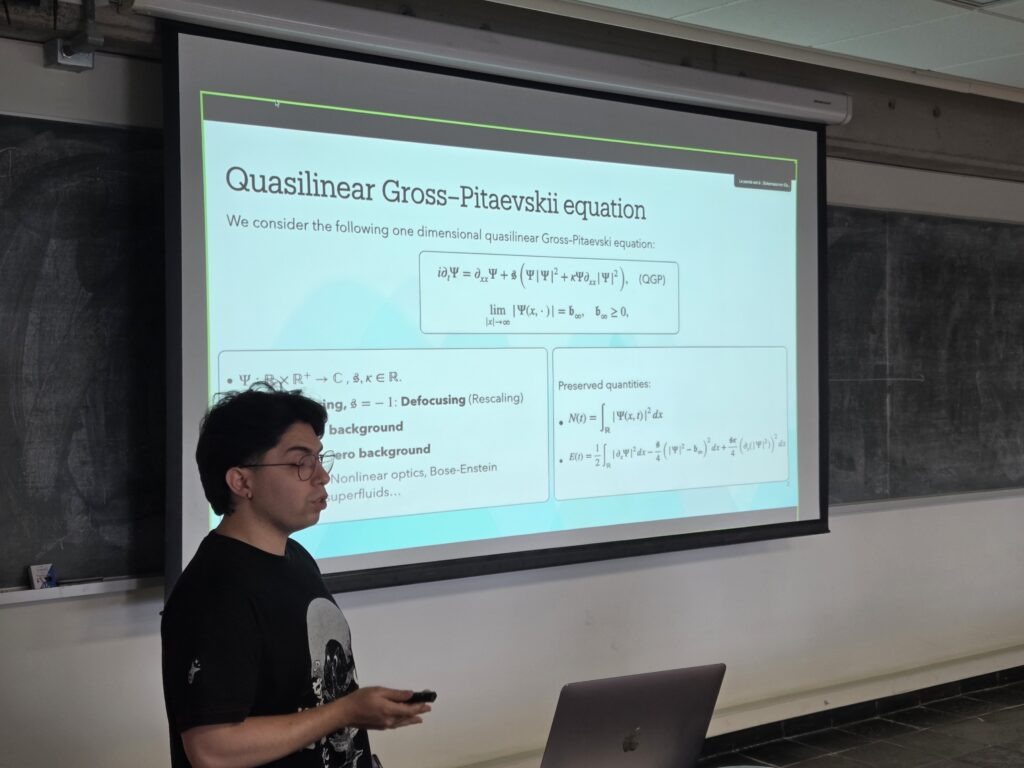
The program continued with a presentation by Sebastián Tapia-Mandiola (Université de Lille and Inria), who presented numerical simulations of a quasilinear Schrödinger equation with variable boundary conditions. His talk focused on soliton stability, blow-up phenomena, and the construction of energy-preserving numerical schemes.
The workshop also included a lecture on the nonlinear stability of nonsingular solitons in the Principal Chiral Field model in 1+1 dimensions, a study employing vector field methods previously applied to Einstein’s equations under the Belinski–Zakharov formalism.
The workshop organizing committee is composed of André de Laire, Claudio Muñoz, and Ricardo Freire, and the event was funded by the ANID Basal Program (FB210005) through the CMM, with additional support from Inria research projects. This initiative reaffirms both institutions’ commitment to the development of advanced research in applied mathematics and to the consolidation of scientific networks that foster interdisciplinary work.
PANDA (Partial Differential Equations, Dispersive Models and Nonlinear Analysis) is an Inria–CMM associated team aimed at establishing collaborative links between Chilean and French research groups in applied mathematics. Its primary objective is the study of systems of partial differential equations based on nonlinear analysis and numerical simulations. Its main application concerns the modeling of ocean surface wave propagation under realistic conditions.
Recent Publications:
- Decay of small energy solutions in the ABCD Boussinesq model under the influence of an uneven bottom. C. Maulén, C. Muñoz y F. Poblete, (2025) https://arxiv.org/abs/2507.0648
This work establishes the foundations for the large-time description of perturbed solutions of variable-bottom fluid models near the state of rest.
- Dynamics of generalized abcd Boussinesq solitary waves under a slowly variable bottom. A. de Laire, O. Goubet, M. E. Martínez, C. Muñoz y F. Poblete, (2025) https://hal.science/hal-05379838
This study analyzes the dynamics of an ABCD-type solitary wave modeling shallow water, evolving under the influence of a slowly varying bottom. It rigorously demonstrates, for the first time, the persistence of the wave when the bottom varies slowly in both space and time.
