
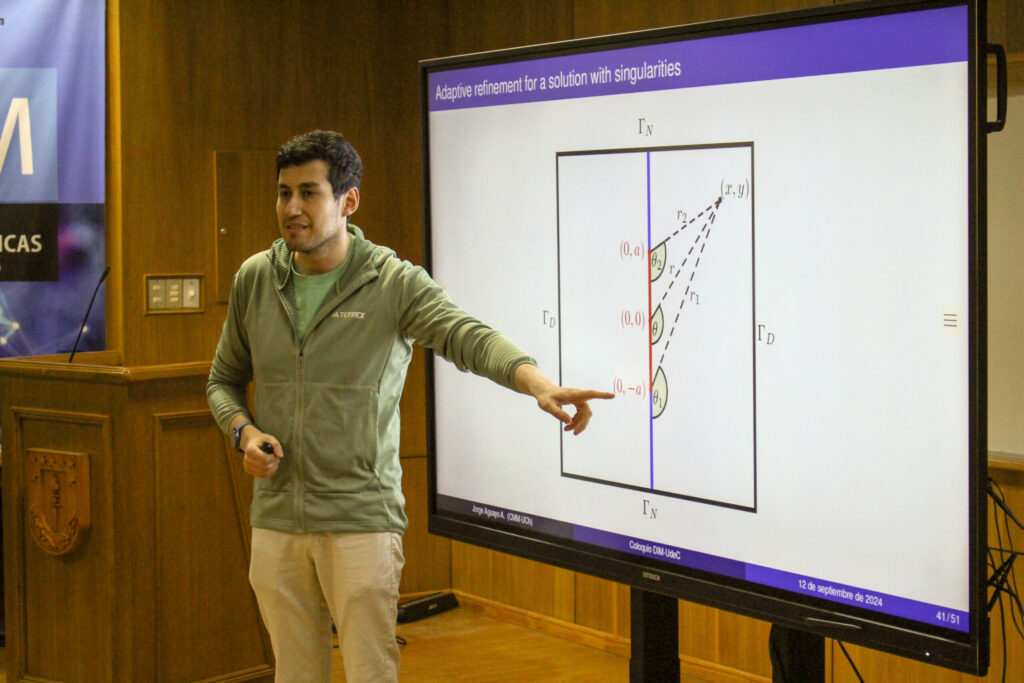
CMM postdoctoral fellow from the U. de Chile presented some of his most recent results in a colloquium of the DIM of the UdeC.
Jorge Aguayo Araneda is a mathematical civil engineer from the Universidad de Concepción (UdeC) and, since 2023, he has been working in a postdoctoral position at the Center for Mathematical Modeling (CMM) of the U. of Chile, after having obtained the highest academic degree at the U. of Chile and at the Rijksuniversiteit Groningen in the Netherlands.
In 2016, Aguayo obtained his professional degree under the guidance of the researcher and current director of the Mathematical Engineering Research Center, CI²MA, of the UdeC Dr. Rodolfo Araya Durán, who commented that “it has always been a pleasure to work with Jorge, both for his innovative ideas and his character”.
Last Thursday 12, Dr. Aguayo presented the talk ‘New tools for the analysis of inverse problems for subduction earthquakes‘, in the context of the colloquiums regularly organized by the Department of Mathematical Engineering of the UdeC.
“The presentation”, commented the speaker, ‘shows a history on how to go about analyzing inverse problems and how they are applied to the detection of faults or seismic jumps with theoretical results that show that the problem is well placed, it is stable, except for the problems from which I cannot correctly recover the fault in the complete domain, which are in the extremes’.
“In that, we have been working with Rodolfo in this last stage, we found a good solver and good tools that allow us to decrease the use of memory and the number of degrees of freedom, simplify the problem to solve, curiously, more complex problems”, detailed Aguayo and explained that these advances have already resulted in three articles that are in prepublication.


Earth science applications
During his week-long stay at UdeC, fully funded by MWC, Aguayo met with Prof. Araya and Dr. Andrés Tassara Oddo, a geologist specializing in seismic networks and seismotectonic and seismovolcanic activity, from the Department of Earth Sciences (Faculty of Chemistry).
“There are serious possibilities for working together,” commented Aguayo, ”among them, to be able to scale these results to 3D examples, more and more realistic and to reach better applications, with real meshes and parameters closer to reality.”
“Making mathematics at the service of other sciences and people, in general, is a goal that is difficult to achieve. We are aware of that and of the limitations, but the idea is to try to reduce them so that this work can be a tool for other scientists, we are committed to making this more expeditious so that geologists and geophysicists can use these tools and apply them to their studies of earthquakes, in general”.
In this sense, Prof. Araya emphasized that “we have been collaborating for several years with our colleagues in Earth sciences, which has resulted in scientific articles, joint projects and co-direction of undergraduate and postgraduate memoirs” and anticipated that, at present, they intend to apply for funds to form an interdisciplinary group to address these issues.
“The idea is to form a research group in the mathematical modeling of Earth science problems, taking advantage of the experience gained in previous collaborative projects. I think we are in a good position to apply for a millennium institute or other equivalent source. We will see what kind of competitions will be opened in the near future”, detailed the CI²MA director.
By Iván R. Tobar Bocaz, journalist of the Center for Mathematical Modeling, Concepción.
