

The event will be held from December 10-15, 2024, at the Vancouver Convention Centre in Canada.
The research work entitled “Symmetries in Overparameterized Neural Networks: a Mean Field Approach”, developed by Joaquín Fontbona, coordinator of the Data Science area and researcher at the Center for Mathematical Modeling (CMM) of the University of Chile, and Javier Maass, mathematical engineer and Master in Applied Mathematics of the Department of Mathematical Engineering (DIM), has been selected to present at NeurIPS 2024, the most prestigious conference on artificial intelligence (AI) and machine learning.
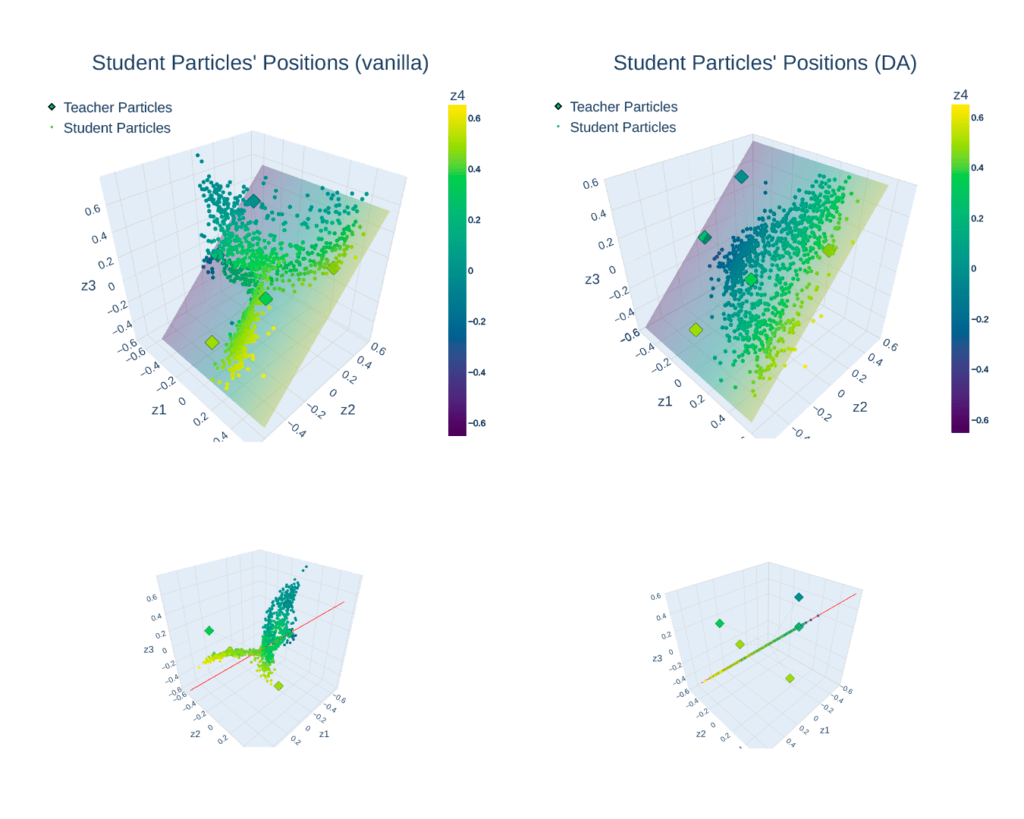
This paper, based on Maass’s Master’s thesis, explores how overparameterized neural networks (those with an extremely large number of parameters) learn when trained on data with specific symmetries. Maass explains, “The study showed that the learning process respects these symmetries, which in turn results in a more efficient parameterization of the networks.” This research provides a fresh theoretical perspective on the generalization capabilities of neural networks and how to design more efficient architectures.
Understanding AI
Artificial neural networks, one of the most successful techniques in machine learning, have revolutionized areas like computer vision, natural language processing, and robotics. However, as Maass noted, “There is no sufficiently complete theoretical understanding of why they are so successful.” This paper seeks to advance that understanding, focusing on how to leverage data symmetries to optimize network performance and generalization capacity.
The work’s impact is significant not only from a mathematical perspective but also due to its potential to foster the development of more efficient network architectures, with applications in fields ranging from biomedicine to engineering.
A Promising Start
The thirty-eighth annual conference on Neural Information Processing Systems (NeurIPS 2024), to be held from December 10-15, 2024, at the Vancouver Convention Centre in Canada, is an interdisciplinary event that brings together experts from various fields, including machine learning, neuroscience, statistics, optimization, computer vision, natural language processing, and other related sciences. NeurIPS provides an unparalleled opportunity to showcase theoretical and practical advances that are revolutionizing diverse sectors such as biomedicine, technology, and social sciences.
For Javier Maass, being selected for NeurIPS 2024 marks a crucial milestone in his early academic research career. “I was very nervous waiting for the news. When I saw it was accepted, I was thrilled. It’s a huge accomplishment. I hope this conference will open doors for international connections and new academic opportunities,” he shared. Notably, less than 25% of nearly 16,000 papers submitted to this conference were accepted. This work is among the top 5% or less, distinguished as a “spotlight” paper.
Mathematical Research for AI
Joaquín Fontbona emphasized, “This work, from a mathematical modeling perspective, allows us to better understand how neural networks reflect the symmetries in data or architectures designed to leverage these symmetries, such as convolutional networks, especially when there are a large number of neurons. What’s fascinating is that mathematics enables precise answers to questions about the behavior of these networks, predicting their function without requiring thousands of experiments or extensive resources.” This approach allows for more targeted development of new AI technologies.
The CMM researcher also highlighted Maass’s role in the project: “He was the ideal collaborator—extremely motivated, full of ideas, with strong technical skills in both mathematics and computer science, and an impressive work ethic. I learned a lot from him and hope to continue collaborating with Javier in the future,” he said.
The selection of this paper also represents recognition of the Department of Mathematical Engineering (DIM) and the CMM’s efforts in recent years at the intersection of mathematics and artificial intelligence.
“Training young researchers is crucial for Chile to have its own talent and scientific capabilities in this area, so we can develop and use AI more beneficially for our country and contribute to global challenges. We cannot settle for merely ‘adopting’ AI,” Fontbona expressed.
Ver esta publicación en Instagram
Center for Mathematical Modeling
The CMM is today the most active scientific research institution in mathematical modeling in Latin America. It is a center of excellence of the National Agency for Research and Development (ANID) of Chile, integrated by eight partner universities and located at the Faculty of Physical and Mathematical Sciences of the University of Chile. It is also the International Research Laboratory (IRL) #2807 of the French National Center for Scientific Research (CNRS).
Its mission is to create mathematics in response to problems in other sciences, industry and public policy. It seeks to develop science with the highest standards, excellence and rigor in areas such as data science, climate and biodiversity, education, resource management, mining and digital health.
Alonso Farías Ponce, journalist of the Center for Mathematical Modeling.
