
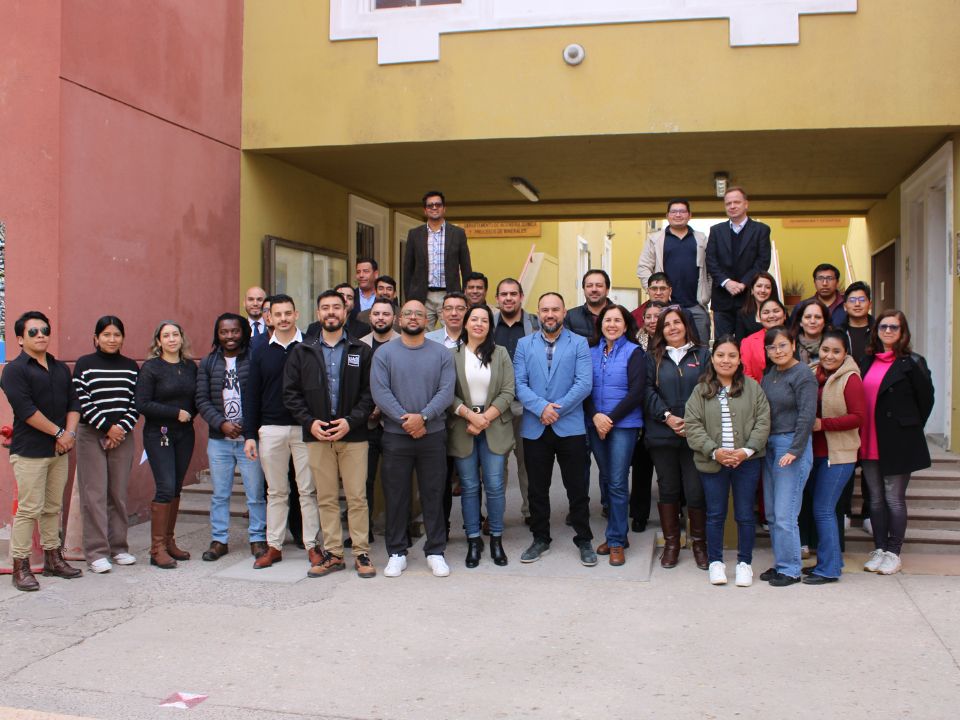
- Two researchers from the University of Chile’s CMM participated in a meeting between academics and representatives of the mining industry to address water scarcity and how this problem can be tackled in the productive sector.
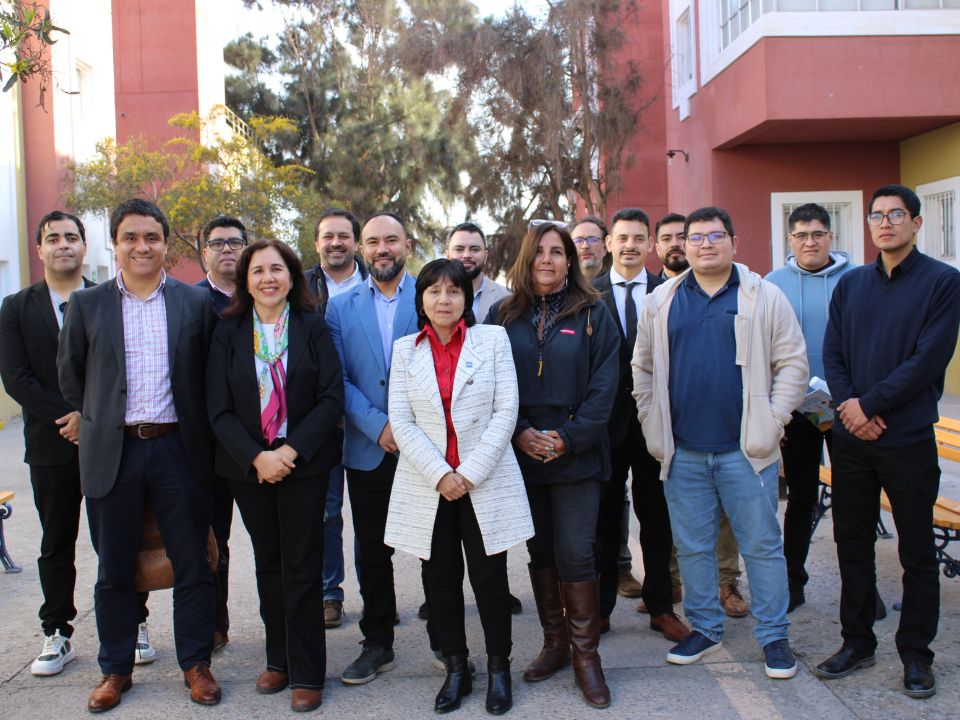
‘Water Resource Management in Mining’ is the name of the seminar organized by the Center for Water Resources for Agriculture and Mining (CRHIAM) that took place on August 21 and 22 at the University of Antofagasta, bringing together representatives from academia and the mining industry to share research, experiences, and proposals around a common challenge: moving toward more sustainable production processes in the face of growing water scarcity affecting the region and the country.
“It is very important to connect with the reality where mining processes are taking place,” said Dr. Gladys Vidal, director of CRHIAM, “particularly, this helps us understand what the needs are and what the scientific evidence is in order to co-construct with the company the research that will be adopted by them.”
Dr. Fernando Betancourt and Dr. Raimund Bürger, both academics from the University of Concepción (UdeC) and researchers at both CRHIAM and the Center for Mathematical Modeling (CMM) at the University of Chile, participated in the seminar.
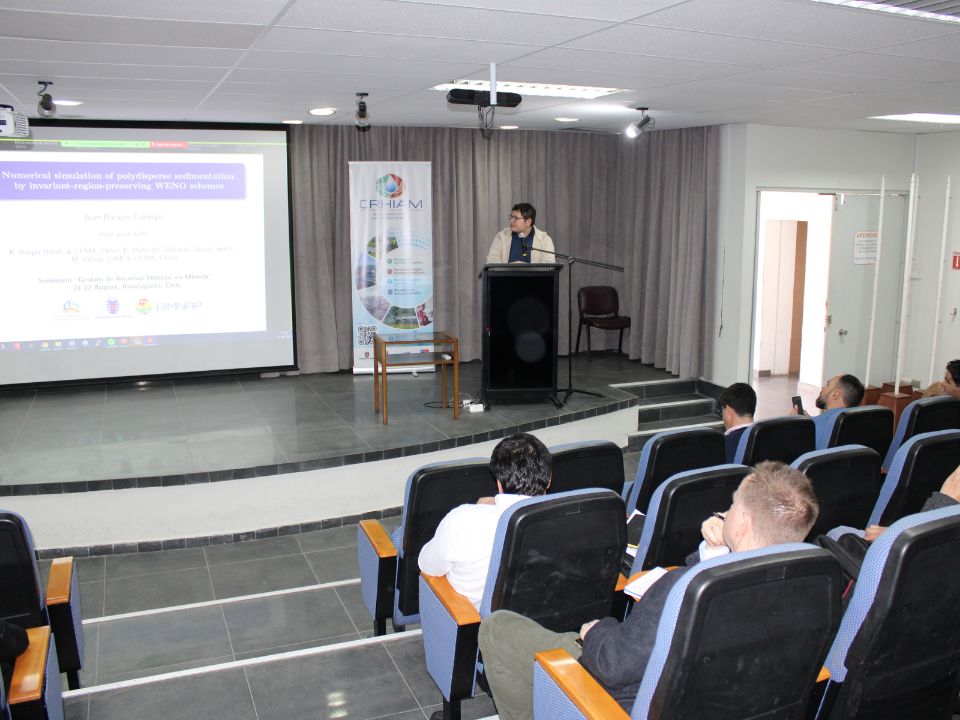
Dr. Betancourt explained that he presented a talk entitled ‘A novel algorithm for metaparticle size estimation in DEM simulations‘, which described “a new algorithm for estimating the size of metaparticles in DEM simulations, representing a significant contribution to the mining industry.”
He said that he was motivated to participate in this event by “the opportunity to disseminate knowledge in regions outside the Metropolitan Region, which is crucial for the development of research at the national level. In addition, it was an ideal meeting point with key players in the mining sector, allowing for fruitful dialogue on the applications of our work. I believe that my objectives were fully met, as new connections were made and collaboration between academia and industry was promoted”.
In addition, the academic from the Department of Metallurgical Engineering at the UdeC highlighted “the success of the seminar in fostering collaboration,” since, he elaborated, “it was not only a platform for disseminating our research, but also served as a catalyst for the start of new collaborations with different actors in the sector. These alliances, although in their infancy, have the potential to generate significant results in the future, an achievement that I consider to be the most important outcome of the seminar.”
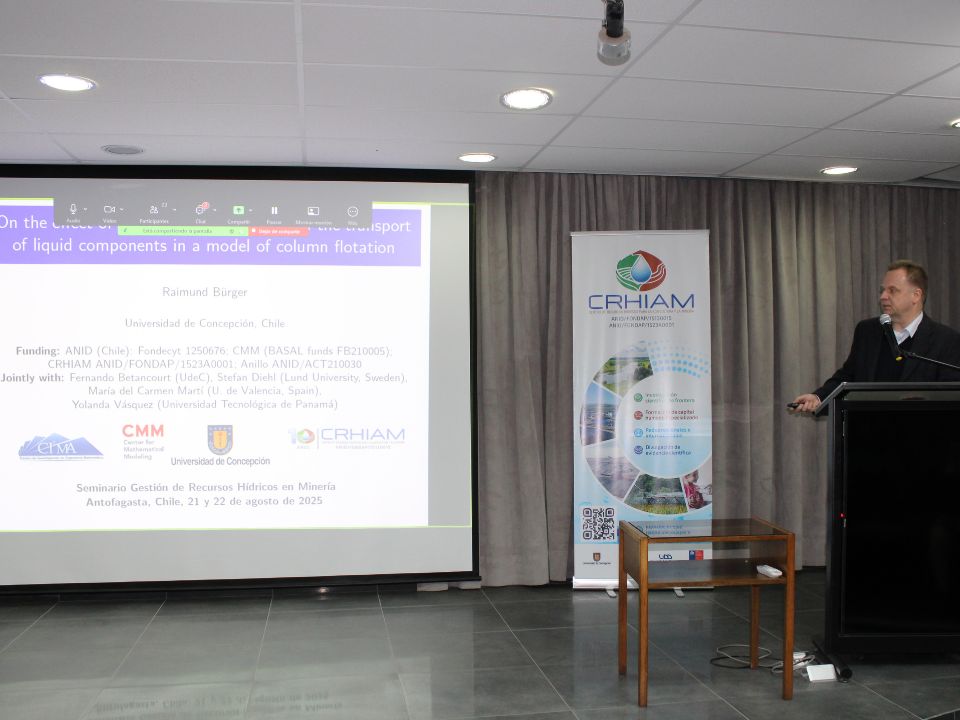
For his part, Dr. Raimund Bürger’s talk was entitled ‘On the effect of bias flow and simulation of the transport of liquid components in a model of column flotation‘.
Sharing results and gathering ideas
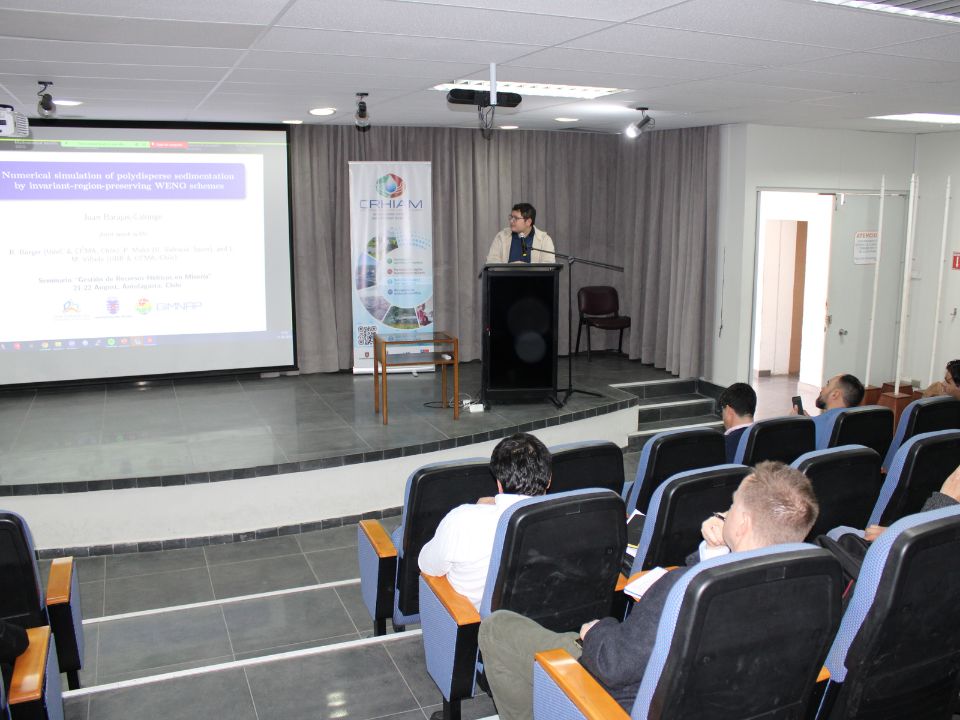
Meanwhile, Juan David Barajas, a PhD student in Applied Mathematics at the University of Bío-Bío (UBB), who is conducting his research under the supervision of Dr. Luis Miguel Villada Osorio (UBB academic and CMM researcher) and the co-supervision of Dr. Raimund Bürger and Pep Mulet from the University of Valencia (Spain)—presented a talk entitled ‘Numerical simulation of polydisperse sedimentation by invariant-region-preserving WENO schemes‘, focusing on some of the advances in his thesis.
“We seek to develop high-order numerical methods to approximate solutions to polydisperse sedimentation problems that produce physically relevant solutions, in the sense that particle concentrations are non-negative and that their total concentration is bounded by their maximum concentration,” the student explained. “These mathematical models describe important processes in mining, so they are always of interest to the engineering community.”
Regarding his motivation for presenting at the seminar, Barajas highlighted that he was able to “exchange ideas with researchers from various fields that are related in some way to the work one does. In this particular case, I had the opportunity to attend many talks on topics such as flotation, thickening, leaching, sedimentation, among others, which, although they had an engineering focus, are topics that Professor Raimund and his collaborators have been studying from the point of view of modeling and numerical analysis for many years, and which are of great interest to me”.
Potential new lines of research
“My talk was well received and I got a lot of interesting questions, which are always welcome”, he added, “because they spark conversations that can lead to ideas for new projects”.
Finally, Barajas highlighted that “I was able to talk to some academics about future topics for my research, in particular, being able to implement and compact some of the numerical methods developed in my thesis project into software for academic and/or industrial purposes.”
“Although this is something I am thinking about in the long term,” he elaborated, “it is always good to set these goals in order to continue working and contributing from a mathematical perspective to water resource management in mining”. He added that “I had the opportunity to visit some laboratories in the Department of Chemical Engineering and Mineral Processing at the University of Antofagasta, where they explained in detail the instruments used for their research, which is quite positive as it helps to better understand how the physical processes that one models and simulates numerically are carried out.”
The participation of Fernando Betancourt, Raimund Bürger, and Juan David Barajas in this seminar was funded by the CRHIAM project ANID/FONDAP/1523A0001.
By Iván R. Tobar Bocaz, CMM Communications.
Photos credits: CRHIAM.
