
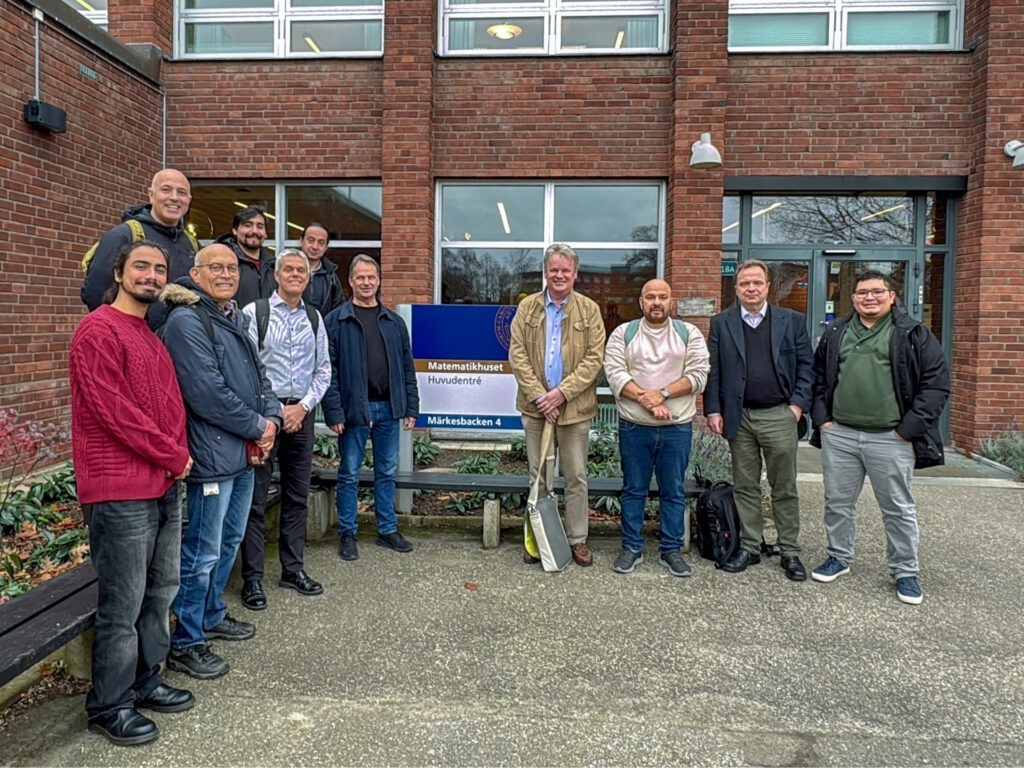
- Scientific meeting brought together mathematicians from both countries to discuss modeling sedimentation processes with applications for optimizing water resource use.
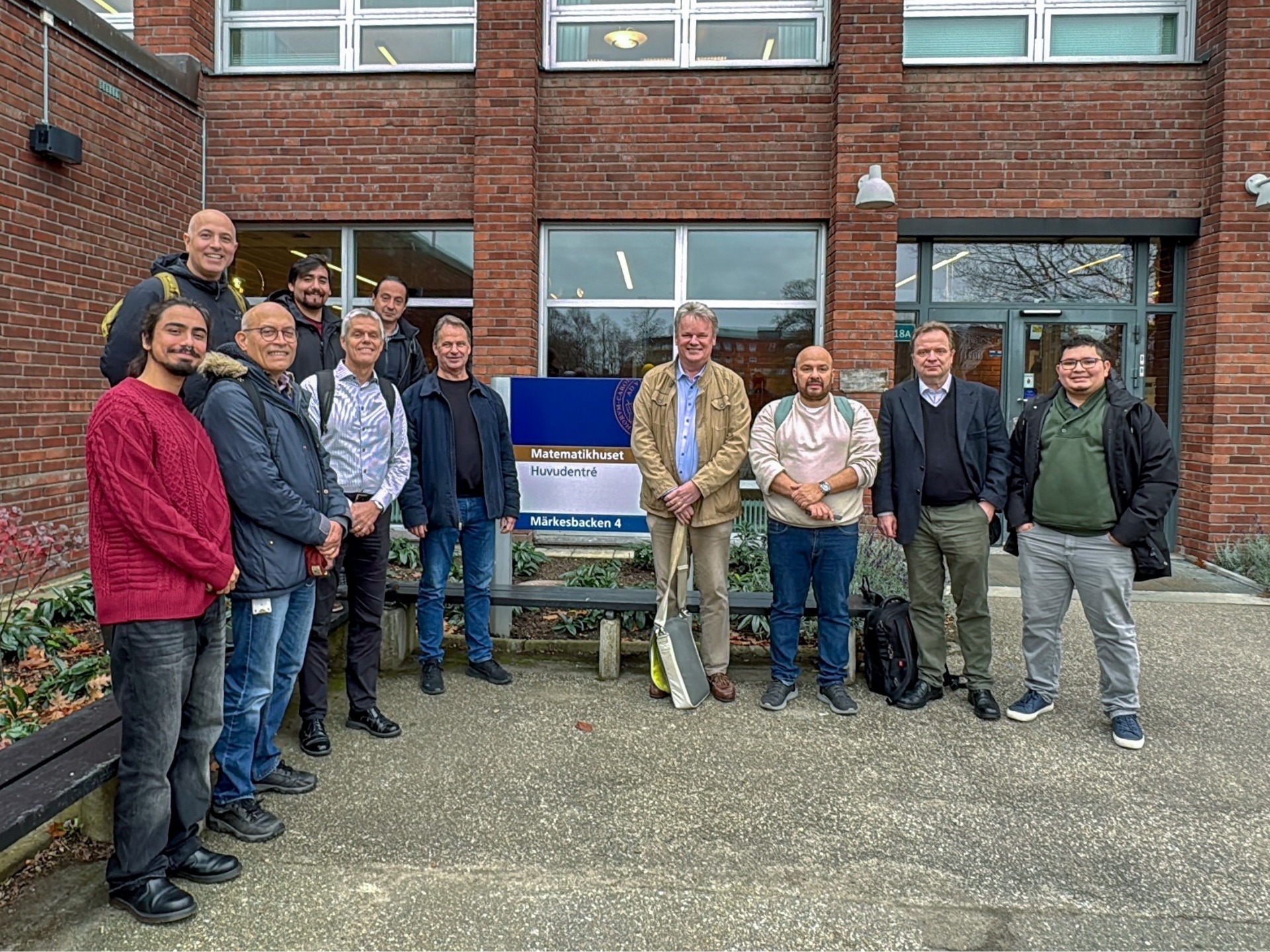
On Monday, November 10, the workshop “Sweden–Chile Focus Seminar on Advanced Modeling of Water-Related Processes” was held, with the participation of scientists from both countries.
The event was co-organized by Prof. Raimund Bürger, professor at the University of Concepción (UdeC) and researcher at the Center for Mathematical Modeling (CMM) at the University of Chile, and his counterpart Dr. Stefan Diehl from the Centre of Mathematical Sciences at Lund University, where the meeting was held. In addition to both organizers, the event featured talks by:
- Dr. Manuel Solano Palma from the Center for Research in Mathematical Engineering (CI²MA) UdeC and CMM: “Numerical approximation for a fluid flow problem arising from reverse osmosis modeling in water desalination”
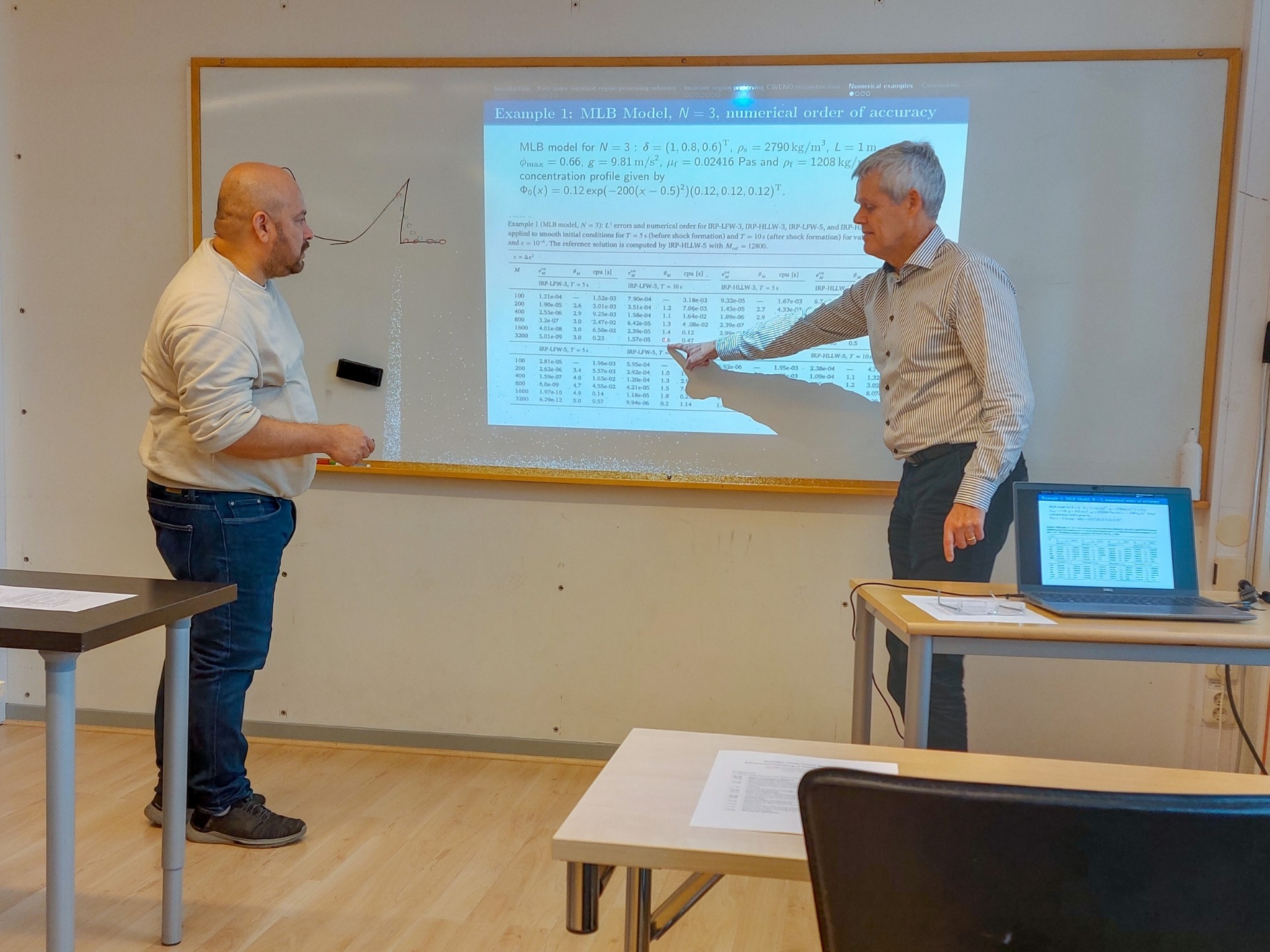
- Dr. Luis Miguel Villada Osorio, University of Bío-Bío (UBB), CI²MA, and CMM: “High order finite volume WENO schemes with invariant-region-preserving properties for one-dimension multispecies kinematic flow models”
- Dr. Julio Careaga, Rijksuniversiteit Groningen (Netherlands), civil engineer and mathematician from UdeC: ‘Modeling the friction effect in the shallow water moment equations for granular flows’.
- Frank Lipnizki, Lunds Universitet: ‘Advancing membrane technologies for sustainable water treatment: From concept to pilot scale’.
- Magnus Larson, Lund University: ‘Modeling coastal evolution from an engineering perspective’.
- Alfredo Mendoza, Lund University: ‘Improved geomodeling in infrastructure projects’.
- Jaime Manríquez, civil engineer and mathematician from the UdeC, doctoral student at Lund University: ‘A multi-phase continuum model for slow sand filtration’.
- Juan David Barajas, doctoral student at the University of Bío-Bío: ‘A second-order invariant-region-preserving scheme for a transport-flow model of polydisperse sedimentation’.
Meanwhile, Professors Diehl and Bürger presented, respectively: ‘Optimization of sequencing batch reactors for wastewater treatment’ and ‘Well-balanced physics-based finite volume schemes for Saint-Venant-Exner models of sediment transport’. Dr. Ricardo Ruiz Baier, an academic at Monash University (Australia) who holds a doctorate from the UdeC, also participated in the meeting.
Impacts of Chile-Sweden collaboration
Dr. Raimund Bürger, also a researcher at the UdeC’s FONDAP Basal Center for Water Resources for Agriculture and Mining (CRHIAM), commented that the collaboration between the researchers participating in this meeting “focuses, first and foremost, on mathematical modeling and numerical analysis of aquatic systems with the presence of another substance.”
Examples of this are desalination problems, wastewater treatment in slow sand filters, sediment transport in shallow waters, and sedimentation models.
“Therefore,” said the deputy director of CI²MA, “it was very interesting to learn about the approaches of our colleagues from Lund, who represent other disciplines, regarding the geomodeling of infrastructure projects, the modeling of coastal edge evolution from an engineering perspective, and membrane technologies for sustainable water treatment, topics presented by the three academics, Mendoza, Larson, and Lipnizki, respectively”.
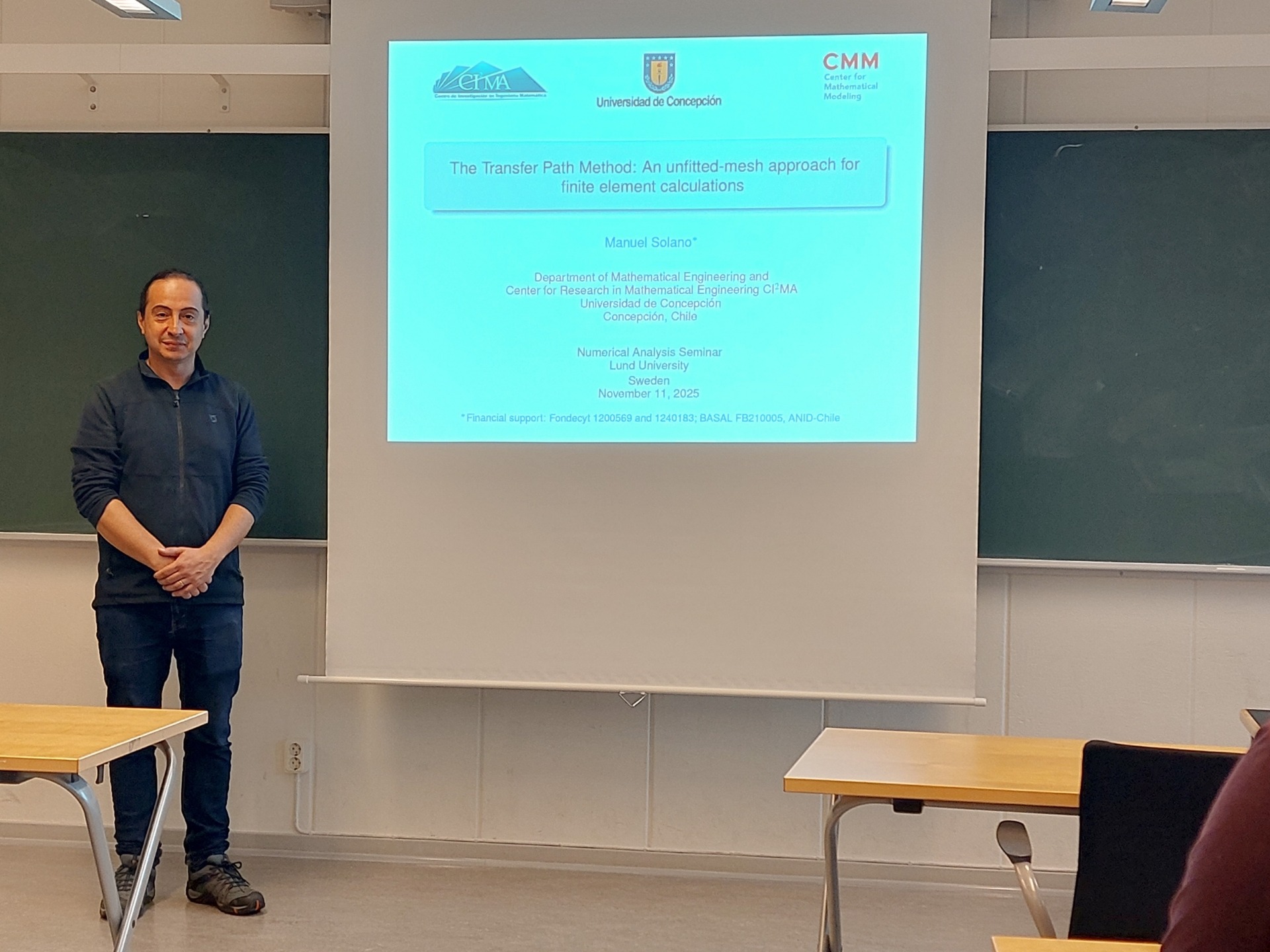
Meanwhile, Dr. Manuel Solano Palma is currently conducting research at the Mittag-Leffler Institute in Stockholm, Sweden. “It so happened that several of Stefan Diehl’s collaborators from Chile were going to be in Europe, so he proposed holding a workshop that I felt was important to attend, as Stefan has been collaborating with Raimund Bürger for several years and has maintained a close relationship with Concepción”.
Solano and Diehl are also currently co-supervising Jaime Manríquez’s doctoral thesis. “I would like to take this opportunity to thank Jaime for his efforts, as his project covered my trip and stay in Lund,” said the CMM researcher. Assessing the meeting, he commented that “I found it very interesting to listen to the talks by researchers from Lund who addressed applied topics”.
Dr. Solano highlighted the visit they made to the host university’s membrane group laboratory, “where we saw the different equipment used in water treatment processes”, he explained.
For his part, Dr. Luis Miguel Villada Osorio commented that the workshop was “an ideal setting to showcase some of the results on high-order numerical schemes for conservation law systems, which have been obtained in collaboration with professors Raimund Bürger, Pep Mulet (University of Valencia, Spain), and UBB doctoral student Juan David Barajas”.
“In addition to the talk”, the CI²MA and CMM researcher added , “we also took the opportunity to discuss topics that have been worked on regarding modeling and numerical simulation of industrial countercurrent decantation processes”.
Agua: línea estratégica
Dado que la casa de estudios albergante del encuentro ha definido la investigación en recursos hídricos como un área de investigación prioritaria, el Dr. Bürger espera que “estas presentaciones pueden abrir posibilidades de ampliar la colaboración entre Suecia y Chile en torno a temas relacionados al agua”.
Además del trabajo realizado por el Dr. Diehl en torno a la organización operativa del evento, el Dr. Bürger destacó que “él y su grupo siempre han sido colaboradores oficiales del CRHIAM en temas relacionados con el modelamiento del tratamiento de aguas servidas”, lo que ha posibilitado la coautoría de un gran número de publicaciones en revistas especializadas y la codirección de tesis en ambas universidades.
“A días del término del actual proyecto FONDAP del CRHIAM” agregó el Dr. Bürger, “agradezco a la dirección por su apoyo financiero a esta colaboración durante todos los años y espero que podamos seguir contribuyendo al estudio de recursos hídricos en ambos países” y citó como potenciales nuevas líneas de investigación colaborativa “el modelamiento refinado de columnas de flotación, la simulación de circuitos de decantación a contracorriente, y el modelamiento de fotobiorreactores”.
El financiamiento de este evento y de la participación de sus expositores provino de ANID a través de los proyectos Fondap/1523A0001 de CHRIAM, FB210005 del CMM, Fondecyt 1250676; la U. del Bío-Bío, Sträng’s foundation y LTH Water Profile Area.
Por Iván R. Tobar Bocaz, Comunicaciones CMM.
