
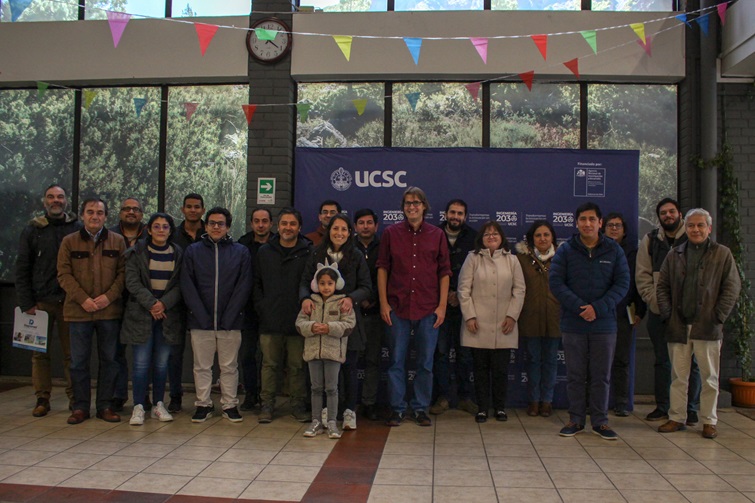
Spanish expert from the U. of North Texas presented research advances in physical processes at UCSC.
Numerical schemes for Nematic Liquid Crystals and their Applications ‘ is the name of the talk given last Thursday 04 by Dr. Giordano Tierra, academic of the University of North Texas (UNT), United States, in the context of the seminars periodically organised by the Department of Applied Mathematics and Physics (DMFA) of the Faculty of Engineering of the Catholic University of the Most Holy Conception (UCSC).
The presentation is part of the activities carried out by Prof. Tierra in Concepción in the context of his two-week visit, funded by the Regular Fondecyt project of Dr. Jessika Camaño Valenzuela, academic of the DMFA-UCSC, and researcher at the Centre for Mathematical Modelling (CMM) of the U. de Chile.
“Giordano’s visit has been very fruitful”, explained Dr. Camaño, co-organiser of the event and member of the ANID’s “Computational Mathematics for Desalination Problems – DSALT” Group Project (ACT210087).
“We have started, together with researcher Ricardo Oyarzúa from the Universidad del Bío-Bío, new research projects that are connected with the topics proposed in my Fondecyt project and also fit within the problems of interest in the DSALT Group Project”.
“During his visit, in addition to working with us”, added Dr. Camaño, “Giordano had the opportunity to work with and mentor students from the local PhD programmes: PhD in Applied Mathematics at the Universidad del Bío-Bío and PhD in Applied Sciences with a specialisation in Mathematical Engineering at the Universidad de Concepción”.
Mathematics applied to physical problems
As astronomer Dr. Markus Rabus, co-organiser of the event, explained, the DMFA-UCSC seminars seek to “address issues of applied mathematics and physics or theoretical physics and, in the case of this talk, I found it very interesting, because it had a combination with physics, with concepts such as energy and conservation and its dissipation. Here you can see that mathematics is a tool for us, in principle to simulate phenomena – and also to do research – because we don’t always have the possibility of doing the experiments we need. So, the equations or simulations help us a lot to better understand the physics behind everything”.
Meanwhile, Dr. Camaño, also a member of the Centre for Research in Mathematical Engineering, CI²MA, of the U. de Concepción, explained that “Giordano’s talk allowed us to learn about the topics that are currently of interest to him and that, eventually, could be topics of future study for anyone who might be interested. I thought it was a very interesting and well thought-out talk, taking into account that our department is made up of both mathematicians and physicists, and that students from local postgraduate programmes also participate in this seminar”.
In his presentation, Dr. Tierra gave an account of the most recent results of studies carried out in collaboration with colleagues from UNT and in particular with the academic Xiao Li from the Department of Materials Science of the Faculty of Engineering.
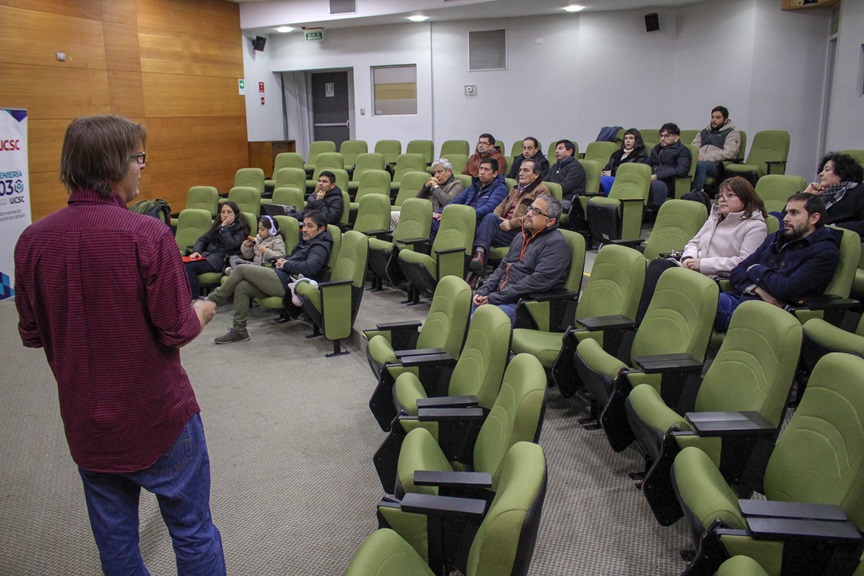
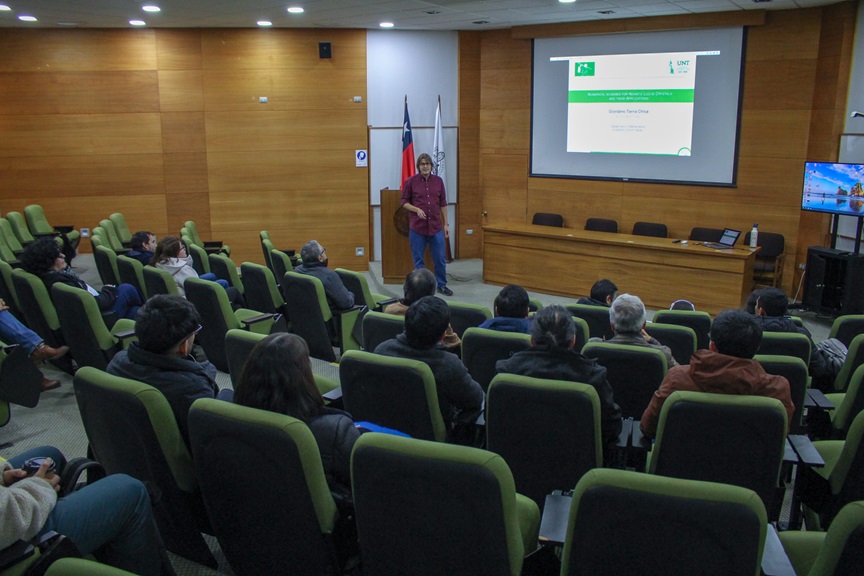
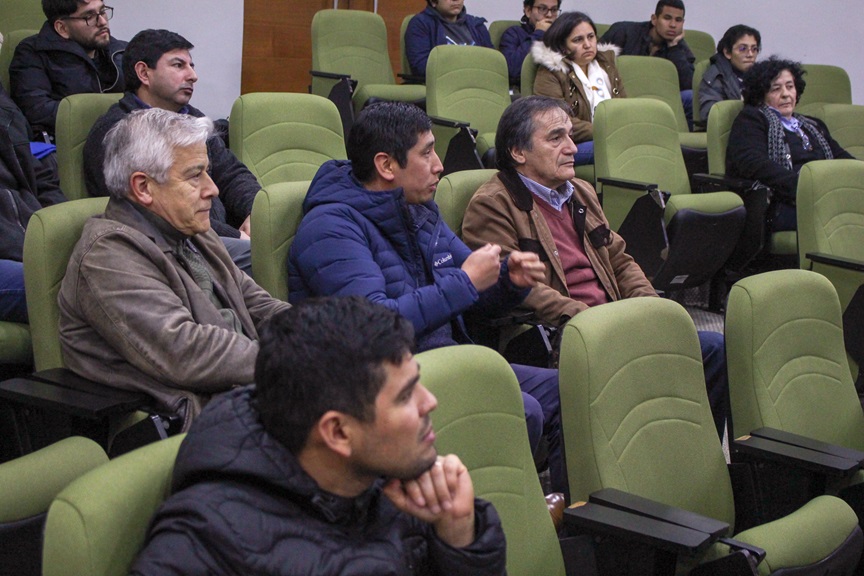
“I started working on phase field models which, mathematically, are very similar to liquid crystal models, but without thinking about the application and once I joined UNT, I found out that she does experiments and we realised that we were doing the same thing, I from the computational point of view and she from the experimental point of view, and so we started to collaborate, putting a lot of effort into trying to understand what each one does, because it is not easy, but after a lot of iterating we were able to converge towards something and now it seems that we have a stable collaboration”, explained the speaker.
Regarding the contents presented, Tierra explained that “I tried to orientate the talk so that it would be attractive, not only for mathematicians, and above all for students. They are really applied in different branches of physics”.
Long history of collaboration
“I have come (to Concepción) several times, especially to CI²MA, to visit – at first – Gabriel Gatica, and later also Jessika (Camaño) and Ricardo (Oyarzúa). But whenever I come, I always collaborate with everyone and we see the things we have in common’, explains Tierra, and in the particular case of this stay, he cites “resuming the collaborations I had with them before COVID”.
The Spanish expert stressed that “they (the group of specialists in Numerical Analysis of Partial Differential Equations from Concepción) have a lot of experience in working on all kinds of complex fluids, and liquid crystals – in the end – are a type of complex fluid. They are not exactly the topics we have worked on together, but they are very closely related. They are experts in this area of complex fluids, so getting their opinion on the studies I’m doing is always good for me because they can give me new ideas or new collaborations can come out of it”.
By Iván R. Tobar Bocaz, CMM journalist in Concepción
